Today is the last day of carnival celebrations throughout the Americas. Much like their better-known counterparts in Rio de Janeiro and New Orleans, carnival festivities in Haiti are fled with color, revelry, and upbeat music. Yet for some musicians in that Caribbean country this year’s celebrations have been marred by unnecessary criticism.
Members of three musical groups alleged that they were barred from performing at Carnival since their tunes poke fun at singer-turned-president Michel Martelly.
"These songs reflect the Haitian reality, but (Martelly) takes it the wrong way… Where's the freedom of speech? Where's the democracy? It shows that he has no tolerance (for criticism)," said Thomas Asabath, the manager of the Brothers Posse band, according to the Associated Press.
One of the songs from the Brothers Posse entitled “Aloral” shows the lead singer critiquing a Martelly lookalike for failing to fulfill his goals in the presidency. (This can be seen between the first and second minutes of the music video for the song).
The singer for RAM, whose group along with Kanpech and Brothers Posse was excluded from the Carnival lineup, said that he was informed that Martelly didn’t like the song they had selected. The music video for that tune, “Men Bwa W”, supposedly depicts “a woman who physically resembles first lady Sophia Martelly stuffing herself with food – a Haitian symbol for avarice and corruption”.
Showing posts with label censorship. Show all posts
Showing posts with label censorship. Show all posts
Tuesday, February 12, 2013

Thursday, March 10, 2011
Nuestro Cine: “Presumed” censorship?
Last year we briefly looked at Mexican documentary “Presunto Culpable” (“Presumed Guilty”). Today we revisit the film after it landed in a recent controversy.
The film focuses on Antonio Zuniga, a man accused of murder, and the efforts of his lawyers and supporters to free him. “Presunto” not only reveals what appears like a weak case against Zuniga but also shows numerous shortcomings of the Mexican judicial system.
In the two weeks “Presunto” was shown in Mexico it became a box-office hit and the country's highest-grossing documentary. But last week a judge issued an injunction against screening “Presunto” after one of the movie’s figures, a key prosecution witness, claimed that he did not give permission to appear in the film. As written in Global Voices, the decision led to anger among some bloggers including concerns over freedom of expression as well as conspiracy theories claiming “the judicial system does not want the film to bring to light all the irregularities in its administration.”
The clamor over “Presunto” being pulled from theaters grew over the past several days culminating in a higher court ruling yesterday to bring the movie back:
Online Sources- The Latin Americanist, The Hollywood Reporter, Huffington Post, Global Voices, Variety
Video Source – PBS via YouTube
The film focuses on Antonio Zuniga, a man accused of murder, and the efforts of his lawyers and supporters to free him. “Presunto” not only reveals what appears like a weak case against Zuniga but also shows numerous shortcomings of the Mexican judicial system.
In the two weeks “Presunto” was shown in Mexico it became a box-office hit and the country's highest-grossing documentary. But last week a judge issued an injunction against screening “Presunto” after one of the movie’s figures, a key prosecution witness, claimed that he did not give permission to appear in the film. As written in Global Voices, the decision led to anger among some bloggers including concerns over freedom of expression as well as conspiracy theories claiming “the judicial system does not want the film to bring to light all the irregularities in its administration.”
The clamor over “Presunto” being pulled from theaters grew over the past several days culminating in a higher court ruling yesterday to bring the movie back:
The three-judge tribunal unanimously voted against the decision to pull the film saying that, despite the potential negative attention to the plaintiff, to force the film out of theaters "caused damage to the interests of society and contravened the regulations of public order, given that society has an interest in seeing respected the right to information enshrined in the sixth article of the Federal Constitution."If you are in the U.S. you can view “Presunto Culpable” in its entirety for free via this PBS website until March 31st. Otherwise, the following is the trailer for the documentary that has caused quite a stir in Mexico:
Online Sources- The Latin Americanist, The Hollywood Reporter, Huffington Post, Global Voices, Variety
Video Source – PBS via YouTube
Tuesday, September 29, 2009
Banned Books Week highlights challenged texts
 This week is Banned Books Week here in the U.S., an occasion which highlights when books have been officially banned or challenged in schools, libraries, and other places. Several literary classics have received scrutiny over the past year like Mark Twain's The Adventures of Huckleberry Finn due to its use of racial slurs. Meanwhile, the Supreme Court may hear the case of Vamos a Cuba- a controversial children’s book about the island that’s been challenged by the Miami-Dade School District.
Rudolfo Anaya may be one of the most prominent Chicano Lit authors yet his Bless Me, Ultima was cited by the American Library Association as one of the most frequently challenged books of 2008. “Occult/satanism, offensive language…and violence” were some of the reasons given for objecting Anaya’s book though this brief excerpt seems to contradict those claims:
Ultima came to stay with us the summer I was almost seven. When she came the beauty of the llano unfolded before my eyes, and the gurgling waters of the river sang to the hum of the turning earth. The magical time of childhood stood still, and the pulse of the living earth pressed its mystery into my living blood. She took my hand, and the silent, magic powers she possessed made beauty from the raw, sun-baked llano, the green river valley, and the blue bowl which was the white sun’s home. My bare feet felt the throbbing earth and my body trembled with excitement. Time stood still, and it shared with me all that had been, and all that was to come.Image- latina.com
Online Sources- Cune Press, American Civil Liberties Union, csmonitor.com, Huffington Post
Tuesday, September 15, 2009
Daily Headlines: September 15, 2009
 * Costa Rica: In an example of the changing face of immigration in some Latin America countries, fifty-four African migrants from as far away as Ethiopia and Somalia were detained in Costa Rica.
* Dominican Republic: Amnesty International denounced proposals to change the Dominican constitution that would hurt reproductive rights including a possible total ban on abortion.
* Puerto Rico: Education officials and Gov. Luis Fortuno defended the silly and controversial decision to ban five prominent books from public high schools curriculums due to their use of slang.
* Chile: The Bachelet administration wants to curb immigration from the mainland to Easter Island in order to preserve the island’s unique environment.
Image- AP (“Undocumented African migrants listen to instructions from a Costa Rican immigration official upon their arrival at a detention center in San Jose, Sunday, Sept. 13, 2009.”)
Online Sources- AP, LAHT, Amnesty International, Bloomberg
Wednesday, July 8, 2009
Honduran daily airbrushed blood from protester
Nineteen-year-old Isis Obed Murillo was killed by the Honduran military on Sunday during confrontations between police and backers of deposed president Manuel Zelaya. The gruesome, Not Safe For Work video of a bloody Murillo has circulated worldwide.
Now it has emerged that one of Honduras’ main newspapers has decided to hide the truth by airbrushing Murillo’s bloody shirt:
(Hat tip: The Daily Dish).
Image- CubaDebate
Online Sources- CubaDebate, The Daily Dish, Narconews, YouTube
Now it has emerged that one of Honduras’ main newspapers has decided to hide the truth by airbrushing Murillo’s bloody shirt:
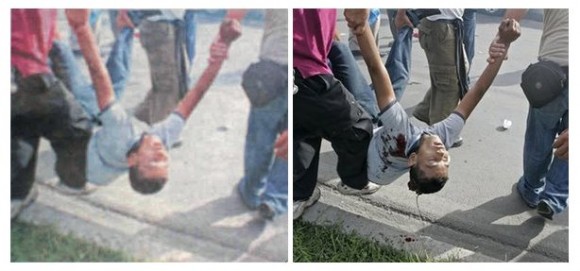
CubaDebate has an illuminating find regarding the coverage of the crisis in Honduras by the pro-coup newspaper, La Prensa.Regardless of what one opines of the political situation in Honduras, La Prensa’s actions are reprehensible and unethical. As ugly and heart-wrenching as the original photo is, there is no excuse for erasing the truth. Sadly, La Prensa’s editors have opted to censor the death of a protester though luckily their deception has been caught for others to see.
The now-iconic photograph of the late 19-year-old Isis Obed Murillo, being carried by his friends to seek medical help moments after his shooting by gunmen during Sunday’s demonstrations in Tegucigalpa, was also published by the Honduran daily… Except that La Prensa chose to airbrush the young man’s blood out of the photo.
Media that literally whitewashes the story to this extreme, of course, is not shut down, destroyed or attacked by the coup regime. That treatment is reserved only for real journalists.
(Hat tip: The Daily Dish).
Image- CubaDebate
Online Sources- CubaDebate, The Daily Dish, Narconews, YouTube
Friday, April 17, 2009
Daily Headlines: April 17, 2009
* U.S.: “Bless Me, Ultima” by Chicano lit author Rudolfo Anaya is fifth on the list of the most frequently challenged books of 2008 according to the American Library Association.* Chile: Thousands of Chileans marched yesterday demanding better job security and more help from the government.
* Brazil: President Luiz Inacio Lula da Silva said that stricter regulations are needed to prevent a future global economic slowdown.
* Puerto Rico: According to a study from The National Low Income Housing Coalition, Puerto Rico is one of the least expensive territories and states to live in.
Image- latina.com
Online Sources- Xinhua, bizjournals.com, Reuters, Guardian UK, Wikipedia
Monday, November 17, 2008
Maradona, Argie celebs back internet censorship
 Several Argentine court decisions have promoted online censorship at the request of paranoid celebs.
Over one hundred “major public figures” in Argentina including soccer legend Diego Maradona have won temporary injunctions pertaining to local search engines. Since last year, Argentine judges have ruled that local search engines are held accountable to the pages they index. As a result, search results from Yahoo Argentina and Google Argentina have been filtered to only include major news sites.
As asinine and ludicrous as the injunctions are, what is more appalling is the obvious conflict of interest by some plaintiffs:
But it's not only Maradona and other celebrities who are looking to protect their image by joining Leguizamon's suit; the litigants also include three important judicial figures, among them high-profile judge Maria Servini de Cubria, many of whose rulings have been questioned in the blogosphere and even in the mainstream media. "She is a public official," said the Google Argentina spokesperson. "Where do we draw the line...? Her presence in the list of lawsuits has made this a political question concerning freedom of information."Furthermore, the esteemed justices overlooked one vital loophole to their dimwitted rulings: users can access the barred information via the international versions of Yahoo and Google.
Other countries have placed restrictions on search engine finds in other countries regarding neo-Nazism. Hopefully the argentine judges can see the error of their ways and reverse the pathetic kowtowing of egotistical public figures.
Image- AFP
Sources- The Latin Americanist, CNET News, World Cup Blog, Time
Friday, October 3, 2008
Daily Headlines: October 3, 2008

* Venezuela: First it was Spain and now it’s France who supports Venezuela’s desire to develop a civilian nuclear energy plan.
* Chile: The government agreed to compensate one of the country’s “top investigative journalists” for censoring her 1999 book.
* Puerto Rico: The FBI arrested “prominent Puerto Rico lawmaker” Jorge de Castro Font for allegedly being involved in an extortion scheme.
* Mexico: Mexico’s government may revise their proposed 2009 budget due to worries over the U.S. financial crisis.
Image- CNN (“Venezuelan Foreign Minister Nicolas Maduro and France's Bernard Kouchner speak in Paris on Thursday.”)Sources- Bloomberg, MSNBC, The Santiago Times, IHT, The Latin Americanist
Friday, July 18, 2008
Is Brazilian Media Being Gagged in Favor of the Man Who Could be It's Next President?
The governor of the Brazilian state of Minas Gerais is favored to follow current president Lula. But are these aspirations causing the freedoms of the media in that state to be curbed? A report by Current TV thinks so.
Tuesday, March 25, 2008
Cuban blogger: Government censored me
 Yoani Sanchez- the author of popular Cuban-based Generacion Y blog- alleged that the island's government has restricted access to her website. In a post written on Monday, Sanchez claimed that “anonymous censors of our famished cyberspace” conspired to deny Cubans that chance to read her blog. (For those not in Cuba, the blog can be accessed via this link.)
So far, the Cuban government has not responded to Sanchez’ accusations though in an interview with Reuters she has promised to continue blogging:
"This breath of fresh air has disheveled the hair of bureaucrats and censors," she said by telephone, vowing to continue her blog. "Anyone with a bit of computer skills knows how to get around them."
The aim of government censors is to block readership in Cuba, where people have limited access to Internet, she said.
"They are admitting that no alternative way of thinking can exist in Cuba, but people will continue reading us somehow," she said. "There is no censorship that can stop people who are determined to access the Internet."
Sources (English)- Reuters UK, On Deadline, Wall Street Journal
Sources (Spanish)- Generacion Y
Image- Canada.com
Subscribe to:
Posts (Atom)
