Tuesday, June 07, 2011

Peruvian stocks bounce back from post-election nosedive

Peru’s stock market recuperated in trading on Tuesday after plummeting on Monday in the wake of Ollanta Humala’s presidential election victory.

The main index for the Peruvian stock exchange rose today by 6.97% to close at 19,881.10 points. The market’s blue chip stocks also rose by 6.18% to end at over 27,000 points and the national currency, the sol, also appreciated in value during trading today.

The rebound came after a black day for the stock exchange when the stock market tanked with a record single-day drop of 12.5%. Investors appeared to be spooked by the possibility that a Humala presidency would halt Peru’s high economic growth. "There will be that suspicion until he proves he's more like (former Brazilian president Luis Ignacio) Lula (da Silva) than (Venezuelan president Hugo) Chavez," said economist Newton Rosa to Reuters.

“My commitment with the people is to maintain economic growth along with social inclusion,” said Humala this morning as he urged Peruvians to “be calm.” In order to try to calm investor fears he also released the names of twenty people who will serve on his presidential transition team. All of the figures are reportedly “political moderates” and include an ex-economy minister and the former chief of Peru’s central bank.

The sky-is-falling fears over the economy under Humala can best be read in this editorial piece from the Investor Business Daily’s website. For some financial analysts, however, such an apocalyptic outlook for Peru’s economy is exaggerative:
“Markets were quick to react over concerns that Humala will be a radical president, but there are reasons to expect some policy stability in the near term,“ said Bank of America Merrill Lynch in a note Tuesday…

Among the reasons to expect near-term stability is a “divided” Peruvian Congress, which would make it “difficult for Humala to institute any radical changes, at least initially,” wrote economist Alejandro Rivera and fixed-income strategist Alberto Boquin at B. of A. Merrill Lynch in a report…

Humala plans to maintain the 1% deficit while increasing revenues through mining taxes and increasing spending on social programs, the broker said. “Still, we believe the government has ample resources to fund additional spending given the 39 billion nuevos soles ($14 billion) in central-government deposits at the central bank.”
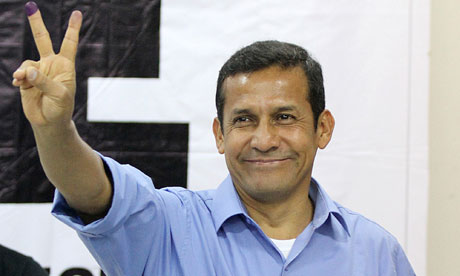
Image- Raul Sifuentes/Getty Images via The Guardian (“Ollanta Humala, winner of Sunday's narrow presidential poll in Peru, addresses supporters in Lima.”)
Online Sources- InfoBAE.com, Bloomberg, MiamiHerald.com, Reuters, Clarin.com, AFP, Investors.com, MarketWatch

Daily Headlines: June 7, 2011

* Mexico: Poet and journalist Javier Sicilia is leading several hundred people in a peaceful anti-violence march from Mexico City to the northern border city of Ciudad Juarez.

* Haiti: Doctors Without Borders warned that Haiti's cholera outbreak could go through an "alarming resurgence" due to ongoing sanitation and hygiene problems.

* South America: The presidents of Brazil and Venezuela, (Dilma Rousseff and Hugo Chávez) signed several oil and infrastructure agreements yesterday.

* Argentina: FIFA officials are looking into odd betting patterns and possible match fixing in last week's 4-1 Argentina loss to Nigeria.

Image - Leovigildo Gonzalez/Reuters via CSMonitor.com ("People rally near the cathedral in Morelia, Mexico as part of a campaign against violence called 'Peace Caravan.' About 500 people started the caravan of 14 buses and 30 cars in Cuernavaca on June 4, to protest against high levels of crime in the country.")
Online Sources - ESPN Soccernet, El Universal, Monsters and Critics, TheStar.com

Monday, June 06, 2011

Peru: Keiko concedes presidential election to Humala

With Ollanta Humala's lead in the Peruvian presidential elections remaining steady and few votes left to be counted, Keiko Fujimori conceded defeat this afternoon:

Fujimori, speaking to reporters in Lima, said she will lead a responsible opposition and “build bridges” with Humula’s government. She said she will offer him her personal congratulations in a meeting later today.

“I recognize his triumph,” said the 36-year-old congresswoman. “It’s important that the country continues its economic course and that it has clear rules.”

Fujimori threw in the towel nearly 24 hours after the voting booths closed on Sunday. Exit polls indicated that Ollanta would win over the congresswoman though official preliminary results only gave him a razor-thin 0.18% lead. In the overnight and morning hours, however, the Humala's lead gradually grew as the remaining votes came from rural areas that have generally backed the ex-army general.

We'll have more on Tuesday on the Peruvian presidential elections; possible topics for discussion may include a focus on Peruvians voting abroad and how a Humala presidency could affect landlocked Bolivia's desire for accessing the ocean.

Online Sources - BusinessWeek, The Latin Americanist
Image - Marco del Rio/LatinContent/Getty Images via The Guardian ("Peruvian presidential candidate Ollanta Humala after voting at Ricardo Palma University in Lima" on Sunday.)

Daily Headlines: June 6, 2011

* Chile: Thousands of Chileans have been evacuated due to the erupting Puyehue volcano that has also spread ash into parts of neighboring Argentina.

* Brazil: President Dilma Rousseff launched the Brazil Without Poverty program that includes more funds to the country's poorest regions, and expanding public health and education plans.

* U.S.: The Obama administration might add provisions for unemployment aid to legislation for free trade pacts with three countries including Panama and Colombia.

* Mexico: El Tri's defense of its Gold Cup title began last night with a convincing 5-0 group stage win over El Salvador.

Image - Martin Iniguez/AP via The Guardian ("A column of smoke and ash rises from Chile's Puyehue volcano after it started erupting for the first time in decades.")
Online Sources - BBC News, Sky News, USA TODAY, Bloomberg

Sunday, June 05, 2011

Growing lead for Humala in Peruvian presidential election (Updated)

Update (6:00 am): Ollanta Humala appears to have won the race for the Peruvian presidency.

The latest figures from Peru's electoral office show that Humala's lead over
Keiko Fujimori has gradually increased. With 90.07% of votes counted the former army general is ahead 51.18% to the congresswoman's 48.82%, a margin of nearly 324,000 votes.

Fujimori has yet to make a public pronunciation since late last night when she said that she might concede "if the official results coincide with the exit polls." (Several exit polls gave Humala the win by a margin of up to 3%).

Humala's possible victory could be chalked up to fear in the Peruvian electorate that electing Fujimori would be a return to the corruption and authoritarianism of the presidency of herAnother factor as mentioned in BBC Mundo may be current president Alan Garcia who beat Humala in the previous election. "Garcia's government maintained the path of economic growth but without more socially inclusive policies," according to the article.

Update (1:00 am): According to the Peruvian electoral office Ollanta Humala's lead over Keiko Fujimori has grown but continues to be slim. With 84.449% of votes counted Humala is ahead 50.7% to 49.3%, a margin of roughly 181,000 votes.

"We will continue what has been good and fix what has gone wrong
," said Humala moments ago as he spoke to hundreds of supporters in one of Lima's main plazas. He added that as president he will fulfill his campaign pledge of giving more economic opportunities to the Peruvian people. "The country will go forward only if the Peruvian family can go forward" said Humala in front of an enthusiastic crowd.

Update (12:30 am): "Everything indicates that we won the elections," declared Ollanta Humala at a press conference that ended moments ago. Humala added that "on July 28th I will assume the presidency of the Peruvian people."

Earlier this evening Peruvian electoral officials announced that
with 78.3% of votes counted Humala led rival Keiko Fujimori 50.087 % to 49.913%. Thus, he held a lead of 0.18% (equaling 20,672 votes) of the over eleven million votes counted.

Election agency chief
Magdalena Chú added that most of the counted votes come from Lima and urban centers. This may serve as an advantage to Humala since the remaining votes to be tallied are from rural areas that have mostly supported the former army general.

Update (10:45 pm): Neither of the political parties represented by Humala or Fujimori have a Congressional majority. Regardless of who wins, passing legislation could be problematic unless they woo legislators backed by moderate parties. Assuming Humala wins the presidential election, however, he may have a legislative alliance between his party and the faction led by ex-President Alejandro Toledo.

Original Post: Today Peruvian voters headed to the ballot box in order to choose whether Ollanta Humala or Keiko Fujimori would be the country's next president. Neither the leftist former army general or the conservative congresswoman had a clear advantage in the polls leading up to today's elections. As reported by the website for Peruvian daily La Republica, however, several exit polls have hinted that Humala may be the next successor to current leader Alan Garcia:
Official results should be published over the next few hours, though that hasn't stopped some of Humala's supporters from celebrating his possible victory.

In the weeks leading to today's elections both Humala and Fujimori ran campaigns filled with attacks and scare-mongering. Humala tried to remind Peruvians of the mass corruption and human rights abuses under the presidency of Keiko's father, Alberto. Fujimori tried to link Humala to Venezuelan president Hugo Chavez and also claimed that his policies would halt Peru's exceptional economic growth. (That last point was debunked by several financial analysts according to Xinhua).

Image Source - Reuters via BBC News ("On the left and right of the political spectrum - presidential hopefuls Ollanta Humala and Keiko Fujimori.")
Online Sources - The Latin Americanist, La Republica, MSNBC, MiamiHerald.com, Xinhua

Saturday, June 04, 2011

Today’s Video: Toss up

Sunday is election day in Peru and voters will have to choose who will be the country's next president: Ollanta Humala or Keiko Fujimori. Humala, an ex-army general, holds a razor-thin edge over Fujimori, a legislator and former First Lady, according to a pair of polls published on Saturday. The presidency is up for grabs, however, and both candidates have sought any advantage possible that may give them victory in the runoff.

Nobel Prize laureate Mario Vargas Llosa bemoaned that choosing between Humala or Fujimori for the presidency was like selecting either "AIDS or cancer." Unpleasant as this may be for some, the realty is that one of these figures will be elected as the successor to current president Alan Garcia.

Video Source - teleSUR via YouTube (Per Peruvian election law, Ollanta Humala and Keiko Fujimori ended their public presidential campaigns last Thursday).
Online Sources - MSNBC, AFP, The Guardian

Weekend Headlines: June 4-5, 2011

* Cuba: Political activist Guillermo Farinas announced yesterday that he would go on another hunger strike to protest the death of fellow dissident Juan Soto.

* Colombia: A U.S. judge decided to go ahead with a class action suit by victims of Colombia’s armed conflict against the Chiquita Brands food company.

* Ecuador: Chevron may not have to pay billions of dollars in restitution in an Ecuadorian environmental damages case after a Quito court dismissed criminal charges in the lawsuit.

* Caribbean: Over 2000 Haitians who left for the neighboring Dominican Republic have reportedly returned voluntarily to their homeland as part of a new immigration program.

Image – EFE
Online Sources- AFP, The Latin Americanist, New York Times, MSNBC

Friday, June 03, 2011

Today’s Video: Ollanta vs. Keiko

We'll be back over the weekend to publish several posts especially on Sunday to cover Peru's presidential election.

According to the latest polls conservative Keiko Fujimori and nationalist Ollanta Humala are in a statistical dead heat in the race for the Peruvian presidency. In the weeks leading to Sunday's runoff, both candidates have engaged in mudslinging in order to gain any electoral advantage. Cardinal Juan Luis Cipriani reportedly delivered a homily blasting the Humala campaign, and his opponents are doubtful that he has cut ties with former ally and Venezuelan president Hugo Chavez. Meanwhile, critics of Fujimori point out that while she claims to distance herself from the human rights abuses of her imprisoned father (ex-president Alberto Fujimori) she has also boasted that he was "Peru's best president ever".

The following are commercials for both of the contenders to succeed current President Alan Garcia. Both Fujimori and Humala narrate their respective ads that touch on the need for more economic opportunities for Peruvians. Note the differences in imagery, however, as well as Keiko alluding to her father's controversial decade in the presidency.

Ollanta Humala - "Vamos con Ollanta":

Keiko Fujimori - "Seguridad y Opurtunidades":

Online Sources - The Irish Times, AP
Video Sources - YouTube

Follow-up: Chile court rejects retrial for Mapuche strikers

Yesterday we examined the case of four imprisoned indigenous Mapuche activists who have been on a hunger strike since the middle of March. The protesters, who were hospitalized this week due to their fragile health, sought a retrial after they were convicted under a controversial dictatorship-era law. (That law severely limits the legal rights of the accused including permitting the state to hold people for up to two years without charges and the use of anonymous witnesses during trials).

Earlier today the Chilean Supreme Court refused to grant the strikers a retrial. The tribunal ruled to annul one of the convictions against the four men and, thus, reduces their prison sentences. Nonetheless, the court upheld another conviction for assault, which means that three of the protesters would have to serve prison sentences of 8 years while the group’s “leader” faces 14 years behind bars.

Mapuche spokeswoman Natividad Llanquileo deemed the decision as “unacceptable” and added that she would take the four men’s cases to the international courts. Meanwhile, the prisoners vowed to continue their hunger strike, which reached its 81st day on Friday.

According to local reports, police arrested twelve Mapuche demonstrators who gathered outside of the La Moneda presidential palace.

The Chilean government has yet to make a public declaration regarding today’s verdict. Both current President Sebastián Piñera and his predecessor, Michelle Bachelet, have strongly defended the controversial anti-terrorism law that opponents view as unjust and draconian:
It is necessary "to bring our ant-terrorism legislation into line with the standards of democracies in the developed world, but that must not mean that we let our guard down against this cruel, merciless scourge, which is itself a grave violation of basic rights," Piñera said in his annual state of the nation address on Saturday May 21.

"It's true that after 2001 (the 9/11 attacks in Washington and New York), powers to combat terrorism at a global level increased…but in the case of this Chilean law, it allows crimes against property to be treated as terrorist crimes, which is disproportionate," (attorney Julio) Cortés said.
Image- 123.cl
Online Sources- UNPO, La Nacion, La Tercera, Terra.com, The Latin Americanist, 123.cl, teleSUR, Houston Chronicle

Daily Headlines: June 3, 2011

* Cuba: Famed musician Pablo Milanes, who is best known for helping found the nueva trova genre, will play in Miami as part of a U.S. concert tour beginning in August.

* Chile: A judge ordered an investigation into the death of Nobel Prize-winning poet Pablo Neruda days after the body of former President Salvador Allende was exhumed.

* U.S.: According to a Pew Research Center report 19% of Latinos use Twitter, which is slightly less than blacks but more than double the percentage of whites.

* Argentina: Congress passed a new anti-tobacco law that bans smoking in public places and bars tobacco ads and sponsorship.

Image – RPP (Cuban musician Pablo Milanes in concert in Lima, Peru in 2009.)
Online Sources- CBS News, CNN, The Latin Americanist, The Hill, BBC News

Thursday, June 02, 2011

Chile: Mapuche hunger strike enters eightieth day

For several decades, Chile’s government and indigenous Mapuche activists haven’t seen eye-to-eye with each other. One of the more pressing concerns is the application of a dictatorship-era law that limits the legal rights of the accused including permitting the state to hold people for up to two years without charges. (Mapuche leaders claimed that the law is used to specifically target members of their community).

Several Mapuche activists who have been imprisoned under the aforementioned law have gone on hunger strikes and have gotten some concessions from the government. On Thursday a hunger strike by four incarcerated activists protest seeking a retrial reached an eightieth day. The protesters are all very ill and two of them, Héctor Llaitul and Jonathan Huillical, were transferred to a local hospital due to the fragile medical state. (One of them allegedly lost as much as 90 pounds).

The Archbishop of Concepción, Fernando Chomalí, visited the strikers this week and he subsequently told the press that the Church “is not indifferent” to their situation. The Mapuche case “is a human problem, not a judicial one” said Chomali who may serve as an intermediary much like his predecessor, Ricardo Ezzati.

Protests in solidarity with the strikers were held in recent days in several European countries. One group of French demonstrators on Wednesday chained themselves for several hours to the Chilean embassy in Paris.

In response to the strikers, government spokeswoman Ena von Baer said that the Pinera administration “100% fulfilled the promises made at the previous negotiation table” last year. Despite government claims that the four strikers were not tried under the controversial anti-terrorism law penal public defender Paula Vial rejected such an assertion.

As discussed in the below video, the Chilean Supreme Court is expected to decide on Friday if the strikers are owed a retrial:

Video Source – teleSUR via YouTube
Online Sources- The Latin Americanist, LAHT, La Segunda, La Nacion, La Tercera, terra.com, UNPO

Overdue justice for the Guarderia ABC victims

On Tuesday we looked at Martha Rivera Alanis, a Mexican kindergarten teacher who was widely praised after she ensured the safety of her students while a gunfight erupted near the classroom. Her actions helped avert any of her students getting hit by errant bullets. Sadly, quick thinking and bravery was in short supply to avoid a tragedy that happened on June 5, 2009.

It was two years ago this Sunday that 49 children were killed and over 100 were injured when a fire swept through the Guarderia ABC (ABC Nursery) in Hermosillo, Mexico. Despite passing an inspection, numerous safety faults led to such a high death toll including “poor infrastructure of the daycare (the ceiling fell creating a “rain of fire”), problems with availability of the main exits, and lack of employees to carry out an appropriate emergency response (there was one adult for every 8-10 children).”

Since the tragedy at the state-run day care center, the federal government has taken some steps to provide medical care for the survivors. Unfortunately it is a minor compensation compared to the impunity enjoyed by those whose irresponsibility and incompetence led to an avoidable disaster.

In order to call attention to the lack of justice in the Guarderia ABC incident, a “citizens court” was organized in Mexico City’s Zocalo Plaza. As you can see in the below video, numerous figures and officials including ex-Sonoran governor Eduardo Bours Castelo were named as part of the “trial” held last week:

Demonstrations will be held on Sunday throughout Mexico in solidarity with the victims’ families and their call for justice.

Parents of the victims are also preparing to bring their case to the Inter-American Commission on Human Rights later this year.

Rather than being put on trial for his possible role in the fire, Bours Castelo will be honored by having a boulevard named after him. Such an action is symbolic of the ongoing heartache and suffering families of the victims of the Guarderia ABC fire have had to endure for nearly two years.

Video Source - El Universal via YouTube
Online Sources- The Latin Americanist, Milenio, El Universal, SDP Noticias, EHUI

Daily Headlines: June 2, 2011

* U.S.: Will the growth in the Latino population in the U.S. be more political beneficial to the Democrats or the Republicans?

* South America: Santos of Brazil is the first finalist of this year’s Copa Libertadores after holding on to beat Paraguay's Cerro Porteno by a 4-3 aggregate score.

* Bolivia: Iranian defense minister Ahmad Vahidi was booted out of Bolivia after strong objections from Argentine officials and Jewish groups.

* Guatemala: Otto Perez, who lost in in the previous presidential race in 2007, is the favorite in the polls to win the presidency in September’s elections.

Image – CNN
Online Sources- Huffington Post, Politico.com, The Telegraph, Reuters

Wednesday, June 01, 2011

Fail to the chief: Blatter reelected to FIFA presidency

Joseph Blatter was reelected today to a fourth term as president of FIFA, the world’s governing soccer body. He thanked the 186 of the 203 representatives who backed him and he vowed to “put FIFA's ship back on the right course in clear, transparent waters” in light of numerous controversies that have plagued his presidency.

Blatter ran unopposed after the president of the Asian Football Federation, Mohamed Bin Hammam, dropped his bid due to bribery allegations. An ethics committee found that Bin Hammam “set up bribes for 25 presidential voters in the Caribbean” as part of his failed campaign. He and FIFA Vice President Jack Warner of Trinidad and Tobago where subsequently fined and suspended based on the committee’s recommendations.

The whistleblower against the two men was made by FIFA executive board member Chuck Blazer of the U.S. who was described as “a longtime ally of Warner’s”. Despite claiming that he gave Bin Hammam and Warner cash bribes, Blazer was rehired as general secretary of the North and Central American and Caribbean soccer region hours after he was fired.

Blatter’s reelection bid was nearly railroaded due to the possibility that there was wrongdoing behind awarding the 2018 and 2022 World Cups to Russia and Qatar, respectively. The head of England’s soccer association, whose country was the favorite to be awarded the 2018 tournament, attempted to postpone today’s vote. Most FIFA members soundly rejected that suggestion and preferred to kowtow to Blatter.

One of the most odd remarks regarding FIFA wrongdoing came from Julio Grondona, president of the Argentinian FA and head of FIFA's finance committee. It was, for lack of a better term, stupid:
In an interview with a German press agency on Tuesday, Grondona called England "pirates" and added: "Yes, I voted for Qatar, because a vote for the US would be like a vote for England, and that is not possible.

"But with the English bid I said: Let us be brief. If you give back the Falkland Islands, which belong to us, you will get my vote. They then became sad and left."
Image- Christian Hartmann/Reuters via The Guardian (Sepp Blatter continues as FIFA president after easily winning another reelection).
Online Sources- FIFA, NPR, New York Times, Los Angeles Times, The Guardian, CSMonitor.com, ESPN Soccernet

Honduras reinstated to OAS

This afternoon members of the Organization of American States (OAS) overwhelmingly voted in favor of readmitting Honduras after an almost two year absence.

All but one of the thirty-three representatives voted in favor of reinstating Honduras, which was suspended from the hemispheric body in the wake of the June 2009 ouster of former President Manuel Zelaya. The “rule of law has not been completed…Repressive impunity continues,” said Ecuadorian diplomat Maria Isabel Salvador who placed the lone vote in objection.

Yet Salvador’s views were not entirely shared by the other representatives that were willing to give Honduras the vote of confidence. “The significance of this cannot be understated,” said Grenada ambassador Gillian Bristol, according to the MiamiHerald.com.

Several events over the past month worked in favor of Honduras’ reinstatement including Zelaya returning to his homeland after courts dropped corruption charges against him. (According to the AP, the possibility that Zelaya could face trial was a sticking point for several countries including Argentina, Brazil, and Nicaragua). Before returning from exile, Zelaya and current president Porfirio Lobo signed a “reconciliation pact” that also facilitated Honduran reinstatement to the OAS.

Several rightwing commentators in the U.S. were highly critical of the process behind Zelaya’s return to Honduras. Former Assistant Secretary of State Roger F. Noriega considered Venezuelan leader Hugo Chavez as a puppet master content with either a “friendly government” in Honduras or a failed state where his “allies in the illegal drug trade will prosper.” Ex-Bush administration official José R. Cárdenas also blasted Chavez and added his criticism for Colombian president Juan Manuel Santos who helped broker the Zelaya-Lobo agreement.

Meanwhile, a group of eighty-seven U.S. legislators sent a letter to Secretary of State Hillary Clinton critiquing her support of Honduras’ reinstatement. In e-mail message we received earlier today, the letter allegedly urged the State Department (DOS) “to vigorously press the Honduran government to take concrete steps to end abuses by official security forces by suspending, investigating and prosecuting those implicated in human rights violations.”

In response, a DOS spokesman said today that the U.S. “will continue to work with the Lobo government to promote greater respect for human rights in Honduras.”

Image- Elmer Martinez/AFP/Getty Images via The Guardian (“The Honduran president, Porfirio Lobo, (left) shakes hands with ousted former leader Manuel Zelaya in Colombia over an agreement to allow the latter's return to his homeland.”)
Online Sources- Department of State, Fox News, Foreign Policy, MSNBC, BBC News, MiamiHerald.com, El Universal

Daily Headlines: June 1, 2011

* Cuba: According to a 2006 document unearthed by WikiLeaks, the U.S. government made plans for a “mass exodus” of Cubans in the event of Fidel Castro’s death.

* Central America: A spokesman for the UN High Commissioner for Human Rights said that he was “extremely concerned” over an increase in violence against public prosecutors.

* Brazil: The Senate approved a bill that would allow for the distribution of food to countries hurt by natural disasters and social unrest such as Bolivia and Haiti.

* Guatemala: A Spanish court approved the extradition of ex-Guatemalan Interior Minister Carlos Vielmann where he awaits trial on charges of murder.

Image – AP via BBC News (Fidel Castro, seated on the left, ruled Cuba for several decades until ceding the presidency to his brother, Raul, in 2008).
Online Sources- Press TV, AHN, People’s Daily Online, CNN