Showing posts with label Sebastián Piñera. Show all posts
Showing posts with label Sebastián Piñera. Show all posts
Friday, May 31, 2013
Daily Headlines: May 31, 2013
* South America: The Venezuelan government threatened with not meditating in peace talks between Colombian officials and FARC rebels after opposition figure Henrique Capriles met with Colombian leader Juan Manuel Santos in Bogotá.
* Brazil: A judge controversially granted bail to four defendants accused of homicide related to a nightclub fire last January that killed 242 people.
* Mexico: Family members of eleven young adults gone missing and possibly kidnapped from a Mexico City bar blocked traffic along the metropolis’ main boulevard in a sign of protest.
* Chile: President Sebastián Piñera has given the green light to the Pascua Lama mining project, which has been strongly opposed by environmentalists and indigenous groups.
Video Source – YouTube via NTN24 (Last February, then-Vice President Nicolas Maduro blasted Henrique Capriles’ visit to Colombia as part of a “conspiracy” against the Venezuelan government. Capriles replied by accusing Maduro of being a “mediocre loudmouth.”)
Online Sources- GlobalPost; USA TODAY; france24.com; CNN

Monday, April 8, 2013
Chilean President Mourns “Great Loss” of Margaret Thatcher
Chilean President Sebastián Piñera expressed his condolences over the death of former British Prime Minister Margaret Thatcher on Monday.
“I wish to express my condolences and solidarity with the family of Margaret Thatcher and the British people,” said Piñera at an event this morning.
“She was a brave woman who faced her obstacles and always had a strong attitude to solve problems. (Her death) is a great loss not only for Britain but for the entire world,” added Piñera.
During her eleven years in power, the “Iron Lady” had close ties with numerous conservative leaders including former U.S. President Ronald Reagan and ex-Chilean strongman Gen. Augusto Pinochet. It was under her rule that in 1980 Britain lifted its arms embargo with Chile that had been put in place since the Pinochet-led military coup d’état against the civilian government. According to the Chilean press, Britain sent over $160 million worth of weapons to Chile including missiles and jet fighters.
The relationship between Thatcher and Pinochet was strengthened during the Falklands War of 1982. Even though the military regimes in Chile and Argentina were close allies during the infamous Operation Condor, the Pinochet regime would send Britain intelligence information regarding Argentina.
Thatcher was steadfast in supporting Pinochet after both leaders left their respective posts of power. In 1999 she blasted British leaders for contemplating the extradition of Pinochet to Spain where he faced charges of human rights abuse.
“Today I break my self-denying ordinance and for a very good reason - to express my outrage at the callous and unjust treatment of Senator Pinochet,” declared Thatcher who had largely been out of the public eye since departing 10 Downing Street in 1990.
“What is planned there is a show trial - lingering death in a foreign land,” she said.
In the end, Pinochet would not be extradited to Spain. He would eventually return to Chile and die in impunity in 2006. Thatcher was one of the few international figures who mourned the death of someone she considered her “friend.”
Speaking of Pinochet, Wikileaks revealed today that the Vatican allegedly turned a blind eye to atrocities committed in Chile during the first few weeks of the military junta:
Thursday, January 24, 2013
Daily Headlines: January 24, 2013
* Venezuela: Spanish newspaper El Pais issued an apology after publishing a fake photo on the cover page of its Thursday first edition depicting an ailing Venezuelan President Hugo Chavez.
* Colombia: U.S. Secretary of State Hillary Clinton praised U.S. collaboration with Colombia during Congressional hearings focused on last year’s deadly attack on a consulate in Benghazi.
* Bolivia: Women’s rights groups called for authorities to investigate an alleged sexual assault in a legislative chamber that was recorded by security camera footage.
* Chile: President Sebastian Piñera visited a new Antarctic base that will be operated by the Chilean military.
Video Source – YouTube via user cablenoticiastv (The image published in El Pais on Thursday that also briefly appeared on the daily’s website was taken from a 2008 YouTube video).
Online Sources- UPI, CNN, Reuters, Fox News
Friday, July 13, 2012
Daily Headlines: July 13, 2012
* Chile: President Sebastián Piñera signed an anti-discrimination bill that was rapidly approved by Congress after the March murder of young gay man.
* Venezuela: "The Bolivarian hurricane is back!" boasted President Hugo Chavez during a campaign rally yesterday, while rival Henrique Capriles said that October’s election would be “a choice between a people that want to progress and a government that wants to stay in power.”
* Mexico: A U.S. Senate Foreign Relations Committee found that Mexican anti-drug efforts are “largely ineffective” and urged for a greater focus on training police and judiciary.
* Brazil: Is Brazil’s stagnant economy on the road to recovery?
Video Source –YouTube via Al Jazeera English (A hate crime bill that had been stalled for years was approved weeks after the killing of Daniel Zamudio nearly four months ago).
Online Sources- Reuters, CNN, Bloomberg, MSNBC
Tuesday, May 22, 2012
Daily Headlines: May 22, 2012
* Honduras: Residents of the Miskito Coast have called on U.S. drug agents to leave the area after four people were killed earlier this month in a counternarcotics raid.
* Haiti: Two U.S. citizens were arrested after allegedly taking part in protests by Haitian former soldiers seeking the return of the country's disbanded army.
* Chile: Several hundred anti-government demonstrators took to the streets of Valparaiso during President Sebastian Piñera’s state of the union address.
* Guatemala: Officials are on high alert due to increased activity from the Volcan de Fuego in central Guatemala.
Video Source – YouTube via Democracy Now (A recent segment on Democracy Now took a critical look at the “war on drugs” including this month’s deadly DEA raid in Honduras).
Online Sources- Fox News Latino, Huffington Post, LAHT, IOL News
Tuesday, May 8, 2012
Daily Headlines: May 8, 2012
* Colombia: A statement from the FARC guerrillas demanded “a broad-ranging debate about freedom of information” as a possible condition for the release of kidnapped French journalist Romeo Langlois.
* Chile: President Sebastián Piñera’s approval ratings reached a new low of 26% according to survey results released yesterday.
* U.S.: Authorities have not named any suspects in the death of a Guatemalan-born stable worker who was killed at Churchill Downs on the same day that the Kentucky Derby was held.
* Venezuela: President Hugo Chavez broke his week-long silence and said that he was “fulfilling (his) duties as head of state” despite multiple trips to Cuba for medical treatment.
Video Source – YouTube via teleSUR (On Sunday a FARC commander claimed that the rebels detained French journalist Romeo Langlois as a “prisoner of war.”)
Online Sources- Reuters, The Latin Americanist, Santiago Times, CNN, MSNBC
Thursday, March 29, 2012
Chileans Mourn Death of Daniel Zamudio (Updated)
There has been widespread outrage in Chile and growing criticism worldwide over the death of a teenager who was brutally beaten possibly due to his sexual orientation.
Friends and family of Daniel Zamudio gathered at his home in a Santiago neighborhood this morning to honor the memory of the teen that died on Tuesday night. As you can see in the following video via CNN Chile, Zamudio’s family has received support from neighbors and strangers and is also seeking funds in order to pay for his funeral on Saturday:
Friends and family of Daniel Zamudio gathered at his home in a Santiago neighborhood this morning to honor the memory of the teen that died on Tuesday night. As you can see in the following video via CNN Chile, Zamudio’s family has received support from neighbors and strangers and is also seeking funds in order to pay for his funeral on Saturday:
Wednesday, February 15, 2012
Daily Headlines: February 15, 2012
* Peru: Hundreds of women forcibly sterilized in the 1990s under a program created by then-President Alberto Fujimori continue to wait for to justice to be served.
* Nicaragua: The head of the central bank quit after a disagreement with President Daniel Ortega over how to pay for a regional bank for the ALBA bloc.
* Venezuela: Political opposition groups cried foul after the Supreme Court ruled against the destruction of lists of voters who participated in Sunday’s primary election.
* South America: Chilean president Sebastian Pinera received a “surprise phone call” from British Prime Minister David Cameron and they reportedly discussed the dispute between the U.K. and Argentina over the Falklands.
Video Source – YouTube via telesurenglish
Online Sources- Fox News, Bloomberg, News24, Mercopress
Friday, November 4, 2011
Daily Headlines: November 4, 2011

* Latin America: Brazilian President Dilma Rousseff was named to Forbes magazine’s list of the world’s most powerful people along with Chilean leader Sebastián Piñera, Mexican business magnate Carlos Slim and wanted drug gang chief Joaquín Guzmán.
* Cuba: Officials announced a new property law that allows Cubans to buy and sell real estate openly for the first time since the 1959 revolution.
* Puerto Rico: A lengthy legal battle regarding the mistreatment of the mentally ill appears to have come to an end.
* Colombia: The Russian government is not too pleased with the conviction of arms dealer Viktor Bout who allegedly tried to sell weapons to Colombian guerillas.
Image Source – Via Flickr user Isaac Ribeiro. (2010 image of then-presidential candidate Dilma Rousseff). (CC BY-SA 2.0)
Online Sources- Huffington Post, Reuters, MSNBC, The Guardian
Monday, September 26, 2011
Chile: Tensions continue between government and student protesters
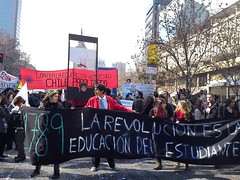
Did the hardline actions of a local mayor in Santiago, Chile worsen tensions between the government and student protesters?
Last week Cristian Labbe, mayor of Providencia, ordered the suspension of the school year and permitted police to remove student protesters who have been residing on local campuses. Labbe also ordered that protesters from the area’s secondary schools sign up to a “government program” that would make up for missed days of school.
At least sixteen people were arrested this morning after clashes between police and individuals upset at Labbe’s edict. In the meantime, Education Minister Felipe Bulnes will meet later today with Labbe though he told the press that he was “definitely displeased and in disagreement” with the mayor’s actions.
Labbe’s orders may have been illegal and overstepping of his authority but they wouldn’t be the first time has tried to put the hammer down on protesters. In 2006 he forced schools to expel students who were involved in demonstrations.
Over the past four months demonstrations have taken place around Chile urging the reform of the country’s educational system. Increased funding for universities and full government control of education are two of the key demands made by the protesters. “The people understand that the crisis in education is in fact a crisis of the model installed under the dictatorship,” student leader Camila Vallejo reportedly said over an educational system virtually unchanged since being established decades ago under the rule of Gen. Augusto Pinochet.
At an event last week at the Council on Foreign Relations, President Sebastian Pinera reiterated his rejection of the protesters’ chief demands. Despite the country’s strong economic growth, he said that the state couldn’t afford to provide free education to all. Pinera also tried to downplay the movement as one that is heavily influenced by elements of the Chilean political left and also criticized coverage of the protests by the media.
Image – Student protesters marching in Santiago, Chile on July 14, 2011. (Via Flickr user b1mbo). (CC BY-SA 2.0)
Online Sources- BBC News, La Tercera, La Nacion, Council on Foreign Relations, BBC News, CNN
Wednesday, July 13, 2011
Daily Headlines: July 13, 2011
 * Mexico: The country’s Supreme Court ruled that members of the military accused of human rights abuses can be tried in civilian courts.
* Venezuela: President Hugo Chavez said that he might undergo radiation therapy and chemotherapy as part of his cancer treatment.
* Chile: In the latest breakthrough for gay rights in Latin America, Chilean President Sebastian Pinera said that he would consider the legalizing of same-sex civil unions.
* Colombia: One of the world’s worst serial killers, Luis Alfredo Garavito, could be extradited to Ecuador and stand trial for murdering children.
Image – Reuters via BBC News (“Soldiers have increasingly taken on policing duties in parts of Mexico.”)
Online Sources- Los Angeles Times, CNN, GlobalPost, Colombia Reports
Saturday, July 9, 2011
Weekend Headlines: July 9-10, 2011
 * Honduras: According to the Honduras Truth and Reconciliation Commission the 2009 ouster of ex-president Manuel Zelaya was an illegal coup though he previously “defied court orders” by seeking a referendum for a constitutional assembly.
* Mexico: The United Nations human rights chief added to mounting global criticism of Thursday’s execution in Texas of a Mexican national who did not receive immediate consular help as stipulated in international law.
* Cuba: The country’s Supreme Court has approved an appeal filed by imprisoned U.S. contractor and accused spy Alan Gross.
* Caribbean: Manuel Galban, a Cuban guitarist who was a member of the Buena Vista Social Club died on Thursday at the age of 80 while esteemed Puerto Rican historian Ricardo Alegria also passed away on that day.
* Chile: President Sebastian Pinera’s approval rating last month (31%) marked a new low for the man whose favorability has nosedived since the rescue of 33 miners last October.
* Latin America: The Under-17 men’s World Cup final on Sunday will be an all-Latin America affair with Uruguay facing host nation Mexico.
Image – AFP via BBC News (“The Truth Commission says Mr. Zelaya and those who ousted him bear responsibility for the coup.”)
Online Sources- Al Jazeera English, Bloomberg, CBC News, CBC Sports, CBS News, CNN, LAHT, The Latin Americanist
Wednesday, July 6, 2011
Daily Headlines: July 6, 2011
 * Mexico: In an action praised by U.S. counternarcotics officials Mexican law enforcement captured the suspected third in command of the violent Zetas drug gang.
* U.S.: South American investors buying and renting out apartments in South Florida is one example of how foreign buyers are reportedly boosting the sagging housing market in some areas of the U.S.
* Chile: President Sebastian Pinera proposed the creation of a $4 billion higher education fund in response to several weeks of student protests.
* Bolivia: According to Bolivian officials the governments of that country and the U.S. are close to reestablishing diplomatic relations that have been broken for nearly three years.
Image – AP via BBC News (“Jesus Enrique Rejon Aguilar is accused of being a founder of the Zetas.”)
Online Sources- El Universal, BBC News, USA TODAY, Reuters, AHN
Friday, June 3, 2011
Follow-up: Chile court rejects retrial for Mapuche strikers
 Yesterday we examined the case of four imprisoned indigenous Mapuche activists who have been on a hunger strike since the middle of March. The protesters, who were hospitalized this week due to their fragile health, sought a retrial after they were convicted under a controversial dictatorship-era law. (That law severely limits the legal rights of the accused including permitting the state to hold people for up to two years without charges and the use of anonymous witnesses during trials).
Earlier today the Chilean Supreme Court refused to grant the strikers a retrial. The tribunal ruled to annul one of the convictions against the four men and, thus, reduces their prison sentences. Nonetheless, the court upheld another conviction for assault, which means that three of the protesters would have to serve prison sentences of 8 years while the group’s “leader” faces 14 years behind bars.
Mapuche spokeswoman Natividad Llanquileo deemed the decision as “unacceptable” and added that she would take the four men’s cases to the international courts. Meanwhile, the prisoners vowed to continue their hunger strike, which reached its 81st day on Friday.
According to local reports, police arrested twelve Mapuche demonstrators who gathered outside of the La Moneda presidential palace.
The Chilean government has yet to make a public declaration regarding today’s verdict. Both current President Sebastián Piñera and his predecessor, Michelle Bachelet, have strongly defended the controversial anti-terrorism law that opponents view as unjust and draconian:
It is necessary "to bring our ant-terrorism legislation into line with the standards of democracies in the developed world, but that must not mean that we let our guard down against this cruel, merciless scourge, which is itself a grave violation of basic rights," Piñera said in his annual state of the nation address on Saturday May 21.Image- 123.cl
"It's true that after 2001 (the 9/11 attacks in Washington and New York), powers to combat terrorism at a global level increased…but in the case of this Chilean law, it allows crimes against property to be treated as terrorist crimes, which is disproportionate," (attorney Julio) Cortés said.
Online Sources- UNPO, La Nacion, La Tercera, Terra.com, The Latin Americanist, 123.cl, teleSUR, Houston Chronicle
Wednesday, April 13, 2011
Daily Headlines: April 13, 2011
* Chile: Was Chilean president Sebastián Piñera really hoodwinked by his pen-stealing Czech counterpart Vaclav Klaus?
* Paraguay: The country is going through one of the worst epidemics of the dengue fever according to local health authorities.
* Guatemala: First lady Sandra Torres de Colom could soon run for the presidency after a judge dismissed a lawsuit challenging the divorce from her president husband.
* Uruguay: Uruguay could become the next Latin American country to legalize same sex marriages.
Video Source – euronews via YouTube
Online Sources- The Guardian, Mercopress, Huffington Press, On Top Magazine
Tuesday, March 22, 2011
Obama skips apologizing for U.S. backing Pinochet
 U.S. President Barack Obama moves on to El Salvador this afternoon for the final leg of his five-day Latin American tour. He spent roughly twenty-four hours in Chile where he focused on the need to look towards a better future for Latin America. Yet when confronted by a delicate question over Chile’s past Obama preferred to skirt the query.
During a press conference yesterday a Chilean reporter asked Obama if he would be willing to apologize for the U.S. involvement with the 1973 coup d’état led by late dictator Augusto Pinochet. “I cannot discuss the politics of the past…It’s important that we do not remain trapped by history” replied Obama.
Nonetheless, Obama pledged that the U.S. would cooperate with Chilean authorities to investigate human rights abuses under the Pinochet regime. (Nearly 3200 people were estimated to have been either killed or “disappeared” under during Pinochet’s seventeen-year rule). Obama’s promise to help “clarify” the deaths of former presidents Salvador Allende and Eduardo Frei Montalva satisfied the son of the latter, congressman Eduardo Frei Ruiz-Tagle, who praised Obama’s “commitment to democracy and human rights.”
Prior to Obama’s comments one group representing victims’ families and several legislators penned a letter seeking a mea culpa from Obama as well as “declassifying all archives pertaining to U.S. intervention in Chile.” Additionally, several hundred protesters marched in the Chilean capital city of Santiago against Obama’s visit and U.S. cooperation with Pinochet.
By not apologizing, however, Obama may have avoided adding more wood to the fire being stoked by opposition at home:
Obama’s decision not to offer an explicit apology may have been aimed avoiding another round of criticism from Republicans at home, who have previously accused him of being on an “apology tour” during his past travels. They have cited remarks he made about the “arrogance” of past U.S. attitudes toward Europe and even some comments on Latin America, though none have appeared to be outright apologies.Image- La Cuarta (Monday afternoon’s press conference between the U.S. and Chilean presidents took place at the same presidential palace where Salvador Allende died in a 1973 coup).
Online Sources- noticias123.cl, ElPais.com, Reuters, La Tercera, La Nacion, El Nuevo Herald, Voice of America, Politico
Friday, February 25, 2011
Chilean quake survivors still suffer one year later
 After being shaken one of the worst earthquakes on record one year ago survivors of a major quake in Chile continue to suffer numerous hardships.
According to Chilean president Sebastián Piñera 50% of rebuilding efforts in the regions hit by the February 27, 2010 tremor and tidal wave have been completed. After signing into law the creation of a new civil protection agency, Piñera said that the reconstruction included housing, hospitals, airports, and other public works projects.
Some Chilean Cabinet officials also shared Piñera’s optimism. “The impact of reconstruction on growth is becoming stronger as time goes on,” asserted Finance Minister Felipe Larrain to Reuters. Interior Minister Rodrigo Hinzpeter added that the Piñera administration was “on top of reconstruction efforts” to the tragedy that took place less than two weeks before he took office.
Despite such a positive outlook the reality is somewhat different in the affected Maule and Bio-Bio areas. One community activist told TeleSUR that the government’s help was “all talk” and little action. As we mentioned last November, some residents felt “forgotten” by officials focused instead on the 33 workers trapped in the San Jose mine. According to Mexico’s Milenio, tourism in those regions has nosedived while some infrastructure problems continue.
Reconstruction in Chile seems to be going at a faster pace compared to parts of Haiti that were hit by a major tremor thirteen months ago. Yet both countries share a commonality: quake survivors facing immense difficulties residing in temporary camps.
In Dichato, almost all the 3 000 residents are in temporary shelters in a zone with no running water, where the cramped living conditions are reviled by those forced to stay there.The earthquake that measured 8.8 on the Richter scale cost 525 deaths, 25 people disappeared and 800,000 survivors left homeless.
"Life in the village is horrible, disgusting. To me, it's like being in a concentration camp," Toledo said.
They and others left homeless from the quake are still waiting for new homes.
Authorities said 135 000 people have been assigned houses to houses yet to be built, but bureaucracy was dragging out the process.
Image- Enrique Marcarian/Reuters via CSMonitor.com (“A resident retrieves some belongings from a building…in Talca, after an 8.8-magnitude earthquake struck central Chile” one year ago.)
Online Sources- news24.com, teleSUR.tv, The Latin Americanist, Milenio, Europa Press
Monday, February 14, 2011
Chile: Tempting fate?
 On Friday Chilean President Sebastián Piñera admitted that the government has not done enough to rebuild coastal areas affected by last February’s earthquake and tidal wave. “It has taken us much longer than people would have liked and we know that we are still behind but not from lack of initiative” said Piñera to the press.
Since Piñera ‘s comments were made a number of tremors have shaken the same region hit by last year’s major tremors. Perhaps one can call it a case of sheer coincidence:
An earthquake measuring 6.6 magnitude on the Richter scale hit off the coast of central-southern Chile Monday, causing no casualties or material damage…Image- AFP via Herald Sun (“Shaky ground: A local resident hurries to abandon the waterfront after an earthquake in Constitucion, south from Santiago, on February 11, 2011.”)
The northern Chilean region of Atacama was struck by a series of moderate quakes last week, causing panic among the local population as the geologists have been warning of an eventual outbreak of tectonic energy in the region.
On Friday a 6.8-magnitude earthquake was registered in Concepcion, capital of the central-southern region of Bio Bio.
Online Sources- La Tercera, The Latin Americanist, Xinhua
Thursday, October 14, 2010
Chile: So now what?
 The future is uncertain for the 33 Chilean miners rescued after being trapped underground for seventy days. For now the survivors are hospitalized though they are in very good health according to Dr. Jorge Montes, assistant director of the Copiapo Hospital. “Some are suffering from minor complications, but nothing to worry about," Montes mentioned and added that most of the men could be released from hospital as early as today.
Despite Montes’ positive prognosis, there remains the possibility that the survivors may have physiological trauma or other physical ailments. According to CNN health officials warned that there prolonged isolation could make them “more susceptible to the common cold or other viruses.”
After being the final worker rescued last night, shift leader Luis Urzua expressed his hope to President Sebastian Pinera that the rescue “should never happen again”. Pinera said today that he couldn’t guarantee future mining accidents yet vowed to improve safety regulations in various industries nationwide. “Never again in our country will we allow working in conditions so inhumane and so unsafe as happened in the San Jose mine” said Pinera who may soon introduce a series of reforms.
The rescue operation became a global media phenomenon with massive coverage via the Internet and from 24-hour TV news networks worldwide. The coverage hasn’t been universally praised; Tom Scocca of Slate.com took exception to the New York Times characterization of the rescue as Pinera’s “extraordinary political calculation”:
In addition to being Chile's top-ranked politician, though, the president of Chile does have another role: he serves as the country's president. So beyond the very important tasks of maintaining his popularity and raising his international profile, is it possible that Piñera was trying to—how to say this?—lead his country?Image- CNN (“Mario Gomez is escorted through Copiapo Hospital in Copiapo, Chile, on Wednesday.”)
Online Sources- CNN, Voice of America, The Latin Americanist, BBC News, Vancouver Sun, slate.com
Tuesday, October 5, 2010
Daily Headlines: October 5, 2010
 * Chile: President Sebastian Pinera expressed his hope that 33 miners trapped underground since early August could be freed before the end of next week.
* U.S.: Eleven Latin American countries including Costa Rica, Mexico and Peru filed a legal brief in Arizona Gov. Jan Brewer's appeal of a July ruling on a controversial immigration measure.
* Colombia: The country’s inspector general barred two former intelligence chiefs from nearly two decades of public office due to their roles in an illegal wiretap scandal.
* Haiti: Some Canadian politicos alleged that the government staged a “photo op” by rerouting a post-earthquake flight with 24 Haitian orphans.
Image – BBC News (“Alberto Segovia, outside the San Jose mine in Copiapo, Chile, shows a portrait of his brother Dario Segovia, 48, one of 33 miners trapped inside.”)
Online Sources- CBC, AP, The Latin Americanist, MSNBC, Voice of America
Subscribe to:
Posts (Atom)