Showing posts with label Cristina Kirchner. Show all posts
Showing posts with label Cristina Kirchner. Show all posts
Thursday, March 7, 2013
Hugo Chávez to be Embalmed, Displayed at Venezuelan Museum (UPDATED)
The body of recently deceased Venezuelan President Hugo Chávez will be embalmed and placed on display at a planned museum according to interim leader Nicolás Maduro.
Chávez’ body will be preserved “so that it may be forever exhibited to the public at the Museum of the Revolution”, declared Maduro to the press at the Fuerte Tiuna military base where Chávez has lied in state on Thursday. The former Vice President compared what will happen to Chávez’ remains with the preserved corpses of famed revolutionary figures Vladimir Lenin and Ho Chinh Minh.
Maduro also said that Chávez would lie in state for an additional seven days before being moved to its final resting place, which is currently under construction.
“We want the whole world to see him without any limitations”, Maduro mentioned after hundreds of thousands of Chavistas put up with hot weather and waits of up to ten hours in order to pay their respects to the former president.
“Comandante — rest in peace. We'll carry on your fight,” said one mourner who also praised Chávez’ “powerful connection” to Venezuela’s impoverished classes.

Thursday, February 28, 2013
Israel “Disappointed” Over Argentina-Iran Truth Panel
The government of is real is none too pleased at Argentine lawmakers who approved the creation of a truth commission with Iran to investigate the 1994 bombing of the AMIA Buenos Aires Jewish community center.
"Past experience shows that agreements with Iran don't change Tehran's positions and are not followed,” read a statement issued by the Israeli Foreign Ministry. “The same holds for the current agreement, which will not lead to bringing those responsible for the bombing to trial. We are disappointed with the decision," said the communiqué.
Argentine and Israeli officials have criticized each other over Argentina’s deal with Iran that was announced by Argentine President Cristina Kirchner on January 27th.
Representatives of Jewish groups in and outside of Argentina were also upset at the Argentine Congress including the slim majority of Chamber of Deputies members who on Thursday accepted the Memorandum of Understanding (MOU) with Iran.
“The idea of establishing a 'truth' commission on the AMIA tragedy that involves the Iranian regime would be like asking Nazi Germany to help establish the facts of Kristallnacht,” declared American Jewish Committee Executive Director David Harris.
"This is a memorandum that is not clear, that is not complete and that we feel doesn't bring any benefit to the cause,” said Julio Schlosser, president of the Jewish umbrella organization DAIA, before the vote took place.
The president of the AMIA Jewish Community Center, Guillermo Borger, threatened that he “will make a presentation to the Argentine Supreme Court seeking invalidation of the agreement.” (Argentina is home to Latin America's largest Jewish community.)
The Kirchner administration believe that the panel will help Argentine courts question eight Iranians suspected of masterminding and carrying out the attack that killed 85 people and wounded 300. The Iranian government has denied involvement in the bombing and there is a possibility that country’s parliament may reject the MOU:
Thursday, January 26, 2012
Daily Headlines: January 26, 2012
* Ecuador: The government might shut down “underground clinics” that allegedly abuse their clients in order to “cure” their homosexuality.
* Argentina: In the latest war of words over the sovereignty of the Falklands/Malvinas, Argentine President Cristina Kirchner blasted British Prime Minister David Cameron for “trying to paint us as bad guys.”
* Nicaragua: A statement from U.S. Secretary of State Hillary Clinton said that Nicaragua's recent elections were “a setback to democracy” and added that President Daniel Ortega must be held accountable.
* Venezuela: With just over two weeks until the opposition presidential primary election, Miranda governor Henrique Capriles got a major endorsement from former candidate Leopoldo Lopez.
Video Source – CNN
Online Sources- MSNBC, BBC News, Voice of America, Reuters
Saturday, January 7, 2012
Weekend Headlines: January 7-8, 2012
* Chile: Is the government correct or scapegoating Mapuche indigenous activists who are accused of intentionally setting off wildfires in central Chile?
* Argentina: According to a team of doctors President Cristina Kirchner did not have thyroid cancer as was originally diagnosed yet the “surgical treatment performed (last Wednesday) is sufficient.”
* Mexico: Authorities captured the supposed mastermind behind last year’s Casino Royale arson in Monterrey that killed fifty-people.
* U.S.: The Labor Department revealed yesterday that the unemployment rate for Latinos dropped by 0.4% last month to 11.0%.
Video Source – YouTube via teleSUR English
Online Sources- Bloomberg, NPR, Voice of America, Hispanically Speaking News
Thursday, January 5, 2012
Daily Headlines: January 5, 2012
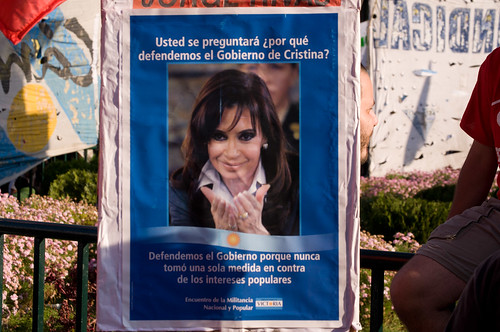
* Argentina: President Cristina Kirchner's thyroid cancer surgery yesterday was successful and her full recovery is expected according to a statement from her team of doctors.
* Latin America: At least thirty-one inmates died after fighting broke out in a Mexican prison, while over nine hundred family members of detainees upset at the Venezuelan judicial system occupied a prison near Caracas.
* Paraguay: Health officials declared a state of emergency in the northern province of San Pedro after detecting a second foot-and-mouth disease outbreak in less than a year.
* U.S.: Gabion Zavala, an auxiliary bishop in the Los Angeles Archdiocese who reportedly worked close with the local Latino community, resigned after admitting that he fathered two children.
Image Source – Flickr via elad abraham (CC BY 2.0)
Online Sources- CNN, The Australian, The Guardian, CBS News, BusinessWeek
Tuesday, November 2, 2010
Daily Headlines: November 2, 2010
 * Colombia: Congrats to Edgar Renteria who was named as the World Series Most Valuable Player as the San Francisco Giants won their first championship in over fifty years.
* Mexico: Four U.S. citizens were killed in separate incidents in northern Mexico over the weekend.
* Argentina: "It's my most painful moment," said President Cristina Fernandez in a nationally televised speech last night regarding the sudden death of her husband.
* Cuba: Local Catholic Church officials said that the government would release a political prisoner held behind bars since 1985.
* Haiti: How did a “South Asian strain” of cholera arrive in Haiti to infect and kill over 330 people?
* Venezuela: Political relations between Venezuela and Colombia are expected to keep improving, as Hugo Chavez will host Juan Manuel Santos in Caracas today.
Image – The Telegraph (“Let the party begin: San Francisco players celebrate after beating the Texas Rangers Photo: REUTERS.”)
Online Sources- Reuters, El Universal, CNN, BBC News, The Latin Americanist, USA TODAY
Wednesday, October 27, 2010
Argentina: Ex-president Kirchner dies
 Nestor Kirchner, former Argentine president and husband to current head of state Cristina Fernández de Kirchner, died this morning of a heart attack.
Kirchner, who had undergone a pair of arterial procedures earlier this year, passed away in his home province of Santa Cruz despite the intervention of medical staff to revive him. The former president between 2003 and 2007 died reportedly with his wife by his side after he was rushed to a nearby hospital.
Numerous regional and world leaders sent messages of condolences to the Kirchner family and solidarity to the Argentine people. Brazilian president Luiz Inacio Lula da Silva declared three days of mourning over the “very sad” news of Kirchner’s death. A moment of silence was held at a meeting of the Organization of American States while Uruguayan president Jose Mujica philosophically said “life goes on, but it is a reminder to everyone that life can be taken from us at any moment."
Prior to his presidency Kirchner served as Santa Cruz governor, and at the time of his death he was serving as both a congressman and as president of the UNASUR bloc. As UNASUR head he helped broker a meeting earlier this year where the Colombian and Venezuelan government agreed to reestablish diplomatic ties.
His time in the Casa Rosada was defined by overseeing Argentina’s economic recovery after a profound crisis that he blamed on the International Monetary Fund (IMF) “dictatorship”. He helped bring some political stability after the country had five presidents in a tumultuous two weeks and he spearheaded justice reforms that led to human rights trials of members of the “Dirty War” junta.
His detractors, however, criticized him for consolidating political power for himself and his wife as well as his fiery speeches against figures such as political elites and the IMF. Other opponents were upset with his kirchnerismo populism that included raising the minimum wage and pensions while also increasing government control of the economy.
Kirchner was said to be a candidate in next year’s presidential elections and his death was described by The Economist as “a political cataclysm.” Argentina is a “country that seems to be condemned to living between tragedy and drama” wrote Eduardo van der Kooy in Clarin.com regarding the nation’s unsure political future.
Kirchner’s body will be in view at a public wake on Thursday at the Casa Rosada presidential palace, reportedly the first time this will be done for a former president.
Image- Al Jazeera English
Online Sources- The Telegraph, Clarin.com, El Universal, BBC News, thisislondon.co.uk, BusinessWeek, The Guardian, The Economist
Monday, October 11, 2010
Argentina peeved over Falklands military maneuvers
 Diplomacy between Argentina and Britain has been strained for decades due to competing claims of sovereignty over the Falkland Islands/Islas Malvinas. The lowest point in bilateral relations was the Falklands War in 1982 though both countries continue to quarrel over the archipelago located nearly 300 miles from the Argentine coast.
The latest kerfuffle over the Falklands concerns British plans to conduct military exercises on the islands. A spokesman for the British Foreign Office told CNN that such maneuvers are “routine”, conducted on a regular basis, and part of standard military procedure. (During military exercises carried out last year British officials said they were necessary to prepare “the regiment's training for deployment in Afghanistan.”)
The Argentine government responded to the British plans with indignation and disappointment. Deputy Foreign Minister Alberto D'Alotto sent a “formal and energetic” letter of protest to British diplomats over the exercises that will reportedly include the deployment of missiles. Argentina’s Ambassador to the U.N. also said that he would present a formal complaint addressing “the United Kingdom has been failing to comply with several UN resolutions all these past years.” The government may also present complaints to the UNASUR regional bloc as well as the Organization of American States.
The governments of Venezuela and Uruguay have given their strong support to Argentine President Cristina Kirchner over this latest dispute. In several postings to her Twitter account that were later deleted, Kirchner vigorously critiqued the upcoming British military drills:
"Serious, very serious," Mrs. Kirchner wrote. "Royal Navy, occupying colonial force in Falkland Islands, reports military exercise with missiles on the coast of East Falkland.Image- CNN (“Britain, which fought a war against Argentina over the Falklands, keeps a military presence on the islands.”)
"Typical nineteenth century colonialism. Anachronistic use of force in violation of international law. They do not care. A clear example of double standards."
Online Sources- globalsecurity.org, The Latin Americanist, CNN, UPI, Reuters, Buenos Aires Herald, Clarin.com, The Telegraph
Thursday, October 7, 2010
Daily Headlines: October 7, 2010
 * U.S.: Forbes’ list of the world’s most powerful women includes Supreme Court justice Sonia Sotomayor (19th), Brazilian model Gisele Bundchen (72nd), and the presidents of Argentina and Costa Rica (68th and 83rd respectively).
* Puerto Rico: FBI agents arrested nearly 130 people including about 90 cops as part of an investigation into alleged corruption within the Puerto Rican police.
* Latin America: The International Monetary Fund claimed that Latin America and the Caribbean are recuperating from the global economic slowdown faster than originally prognosticated.
* Cuba: President Raul Castro claimed that the U.S. has ignored at least three offers since 2001 for "bilateral cooperation to fight against terrorism."
Image – CBS News
Online Sources- Bloomberg, AP, Forbes, Miami Herald
Thursday, August 26, 2010
Daily Headlines: August 26, 2010
 * U.S.: Members of Baltimore’s Latino community are worried and concerned after a rash of attacks against residents of Honduran background.
* Argentina: President Cristina Fernandez has clashed with the press after accusing two major newspapers with collusion and illegally driving out competition for over three decades.
* Bolivia: Authorities have declared a health alert for areas of northern Bolivia after a teen died from bubonic plague.
* Cuba: According to Cuban stat television Venezuelan President Hugo Chavez met for five hours in Havana with Fidel Castro.
Image – Baltimore Sun (51-year-old Martin Reyes was killed on Saturday allegedly by mentally disabled man who said he hated "Mexicans").
Online Sources- Sky News, MSNBC, The Guardian, Baltimore Sun
Saturday, January 30, 2010
Weekend Headlines: January 30-31, 2010
 * Argentina: The dispute between central bank chief Martin Redrado and President Cristina Kirchner came to a climax yesterday after Redrado quit his post.
* U.K.: A family originally from Bolivia was awarded over $159,000 from the British government after being falsely placed in a detention center for 42 days.
* U.S.: A study published yesterday found that Latino immigrants in California’s in San Diego County have the highest level of self-employment.
* Latin America: The 2010 Copa Libertadores began this week with first round home victories for Deportivo Tachira (Venezuela), Colon (Argentina), and Juan Aurich (Peru).
Image – AFP (Argentine central bank chief Martin Redrado resigned amidst his battle with President Cristina Kirchner over how to pay the government’s debt)
Online Sources- Bloomberg, Channel 4 News, signonsandiego.com, Goal.com
Thursday, January 28, 2010
More than just the other white meat
 Some stories speak for themselves:
Argentinean President Cristina Fernandez has told a gathering at her Presidential Palace that pork is even better than Viagra for spicing things up in the bedroom - and credited a satisfying weekend with her husband to the meat.So how may double entendres did you find among Kirchner’s comments?
"I've just been told something I didn't know, that eating pork improves your sex life," she said in a televised speech to the leaders of the Argentinean meat industry, "I'd say it's a lot nicer to eat a bit of grilled pork than take Viagra"…
Speaking of a weekend spent with her husband after eating the meat, Fernandez said, "We were in high spirits the whole weekend... I'm a pork fanatic."
Image- Boston Herald
Online Sources- Huffington Post
Tuesday, December 15, 2009
Daily Headlines: December 15, 2009
 * Spain: The Royal Language Academy of issued a new 4000-page grammar book designed to better reflect the evolution of the Spanish language throughout the Americas.
* Latin America: Cuba and Venezuela strengthened their ties after signing several deals worth approximately $3 billion.
* Mexico: The country’s severely weakened economy and decreased oil output has led Standard & Poor’s to lower Mexico’s credit rating.
* Argentina: President Cristina Kirchner was the target of death threats by someone who tapped into the radio frequency of the presidential helicopter.
Image – BBC News (King Juan Carlos was given a copy of the new Spanish grammar rules that will replace the Royal Language Academy’s 1931 guidelines).
Online Sources- Bloomberg, ABC News, Toronto Sun, MSNBC
Friday, August 28, 2009
LatAm leaders blast Colombia-U.S. military pact
 The deal to expand the U.S. military presence in Colombia has been the main focus of the Union of the South American Nations (UNASUR) extraordinary summit today in Argentina.
Venezuela’s Hugo Chavez- who has been the most vociferous opponent of the pact- claimed that the deal is part of a U.S. plan of “global domination” in Latin America. Bolivia’s Evo Morales claimed that the sovereignty of states cannot “be brought or sold” and proposed that UNASUR signed a declaration prohibiting foreign countries from establishing a military presence. UNASUR president pro-tempore and Ecuadorian president Rafael Correa questioned the reasoning behind the pact that could be exploited for increased U.S. interventionism.
More moderate leaders also expressed their displeasure with the pact whose reported purpose is of combating narcotrafficking in the Americas. Argentine President Cristina Kirchner warned that "tomorrow, another country might want to do the same thing (with another foreign power)." Ahead of the summit, Brazilian President Luiz Inacio Lula da Silva urged that his Colombian counterpart Alvaro Uribe “make written guarantees at the summit.” Chile’s Michelle Bachelet claimed that she has not read the agreement since neither officials in Bogotá or Washington have released the plan’s details.
For his part, Uribe defended the deal by claiming that its Colombia’s sovereign right to combat narcotrafficking. Uribe refused to explain the plan in more detail and instead choose to launch salvos against Colombia’s leftist guerillas.
Much like Uribe, U.S. officials have been mostly mum over the intricacies of the pact that is expected to soon be signed:
(The US deputy assistant secretary of state for western hemisphere affairs, Christopher McMullen) asserted that the US military had enjoyed access to Colombian bases "for many years" and the planned deal was just an expansion of a longstanding accord.Image- Al Jazeera English (The presidents of Colombia and the U.S. recently met for discussions at the White House.)
He noted that under a current cap imposed by the US Congress, the number of US military personnel in Colombia was limited to 800. There have been only around 270 deployed over the past three years, he said.
Online Sources- AFP, Colombia Reports, El Tiempo, El Espectador, AP, NPR
Thursday, August 20, 2009
Hispanic trio makes Forbes most powerful women list
 Three women of Hispanic background were among those selected for Forbes magazine's annual "100 Most Powerful Women" ranking.
- Argentine president Cristina Kirchner was eleventh on the list. Despite being ranked higher than the chief executives of major firms like Xerox and Avon, the magazine mentioned Argentina’s recent economic troubles. The magazine cited dismal midterm election results that may lead Kirchner to pull a Palin and resign before the end of her term in office.
- Chilean president Michelle Bachelet has been on the list before and this year was no exception. She was placed at 22nd on the list with Forbes praising Chile’s numerous trade pacts as well as Bachelet’s role as head of the UNASUR bloc.
- She has yet to listen to her first Supreme Court case but Sonia Sotomayor earned the #55 spot on the list just ahead of Securities & Exchange Commission chair Mary Schapiro and Health & Human Services chief Kathleen Sibelius. Forbes highlighted her extensive judicial experience and Ivy League background while also acknowledging the stiff opposition during her nomination process.
Image- La Nacion (2007 photo of the current presidents of Chile and Argentina).
Online Sources- The Latin Americanist, AHN, Forbes.com
Monday, August 3, 2009
Daily Headlines: August 3, 2009
 * U.S.: Family of Jose Sucuzhañay was present at the dedication of the Brooklyn street corner where he was murdered in a suspected hate crime.
* Argentina: Representatives of President Cristina Kirchner’s government will meet with farm leaders threatening to go on strike over Argentina’s weakened economy.
* Cuba: "We are ready to talk about everything, but ... not to negotiate our political and social system," declared Cuban President Raul Castro in a speech to the country’s legislature.
* Colombia: A symbol of Colombia’s continued armed conflict- the roughly 2000 displaced people in Bogota’s Tercer Milenio Park- agreed to leave the site after four months of peaceful occupation.
Image- New York Daily News (“A business card belonging to Jose Oswald Sucuzhanay” who was slain in December 2008.)
Online Sources- AFP, Colombia Reports, NY1, Reuters, The Latin Americanist
Wednesday, July 29, 2009
Daily Headlines: July 29, 2009
 * Argentina: The personal wealth of Argentina’s power couple has come under increased scrutiny as the country’s economic woes worsen.
* Nicaragua: Nicaraguan Ernesto Cardenal won the Pablo Neruda Ibero-American Poetry Prize and used his award speech to blast President Daniel Ortega.
* Mexico: Mexicans could soon be obligated to carry a national ID card which will include fingerprints and a retina scan.
* U.S.: Health authorities in New York warned against the use of certain beauty products imported from the Dominican Republic that contain dangerous chemicals but are popular in Latino neighborhoods.
Image- BBC News (Argentina’s president and First Husband in happier times).
Online Sources- Guardian UK, Xinhua, LAHT, UPI
Wednesday, July 8, 2009
Notable Quotable: Liar, liar…

“This man (Fernández) is a liar, he's got a nose as long as Pinocchio's.”---Newly elected Argentine legislator Fernando ‘Pino' Solanas blasted the designation of Aníbal Fernandez as the new Cabinet chief.
Nearly two weeks after the ruling party suffered setbacks in local elections, Argentine President Cristina Kirchner made several major changes in her Cabinet. One of the main changes in the Cabinet occurred days ago with a switch in Health Ministers due to increasing criticism of the government’s handling of the swine flu outbreak.
Image- The Telegraph
Online Sources- Buenos Aires Herald, The Latin Americanist, New York Times, Reuters
Tuesday, June 30, 2009
Argentine elections stun Kirchners
 Mel Zelaya wasn’t the only Latin American leader to have a lousy weekend.
Sunday’s congressional elections served as a stunning setback for President Cristina Kirchner and her ex-presidential husband. Infighting within the Peronist Party led them to lose its majority in both legislative chambers as well as local seats in Buenos Aires and even the Kirchners' home province of Santa Cruz. After losing his own bid for a seat in Congress, Nestor Kirchner quit as leader of the Justicialists while the president tried to save face by emphasizing “consensus and agreements in order to govern.”
For a greater insight into Sunday’s elections and the future of Argentina, Rice University professor of political science Mark Jones was gracious enough to grant us an interview.
The Latin Americanist: Surely the biggest losers of Sunday's local elections in Argentina are the Kirchners. But which political figures could be labeled as the "big winners.?
Mark Jones: There were three big winners on Sunday.
Most prominently, the alliance of parties backed by Vice President Julio Cobos in his home province of Mendoza won a resounding victory over the Kirchner aligned governor's (Celso Jaque) list. In the top of the ticket Senate race, Cobos' Federal Civic Front won 50% of the vote to Jaque's Front for Victory's 25%. This victory positions Cobos as the front-runner for the 2011 presidential election from within the non-Peronist opposition.
Another big winner on Sunday was Senator Carlos Reutemann. Reutemann, a moderately anti-Kirchner Peronist, kept his presidential aspirations alive by narrowly defeating Socialist Rubén Giustiniani (the shadow candidate of Santa Fe Governor Hermes Binner) in the Santa Fe Senate elections, 42% to 41%. Reutemann's performance was weakened by the presence of a Kirchner-aligned Peronist in the race, who siphoned off 8% of the Peronist vote (much of which would have otherwise gone to Reutemann).
Dissident Peronist Francisco De Narváez should also be considered a big winner, defeating former President Néstor Kirchner in the Province of Buenos Aires Chamber of Deputies election 35% to 32% (De Narváez and Kirchner headed the Union PRO and Justicialista Front for Victory lists respectively). Through this victory De Narváez has positioned himself well for a run at the office of Governor in the Province of Buenos Aires in 2011. However the road to La Plata (capital of the Province of Buenos Aires) will not be free of obstacles for De Narváez, with Cabinet Chief Sergio Massa representing a formidable rival for the governorship in 2011.
Lastly, while not reaching the same level of salience as the three above-mentioned victories, on Sunday several governors ratified their dominance within their respective province. For instance, the Peronist Governor of Chubut, Mario Das Neves (a dark horse candidate for the presidency in 2011) can be considered a winner due to the manner in which he demonstrated his absolute control of his province. Das Neves' Front for Integration list won 56% of the vote, more than three times that won by the runner-up Radical Civic Union (18%). A similar level of dominance was demonstrated by other governors, including Peronists José Alperovich (Tucumán), José Luis Gioja (San Juan), Alberto Rodríguez Saá (San Luis), and pro-Kirchner Radical Gerardo Zamora (Santiago del Estero).
TLA: Did President Cristina Fernandez miscalcuate by moving the elections up from October?
MJ: President Fernández did not miscalculate, simply because she does not make the important political decisions. Her husband, former President Néstor Kirchner, and the real powerbroker and decisionmaker, definitely miscalculated, but principally in terms of campaign strategy, by turning the election in the Province of Buenos Aires (in particular) as well as those (to a lesser extent) in the interior provinces into a referendum on him and the Kirchner Government. The electoral results demonstrated substantially more antipathy towards the Kirchners within the electorate than had been estimated by the public opinion polls. As a result of Kirchner's referendum approach to the election, the disparate opposition (principally the pan-Radical opposition alliance and the alliance of dissident Peronists with Capital Federal "Governor" Mauricio Macri) did not need to develop a credible or effective campaign message based on policy proposals, but rather (with some important provincial exceptions) could campaign simply based on their representing a vote "against" the Kirchners. As things turned out, from Kirchner's home province of Santa Cruz (where the Kirchner list was defeated, 43% to 41%) in the South to the Province of Buenos Aires on the Eastern coast, to Mendoza in the Andes, a majority of Argentine citizens chose to cast a vote against the Kirchners, handing them an embarrassing defeat with nearly two and a half years remaining in the presidency of Cristina Fernández de Kirchner.
In regard to the decision to move the elections to October, that probably was not a miscalculation, since waiting until October would have resulted in a further erosion of support (due principally to the deepening economic crisis in Argentina) as well as would have allowed the opposition to better organize itself to compete in the elections.
TLA: Ex-president Kirchner has already quit as head of the Peronistas but what should the current president's next political move be?
MJ: The Peronist Party (Partido Justicialista) formal party structure is an empty shell that is only as important as the person running the show. For the time being Néstor Kirchner will still be the de facto leader of the Peronist movement, albeit in a position where he has to increasingly negotiate with the major powerbrokers within Peronism (principally the Peronist governors).
TLA: Is the Peronist Party dead or will it be able to soon regroup?
MJ: Peronism is a very resilient movement. It will soon regroup, most likely under the leadership of the most viable Peronist presidential candidate for the 2011 election (e.g., Carlos Reutemann). However, between now and the 2011 election will be a period of transition and tension, since while many Peronists will gravitate towards Reutemann (or another leader if that person becomes the front-runner), the fact remains that for the next two and a half years (i.e., until December 10, 2011), Néstor Kirchner will continue to control the purse strings, and therefore the governors will need to work with him in order to keep their provinces running. What we are likely to see though is a change in the relationship between Kirchner in the governors, moving from the current authoritarian top-down relationship of patron and client, to one of something approaching (though not actually reaching) that of a relationship among equals.
Barring a major surprise over the next two years, it is very likely that the next Argentine President will be Peronist, with today Carlos Reutemann representing the front-runner in the race. It is though still far too early to rule out other potential Peronist candidates such as Chubut Governor Mario Das Neves, Buenos Aires Governor Daniel Scioli (though weakened by his strong association with the Kirchners), and quasi-Peronist Mauricio Macri ("Governor" of the City of Buenos Aires).
Image- AP (“Argentina's President Cristina Fernandez gestures during a press conference at the government house in Buenos Aires, Monday, June 29, 2009. Fernandez and her predecessor and husband Nestor Kirchner suffered a stunning setback in Sunday congressional elections, seen as a referendum on their political dynasty, losing control of both houses of Congress. (AP Photo/Natacha Pisarenko)”)
Online Sources- AFP, BBC News, CNN
Tuesday, April 28, 2009
Bolivia, Paraguay reaches border agreement
 Bolivia and Paraguay have settled a long-running dispute over the Chaco region of South America.
With Argentine President Cristina Kirchner serving as a guarantor, Paraguay’s Fernando Lugo and Bolivia’ Evo Morales signed the deal on Monday in Buenos Aires. Lugo and Morales agreed to resolve their differences over the Chaco area which was the basis for the bloody Chaco War in the 1930s.
Both presidents called for a new era of diplomacy between Bolivia and Paraguay yet also blamed the Chaco War on “foreign interests”:
Mr. Morales blamed multi-national oil firms - in their quest for natural resources - for fuelling the Chaco war, which claimed 100,000 lives.The Chaco region is over 400,000 square miles in size and has been dubbed as "the last South American frontier".
The key energy companies operating in the region at the time were US Standard Oil, backed by Bolivia, and the Anglo-Dutch Shell Oil Company, supported by Paraguay.
President Lugo expressed the hope that natural resources could now "be developed and used by both countries without any foreign intervention."
Image- daylife.com (The Chaco region was hit hard by a drought last year which affected livestock and the sparsely populated indigenous peoples living there).
Online Sources- momento24.com, Wikipedia, BBC News, PRESS TV
Subscribe to:
Posts (Atom)