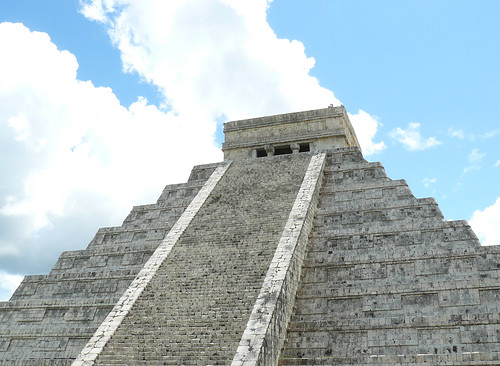
* Latin America: According to Mexican and British researchers a severe drought led to the demise of the Mayan civilization over one thousand years ago.
* Argentina: The blame game into the cause of Wednesday’s train crash that killed fifty people continued with allegations of government corruption and malfeasance by the heads of the private firm that runs the Buenos Aires passenger rail network.
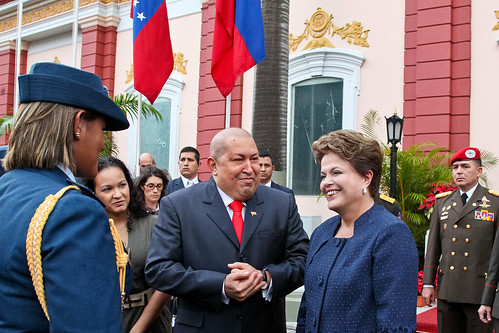
* Venezuela: President Hugo Chavez is expected to arrive in Cuba today in order to undergo an operation for a new lesion in the same area where a cancerous tumor was removed last year.
* El Salvador: Ex-defense minister Carlos Eugenio Vides Casanova may soon be deported from the U.S. to his native El Salvador where he awaits trial for alleged “war-related crimes.”
Image Source – Flickr via Mike_fleming (Mayan ruins at Chichen Itza in southern Mexico). (CC BY 2.0) Online Sources- BBC News, IOL, The Latin Americanist, CNN, UPI
* Syria: President Bashar al-Assad and other members of his regime may be responsible for “widespread human rights violations” and possible crimes against humanity according to a U.N. report issued on Thursday.
* World: German Chancellor Angela Merkel asked for forgiveness for the state’s role in botching up the investigation into a “neo-Nazi killing spree”, while U.S. President Barack Obama apologized for the burning of copies of the Koran at a military base in Afghanistan.
* India: The government has come under fire for opposing and then backing a Supreme Court ruling that decriminalizes gay sex.
* Somalia: Representatives from over fifty countries are meeting in London in order to discuss the security and future of Somalia.
Video Source– YouTube via Associated Press (“Amateur footage purportedly showing more shelling in the Baba Amr area of Homs, Syria was posted on the internet by activists on Thursday.”)
Online Sources – Voice of America, IOL, BusinessWeek, BBC News, The Guardian
* Ecuador: President Rafael Correa said that he might annul the controversial prison sentence against three former newspaper directors accused of libeling him. (Note: link is in Spanish).
* Honduras: Relatives of some of the 359 inmates who died in a Honduran prison fire last week have called on authorities to confirm a preliminary report claiming that the cause of the blaze was accidental.
* U.S.: A group of Latino student activists supporting the DREAM Act protested outside of the site of last night’s Republican presidential debate in Arizona.
* Bolivia: At least ten people are dead as a state of emergency was issued for parts of the Amazon region hit by heavy flooding.
Image Source – Flickr via Gobierno de Chile (Ecuadorian President Rafael Correa, seen here in the dark blue jacket during a 2010 visit to Chile, has come under fire from press rights groups after suing three former newspaper directors for libel). (CC BY 2.0)
Online Sources- El Espectador, Cronkite News, BBC News, The Australian, The Latin Americanist
At least forty-nine people are dead and approximately six hundred are injured after a train derailed during the morning rush hour in Argentina’s Buenos Aires province:
Police spokesman Fernando Sostre told the local press that the train from the neighborhood of Moreno crashed into a platform at the Once train station at approximately 8:30 AM. Moreno added that the collision “caused all the inertia and energy to impact the first eight railcars with the greatest impact hitting between the first and second cars.”
Eyewitnesses reportedly told the local press that first car, reserved for passengers who use bicycles, was a “tangled mess of steel and glass” as a result of the accident. “There were a lot of people hurt, a lot of kids, elderly,” said one person to Reuters.
According to Transport Minister Juan Pablo Schiavi the accident occurred when the train’s brakes failed as it approached the station and the convoy crashed through the buffers at the end of the line. Nonetheless, Schiavi noted that “everything was filmed” by closed circuit cameras at the station and this will “facilitate the investigation” into the crash.
The train involved in today’s crash was allegedly imported to Argentina forty or fifty years ago and was not properly maintained according to local labor leaders. “We have been denouncing for many years the (poor) state of the rolling stock,” said Rubén Sobrero with regards to the supposedly outdated and poorly maintained equipment in the Argentine rail system.
Over the past year there have been a handful of train crashes and derailments that have killed at least thirty people and left hundreds injured. This year alone two people died in reportedly overcrowded trains though it's unknown if the train involved in this morning's crash held more passengers than it's intended to carry.
Until today the deadliest accident from the past twelve months happened last September when eleven people died in a collision at a train crossing in the Buenos Aires suburb of Flores.
Update: The death toll from Wednesday's train accident has increased to fifty and their are officially 676 people injured.
"There are amputees and people who have had cardiorespiratory arrests. Everything you can imagine from a situation like this," said Alberto Crescenti, the president of Argentina's emergency care system.
According to the EFE news agency, the eight-car train that crashed held approximately 1200 passengers and traveled at about thirteen miles per hour when it entered the station. Furthermore, "hundreds of passangers traveled standing up and near the train's doors" in order to quickly jump off the train and onto the platform of the very busy Once station.
President Cristina Fernandez de Kirchner cancelled several official events including one that was reportedly going to address Argentina's claims to the Falklands Islands. She also declared Thursday and Friday as dual days of mourning.
In the aftermath of the accident, the Kirchner administration has come under fire by opposition politicians including legislators who called for the prompt resignation of Transport Minister Juan Pablo Schiavi.
Video Source – YouTube via euronews
Online Sources (including Update) – La Nacion, El Universal, BBC News, El Tiempo, 20minutos.es, Clarin, GlobalPost, El Pais, Diario ABC Color, lanacion.com, Cadena 3
* Venezuela: President Hugo Chavez said that he would soon return to Cuba for surgery to treat a new lesion in the same area where a cancerous tumor was removed last year.
* Mexico: Unrest broke out once again in the Apodaca prison where forty-four inmates died in a riot over the weekend, while three detainees where reportedly stabbed to death in the Topo Chico prison.
* U.S.: Comcast announced the creation of four new channels including a Latino-oriented network run with input from director Robert Rodriguez.
* Haiti: A U.S. judge said he’ll delay his decision on possibly reducing former Haitian drug lord Jacques Ketant’s 27-year prison sentence by half.
Image Source – Flickr via Dilma Rousseff (Venezuela president Hugo Chavez received the visit of his Brazilian counterpart, President Dilma Rousseff, in Caracas last December). (CC BY-SA 2.0).
Online Sources- BusinessWeek, CBS News, CNN, Reuters, Miami Herald
* Argentina: Prolific theater, film and TV actress Lydia Lamaison died yesterday in Buenos Aires at the age of 97.
* Honduras: Relatives of some of the 358 inmates who died in a Comayagua prison fire last week continue to camp outside a Tegucigalpa morgue and wait for their loved ones to be properly identified.
* Ecuador: The country’s Supreme Court could hear an appeal by Chevron after a lower court rejected a multibillion-dollar arbitration favoring the U.S. oil firm.
* Chile: Police shutdown a stretch of the Pan-American Highway in Chile near the border with Peru after floodwaters unearthed a pair of landmines.
Funerals have token place over the past several days for some of the over 350 inmates who died in a major prison fire last week in Comayagua, Honduras. Their mourning is mixed with anger and distrust against authorities who may be handing over the incorrect remains of their loved ones.
Though the fire occurred in Honduras, the incident could have easily occurred in a region rife with problems relating to the prison system including overcrowding and unsanitary conditions. Over the weekend alone forty-four people died in a Mexican prison riot that may have served as a cover for a planned escape by thirty inmates. Meanwhile border agents in Chile and Bolivia were placed on high alert after over a dozen convicts escaped from a Peruvian prison yesterday.
The following video is an excerpt from a documentary entitled “Under the Brazilian Sun” that examines the many dilemmas in the Brazilian prison system including extreme overcrowding:
As noted in the latest edition of the BBC World Service’s “World Have You Say” program, the tragedy in Comayagua has led to increased scrutiny of the prison systems in Honduras as well as the Americas. But will this lead to serious and meaningful reforms or will history sadly repeat itself?
What do you think?
Video Source – YouTube via MsReever
Online Sources- The Latin Americanist, The Miami Herald, New York Daily News, La Republica, BBC World Service, Listverse
* Brazil: According to risk consultancy firm Maplecroft the BRIC group of economically emerging countries that includes Brazil continue to be vulnerable to a possible global crisis.
* Venezuela: In an interview with Venezuela’s El Universal, opposition presidential candidate Henrique Capriles said that demeaning comments from President Hugo Chavez are “business as usual in a weary, big, heavy boxer.”
* Mexico: U.S. Secretary of State Hillary Rodham Clinton and Mexican Foreign Minister Patricia Espinosa signed a deal for the “development of oil and gas reservoirs” in the border area in the Gulf of Mexico.
* Paraguay: Tranquilo Favero, the head of Paraguay’s largest soy producer, apologized after claiming that “you have to treat (farmworkers) like a bad woman, with a stick.”
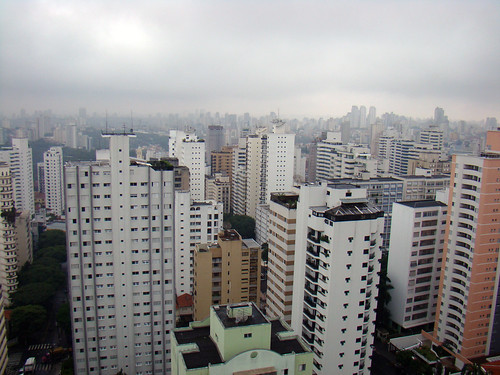
Image Source – Flickr via Rodrigo Soldon (Photo of the Sao Paulo skyline). (CC BY 2.0)
Online Sources- NASDAQ, Bloomberg, ABC News, El Universal
* Honduras: Honduran and international human rights groups alleged that the government’s crackdown on gang violence led to overcrowded prisons including the one where over 350 people died in a fire.
* Latin America: According to a new study China has issued $75 billion in loans to Latin America since 2005; thus, topping financing from the World Bank, Inter-American Development Bank and U.S. Export-Import Bank.
* Brazil: Officials in Rio de Janeiro state reportedly plan to give away over three million condoms during Carnival festivities that begin this week.
* U.S.: A Pew Research Center analysis concluded that Latinos have helped boost the rise in interracial marriages to a record 4.8 million unions.
Video Source – YouTube via Al Jazeera English (The prison in Comayagua, Honduras where a major fire took place this week housed over 800 inmates, more than double its original capacity.) Online Sources- Fox News Latino, CNN, Americas Quarterly Blog, Bloomberg, The Latin Americanist
* Honduras: According to “an internal Honduran government report obtained by The Associated Press” most of the inmates in a Comayagua prison where a major fire took place on Tuesday hadn’t been convicted of any crime.
* Central America: Guatemala’s conservative president, Otto Perez, and El Salvador’s leftist president, Mauricio Funes said that they would consider some form of drug legalization.
* Mexico: Police captured a suspected methamphetamine producer who is also a fugitive in the U.S.
* Cuba: Cuba’s Foreign Minister said that his country would be willing to attend the upcoming Summit of the Americas but rejected the idea of rejoining the Organization of American States.
Video Source – YouTube via euronews (“Body after body has been brought out of the raised Comayagua jail in Honduras after what is now recognized as the world's worst prison fire.”)
Online Sources- The Latin Americanist, CBS News, USA TODAY, BBC News, CNN
In what is being reported as “one of the worst prison fires ever in Latin America,” at least 357 people died after a massive blaze swept through a Comayagua prison on Tuesday night.
Officials including one speaking in the below video said that most of the dead were “burnt, carbonized, or asphyxiated” due to the acrid smoke:
The exact cause of the fire in the prison has yet to be determined though prison service head Daniel Orellana claimed that one hypothesis is that a prisoner set fire to the mattress in his cell. Yet Orellana denied rumors that a riot in the prison occurred before the fire.
Today about 300 inmates’ relatives surrounded the Comayagua prison seeking answers over the state of their loved ones who ether died or are disappeared. Police fired tear gas after some relatives attempted in desperation to break through the prison gates.
“We understand the families’ pain but we have to go through with the process according to the law”, said Security Minister Pompeyo Bonilla to the Honduran press.
A few of the survivors accused the prison guards of not opening all of the cells to permit inmates to flee the fire. These allegations are unproven though Comayagua firefighters' spokesman Josue Garcia noted, “we couldn't get them out because we didn't have the keys and couldn't find the guards who had them.”
The Comayagua prison housed approximately 850 inmates, more than double its original capacity. Overcrowding is one of the worst problems in Latin American prisons including in Honduras according to a recent U.S. State Department report:
Prisoners "suffered from severe overcrowding, malnutrition, and lack of adequate sanitation," it cited human rights groups as saying.
"Authorities did not provide adequate food or other basic necessities. The ready access of prisoners to weapons and other contraband, impunity for inmate attacks against nonviolent prisoners, inmate escapes, and threats by inmates and their associates outside prisons against prison officials and their families contributed to an unstable and dangerous penitentiary system environment," the department said in its 2010 Country Reports on Human Rights Practices.
As we mentioned last week, U.N. human rights representative for South America Amerigo Incalcaterra decried the “alarming pattern of prison violence in the region” due to overcrowding and unsanitary conditions.
Update: According to the Honduran press, the death toll has increased to at least 364 deaths while authorities believe that between eighty and ninety inmates may have escaped amidst the chaos caused by the fire.
In a televised speech this afternoon Honduran president Porfirio Lobo suspended prison officials as part of a "totally transparent" investigation into the fire. Meanwhile, a team from the Inter-American Commission on Human Rights will be dispatched to Honduras in order to conduct their own probe.
Video Source – YouTube via telegraphtv
Online Sources (including Updates) – Milenio, MSNBC, BBC News, CNN, The Latin Americanist, Los Angeles Times, La Prensa, infoBAE.com, Univision.com
* Peru: Hundreds of women forcibly sterilized in the 1990s under a program created by then-President Alberto Fujimori continue to wait for to justice to be served.
* Nicaragua: The head of the central bank quit after a disagreement with President Daniel Ortega over how to pay for a regional bank for the ALBA bloc. * Venezuela: Political opposition groups cried foul after the Supreme Court ruled against the destruction of lists of voters who participated in Sunday’s primary election.
* South America: Chilean president Sebastian Pinera received a “surprise phone call” from British Prime Minister David Cameron and they reportedly discussed the dispute between the U.K. and Argentina over the Falklands.
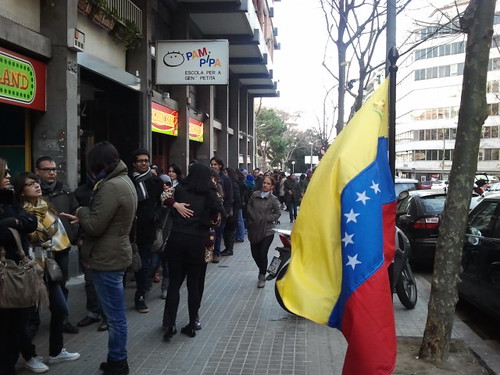
* Venezuela: One day after winning the opposition presidential primary election, Henrique Capriles called on Venezuelans to support his campaign and criticized President Hugo Chavez’ economic policies.
* Mexico: Despite heavy media coverage of the Mexican “drug war” tourism to that country rose in 2011 with over 22 million foreign visitors arriving by air.
* Argentina: The Argentina's transport worker's union will reportedly boycott all British ships due to the dispute over the Falklands Islands.
* Peru: “The Shining Path is no longer a threat to the country,” proclaimed President Ollanta Humala after the rebel’s leader was captured in a military operation.
Image Source – Flickr via Andrea Daza Tapia (Venezuelan expats in Barcelona, Spain wait on line in order to vote in Sunday’s opposition presidential primary election). (CC BY 2.0)
Online Sources- CBS News, Los Angeles Times, BBC News, The Guardian
* Zambia: The Zambian men’s soccer team celebrated their first ever Africa Cup of Nations title by paying their respects to their comrades who died in a 1993 plane crash in Gabon.
* Syria: U.N. human rights chief Navi Pillay accused Syrian officials of committing crimes against humanity as part of their brutal crackdown against civilian protesters.
* Greece: Stocks around the world rose after the Greek parliament approved a controversial austerity plan that was not well received by demonstrators in Athens.
* Middle East: The Israeli and Iranian governments have accused each other of a pair of bomb attacks at Israeli missions in India and Georgia.
Video Source– YouTube via swagsoccer7 Online Sources – CNN, Reuters, ABC News, Bloomberg
The latest edition of the Grammy Awards on Sunday night will most likely be remembered for Adele winning six trophies as well as the tributes to the recently deceased Whitney Houston. In terms of Latino music, one of the event’s biggest surprises was Mana beating out Calle 13 to win in the Latin Pop, Rock or Urban Album category. Yet an even greater surprise could occur later this year thanks to another Grammy winner: Venezuelan conductor Gustavo Dudamel.
Dudamel may’ve won his Grammy with the Los Angeles Philharmonic for their recording of Brahms' Fourth Symphony, but since 1999 he has served as the music director of the Simon Bolivar Youth Orchestra. This orchestra is an important product of El Sistema, a novel music education program run in Venezuela. Founded in 1975 by former economist José Antonio Abreu, the El Sistema network has helped teach classical music to at least 250,000 youth including children from impoverished economic backgrounds. The program has received government support since 1977 and has been critically acclaimed around the world.
In 2008 Abreu won both the Glenn Gould Prize and the Prince of Asturias Award for he Arts. He could earn a greater recognition later this year after representatives of the International Hagiography Academy nominated him for the Nobel Peace Prize. “Master Abreu has met all the conditions because he made music the language of peace and a symbol of Venezuela,” proclaimed the Academy’s president, Monsignor Rafael Febres Cordero, last month.
Should José Antonio Abreu become the first Latin American in two decades to win the Nobel Peace Prize? Perhaps the music from the Simon Bolivar Youth Orchestra will help you decide:
Video Source – YouTube via TEDtalksDirector
Online Sources- Los Angeles Times, The Onion A.V. Club, The Telegraph, El-Nacional.com
* South America: While UN Secretary-General Ban Ki-Moon urged Argentina and Britain to “avoid an escalation” in the dispute over the Falklands, Chilean officials denied “media rumors” claiming that they would consider a blockade of the disputed islands.
* Mexico: According to documents filed in a U.S. court, Mexican drug gangs paid $4.5 million in “political bribes” to figures in the opposition Institutional Revolutionary Party (PRI).
* Brazil: Will France’s Dassault Aviation beat Boeing and Saab and win a major contract to refurbish the Brazilian air force?
* Haiti: A fifteen-member delegation of the U.N. Security Council is expected to arrive today in Haiti in order to observe reconstruction efforts over two years after a deadly earthquake shook the country.
Image Source – Flickr via wallygrom (Falklands War memorial in Ushuaia, Argentina). (CC BY-SA 2.0)
Online Sources- Bernama.com, Reuters, Voice of America, Miami Herald