Today is World Press Freedom Day and, as we mentioned briefly yesterday, Freedom House report found that there is a decline in media freedom throughout Latin America. Several recent incidents in the region appear to prove Freedom House’s assertion.
Mexico
Radio and TV announcer Jose Gerardo Padilla Blanquet has gone missing since Tuesday in Saltillo, the capital of Coahuila state. Padilla Blanquet works for Radio Grande de Coahuila, a radio station whose director was assaulted months ago after receiving numerous threats.
The disappearances come days after photographer Daniel Martinez Bazaldua was murdered and dismembered in Saltillo. An editorial in Vanguardia, the newspaper Martinez Bazaldua worked for, subsequently blasted local authorities for implying that the victims worked for one of Mexico’s drug gangs.
Colombia
Semana reporter Ricardo Calderón was attacked by gunfire while driving on a Colombian highway yesterday. The veteran investigative journalist, who helped uncover an illegal and massive wiretapping operation in 2007, may have been targeted in a possible assassination attempt.
The Colombian International Press Association condemned the attack on Calderón and expressed their worry over “the security of all journalists nationwide, especially those in high conflict zones.”
Argentina
The Argentine Journalism Forum (FOPEA, in Spanish) denounced the firing of tear gas and rubber bullets by police on media members covering a protest one week ago. FOPEA alleged that at least seven journalists were injured while covering the demonstration and authorities prevented some of them from receiving medical attention.
Meanwhile, an editorial in Diario Los Andes yesterday blasted the suggestion of Chaco province governor Jorge Capitanich to enact a “press ethics law” on the same day several newspapers reported money-laundering allegations against him.
Guatemala
The Committee to Protect Journalists (CPJ) yesterday highlighted a series of cyberattacks against the website of major news outlet elPeriódico. According to the CPJ, the hacking had been occurring for the past several months but had intensified after elPeriódico published an April 8th article that “alleged corruption, embezzlement, and abuse of authority by President Otto Pérez Molina and Vice President Roxana Baldetti”.
Latin America
Reporters Without Borders (RWB) issued today its list of thirty-nine “predators of freedom of information” and it includes four figures from Latin America and the Caribbean. The heads of Colombia’s rightwing paramilitaries, Mexico’s Zetas drug gang and Cuban President Raul Castro are among those criticized by RWB.
RWB said the following on Honduran businessman and political figure M. Facussé Barcum as if he were the one mentioning it:
* Latin America: A Freedom House report concluded that there a rise in media controls is partly to blame for a decrease in press freedom throughout Latin America.
* Puerto Rico: Health problems, high unemployment and undetonated explosives are some of the obstacles hurting residents of Vieques ten years since the U.S. military left the island.
* Cuba: Senior U.N. officials urged the U.S. to halt the forced feeding of approximately twenty-one inmates who are on a hunger trike at the Guantanamo detention center.
* Mexico: Legislators passed a government-backed telecommunications reform bill aimed at increasing foreign investment and curbing media monopolies.
Video Source – YouTube via Al Jazeera English Online Sources- Washington Post; ABC News; BBC News; The Guardian
* Ecuador: President Rafael Correa said that he might annul the controversial prison sentence against three former newspaper directors accused of libeling him. (Note: link is in Spanish).
* Honduras: Relatives of some of the 359 inmates who died in a Honduran prison fire last week have called on authorities to confirm a preliminary report claiming that the cause of the blaze was accidental.
* U.S.: A group of Latino student activists supporting the DREAM Act protested outside of the site of last night’s Republican presidential debate in Arizona.
* Bolivia: At least ten people are dead as a state of emergency was issued for parts of the Amazon region hit by heavy flooding.
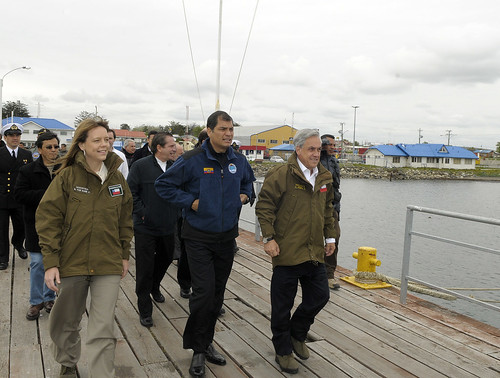
Image Source – Flickr via Gobierno de Chile (Ecuadorian President Rafael Correa, seen here in the dark blue jacket during a 2010 visit to Chile, has come under fire from press rights groups after suing three former newspaper directors for libel). (CC BY 2.0)
Online Sources- El Espectador, Cronkite News, BBC News, The Australian, The Latin Americanist
Note: For the next few days our daily “Today’s Video” posts will examine the freedom of the press in several Latin American and Caribbean countries.
On Tuesday media watchdog group Reporters Without Borders (or RSF based on its French initials) published their tenth annual press freedom index. Unfortunately the rankings decreased for most Latin American and Caribbean states including several countries whose position plummeted in 2011 compared to the previous year.
Chile nosedived by 47 spots and was ranked 80 out of 179 countries on the RSF index. Numerous factors accounted for such a sleep decline according to RSF:
In Chile, where student protesters questioned the over-concentration of media ownership, violence against journalists included beatings, cyber-attacks and attacks on editorial staffs. Many of these assaults, often accompanied by heavy-handed arrests and destruction of equipment, were carried out by abusive armed police who were rarely called to account.
Last week the Chilean government dropped their support of a controversial measure that would’ve permitted police to seize media images without a court order. Dubbed the “Hinzpeter Law” after the Chilean Interior Minister, the plan was decried by media groups and free speech advocates. Mauricio Weibel, president of Chilean Foreign Press Association, reportedly warned that the measure could damage Chile’s image and might be factored in to the RSF’s rankings.
In September 2011 we highlighted the case of an Argentine TV news crew who claimed unknown assailants while covering protests in Santiago attacked them. Less than a month after that, police arrested Chilevision journalist Luis Narváez after his cameraman was bumped into and possibly assaulted by an officer. As the following video shows, Narváez was detained seemingly for no reason despite him showing officers his press card and claiming his innocence:
Unfortunately Narváez wasn’t the only media member apparently targeted by the authorities while covering student protests in early October.
In our next "Today's Video" installment we’ll examine another South American state that plummeted in the latest RSF press freedom index.
Video Source – YouTube via hersome
Online Sources- Reporters Without Borders, IFEX, Washington Post, The Latin Americanist
A recently released Amnesty International report claimed that Latin America is one of the most dangerous regions for journalists. Indeed several incidents over the past month appear to strengthen the human rights group’s conclusion:
Mexico joined Cuba, Venezuela, and Honduras as the only Latin American nations without a "free press" according to Freedom House.
Honduran reporter Francisco Medina became the eleventh journalist killed in that country over the past eighteen months.
Venezuelan journalist and opposition political activist Wilfred Ivan Ojeda Peralta was killed and police found his body with signs of torture.
A trio of suspected gang members shot and murdered Salvadoran TV cameraman Alfredo Hurtado as he rode a bus to work.
Peru’s run for the presidency is a tight and hard-fought affair between leftist Ollanta Humala and conservative Keiko Fujimori. While political tensions increase so have the risks and threats against the local press. The Knight Center for Journalism in the Americas highlighted several examples of aggression against journalists. Perhaps the most hair-raising and worst example can be seen in the video below when funeral wreaths where sent to the offices of the La Primera newspaper:
Both Humala and Fujimori pledged to protect press freedoms if elected to Peru’s highest public office. But if the threats against journalists are any indication those promises will most likely be in vain.
Video Source – La Republica via YouTube Online Sources- CNN, International Press Institute, Canadian Press, CBS News, CSMonitor.com, The Knight Center for Journalism in the Americas, Committee to Protect Journalists
* Latin America: Freedom House deemed that the Mexican press is “not free” due to the dangers the media faces from drug-related violence.
* Puerto Rico: An ACLU delegation accused the Puerto Rican police of brutality during protests against university students upset over a new government-imposed fee.
* Venezuela: Could Miranda state Gov. Henrique Capriles launch a serious challenge against President Hugo Chavez in next February’s elections?
* U.S.: Dominican-born pitcher Francisco Liriano hurled the first no-hitter in the major leagues this season in a 1-0 Minnesota Twins 1-0 victory over the Chicago White Sox.
Image – AP via MSNBC (“A protester carries as sign saying "Not one more of our young men!" as people march in a protest against violence in Mexico City” last month.) Online Sources- CSMonitor.com, MSNBC, Voice of America, Los Angeles Times
* Latin America: Freedom for the media in most Latin American countries including Colombia, Honduras, Mexico, and Venezuela has unfortunately worsened according to Reporters Without Borders.
* Mexico: Good luck to the new police chief of the northern border town of Praxedis G. Guerrero – a 20-year-old student “whose only (prior) police experience was a stint as a department secretary.”
* Brazil: The latest polls in the Brazilian presidential race showed that ruling party candidate Dilma Rousseff has rebounded against rival Jose Serra.
* Cuba: President Barack Obama said that he would be willing to continue the thaw in U.S.-Cuba relations yet warned, “we want to see that the Castro regime is serious about different ways to deal with the situation". Image – Christian Science Monitor ("Members of the press protest violence against journalists in Mexico City, on Aug. 7. Marco Ugarte/AP/File”) Online Sources- Knight Center for Journalism in the Americas, NPR, LAHT, Reuters
Representatives from the U.N. and Organization of American States have warned against the dangers the Mexican press faces on a daily basis.
Representatives from both organizations concluded a two-week tour of Mexico including Ciudad Juarez in order to investigate violence against journalists. Frank La Rue of the U.N. and Catalina Botero of the OAS met with government officials, NGO representatives, and members of the media during their investigation. The pair concluded that organized crime is the primary threat against the media and even claimed that Mexico is the riskiest country for journalists.
La Rue and Botero also urged the government to take a more active role in helping the press such as creating a “high-level body” to investigate threats and harassment. "Due to the serious situation facing freedom of expression and journalists in the country, it is urgent that the Mexican government adopt a comprehensive policy of prevention, protection and law enforcement," according to a preliminary report.
According to a the Center for Journalism and Public Ethics study there were “documented aggressions against 183 journalists and 19 media organizations for reasons connected to their work” in 2009. In July police freed two cameramen who were kidnapped while investigating possible corruption while an explosive was detonated weeks ago outside the Monterrey headquarters of media giant Televisa. It should come as no surprise then that a coalition of media groups and labor unions united this month to call for an end to the “atmosphere of affronts and violence” against the Mexican press.
Image- AFP (“A Mexican Federal police officer takes care of Televisa cameraman Alejandro Hernandez Pacheco after his rescue” in July). Online Sources- The Latin Americanist, BBC News, AP, LAHT, Laredo Sun
In commemoration of World Press Freedom Day watchdog group Reporters Without Borders (RSF) identified forty global “predators” who are dangers against the media. "These predators of press freedom have the power to censor, imprison, kidnap, torture and, in the worst cases, murder journalists" according to an RSF statement. RSF named to its list of shame leaders such as China's Hu Jintao and Russian Prime Minister Vladimir Putin as well as criminal organizations like the Italian mafia and Spain’s ETA.
The Americas were not spared of RSF’s anger; Cuban president Raul Castro “has behaved little better than his brother as regards human rights”. Mexican drug gangs were also blacklisted as RSF deemed Mexico as the “most dangerous country for journalists”. Further south, RSF signaled Colombia’s armed groups with threatening the country’s media:
According to RSF, The Black Eagles a paramilitary structure that "continues to spread terror, forcing journalists to self-censorship or exile, when they resort to murder"…
"The death threats directed at journalists, well-known and sometimes at odds with the government of Alvaro Uribe, often bear the signature of the Black Eagles," the group adds.
Regarding the FARC, the organization made the list of "predators" for several reasons including being “behind the abduction of fifty journalists since 1997 and (for making) it practically impossible to work the press in the regions they control. " – [ed. Translated text]
Image- Time (“Monterrey police investigating a 2009 attack on the local offices of Televisa). Online Sources- AP, Semana.com, BBC News, Reporters Without Borders, New York Daily News
One group of victims in an increasingly violent Mexico is journalists. The death of Bradley Will in Oaxaca two years ago comes to mind though those killed are mostly locals like “top crime reporter” Armando Rodriguez who was gunned down last month. Is it any wonder that in 2007 Reporters Without Borders named Mexico the second-most dangerous country in the world for journalists?
Thus, it’s disheartening to read that some Mexican officials are trying to sugar-coat such a dangerous situation for journalists:
Only three of 25 reporters who died violently in the last two years in Mexico were killed because of their work, the country's special prosecutor for crimes against journalists said Tuesday.
Octavio Orellana said most of the reporters who died were bystanders in attacks against other people, were killed in accidents or committed suicide. He said several victims who worked with media outlets were not reporters.
The motives behind most reporters' deaths "are similar to what affects the rest of Mexicans," Orellana added, referring to sharply increased murder rates across the country.
The reaction from the Committee to Protect Journalists was to justifiable blast Orellana for “cherry-picking statistics” rather than effectively combating those who target journalists.
While Orellana feels it’s his duty to be a lame spinmeister, Mexican journalists and their families continue to live in fear of threats and being killed. Just ask Rodriguez’ 8-year-old daughter who sat with her dad as he was riddled with bullets.
Image- washingtonpost.com (“Police technicians tend to the body of journalist Armando Rodriguez after he was shot outside his home in Ciudad Juarez, across the border from El Paso.”) Sources- Committee to Protect Journalists, csmonitor.com, AFP, Gothamist, AP
The freedom of press in numerous Latin American countries is “under threat”, according to the Inter-American Press Association (IAPA).The IAPA conference cited the governments of Cuba and Venezuela for detaining journalists and increasing restrictions against the press, respectively.Yet the IAPA also highlighted other countries for not ensuring full liberties to the media:
The IAPA statement singled out the United States for trying to erode a reporter's right to source confidentiality, noting court "cases where federal judges force journalists to reveal their sources and impose heavy fines on them." The IAPA meeting also issued a resolution against the growing number of unsolved murders and kidnappings of journalists in Argentina, Honduras, Haiti, Mexico and Colombia, whose governments it urged to investigate "quickly and thoroughly."
The IAPA conference was in the Venezuelan capital of Caracas where a parallel forum was also held denouncing the supposed conspiracy between regional media and “the corporate elite.”
Sources- BBC News, International Herald Tribune, caribbeannetnews.com, Voice of America
“As the official slogan, ‘Build power from below’, proclaims, their stated purpose is to promote grass-roots democracy and hand power directly to the people - in particular the urban poor who make up the bulk of his most fervent supporters.
But as well as grappling with the grim conditions in slums such as Catia, members of these voluntary groups will constitute a nationwide militia, schooled in Cuban-style tactics for both guerrilla warfare and counter-insurgency".
The article went on to cite an advisor to Chavez who admitted that “some communal groups have already received military training” as well as a local opposition politician who said that the government was denying anti-Chavez groups from being part of the communal councils.