Showing posts with label Oscar Arias. Show all posts
Showing posts with label Oscar Arias. Show all posts
Tuesday, April 2, 2013
Former Costa Rican President Applauds U.N. Arms Treaty Vote
Ex-Costa Rican President Óscar Arias praised the U.N. General Assembly after it overwhelmingly approved a treaty aimed at controlling the global trade in conventional weapons.
“It’s the history of a dream behind wanting to regulate international arms trade,” said the Nobel laureate according to the website for Costa Rican daily El Financiero.
“I’m very moved by the vote because I never expected the U.S. to back the agreement while I was still alive,” added Arias who ha campaigned for comprehensive global arms treaty for the past sixteen years.
Arias also praised his country’s diplomatic team for their efforts over the past seven years to help formulate the Arms Trade Treaty (ATT) and obtain such a strong vote of confidence at the U.N.
“The treaty is the greatest contribution by Costa Rica to humankind in its entire history. It’s a triumph of the moral authority held by this small country,” said Arias.
Several Latin American states including Argentina, Mexico and Colombia helped Costa Rica to push the pact that had stalled numerous times including as recently as last week. (See embedded video above).
Syria, Iran and North Korea were the only countries to vote against the ATT in Tuesday’s vote while 154 member states including most Western Hemispheric nations approved the pact.
Among the twenty-three countries that abstained from the vote were five countries belonging to the Bolivarian Alliance for the Americas bloc: Bolivia, Cuba, Ecuador, Nicaragua and Venezuela.
Cuban representative Rodolfo Reyes Rodriguez said his country would abstain since the final version of the ATT had “serous limitations…and multiple ambiguities and legal gaps.” Nevertheless, Costa Rica's Eduardo Ulibarri said that the agreement was a fair compromise that demonstrates that the U.N. is “able to address the most serious and complex global challenges.”

Saturday, November 27, 2010
Weekend Headlines: November 27-28, 2010
* Brazil: Police have allegedly surrounded a group of drug traffickers in a Rio de Janeiro favela after nearly one week of intense fighting and violence.
* Mexico: Did kidnappers safely release former presidential candidate Diego Fernandez de Cevallos as a Mexican newspaper claimed this morning?
* Latin America: Ecuador and Colombia agreed to reestablish diplomatic ties after two years of broken relations due to a controversial military raid on a guerilla camp.
* Haiti: The country’s presidential campaigns head into the homestretch amid reports of violence and mounting tensions.
* Costa Rica: Ex-president Oscar Arias may have to stand trial over alleged irregularities in a major mine concession.
* South America: England’s bid to host the 2018 World Cup may’ve suffered a heavy blow after South America’s soccer federation publicly backed the joint bid from Spain and Portugal.
Video Source – BBC News via YouTube
Online Sources- BBC News, MSNBC, Voice of America, Insidecostarica.com, ESPN Soccernet, CNN
Thursday, April 8, 2010
Daily Headlines: April 8, 2010
 * Costa Rica: President Oscar Arias reportedly commented that the Catholic Church should drop forcing priests to vows of celibacy and also advocated marriages for same-sex couples.
* Latin America: Chinese President Hu Jintao will visit Brazil, Chile and Venezuela later this month in order to strengthen political and economic ties to Latin America.
* Peru: U.S. authorities returned 25 “irreplaceable” pre-Columbian items to Peru including Inca-era ceramics and decorative skulls.
* Dominican Republic: At least fourteen people have died due to dengue fever according to health officials who also warned that there may be more dengue cases this year than 2009’s 8,800.
Image – BBC News
Online Sources- UPI, AP, LAHT, Xinhua
Monday, February 8, 2010
New Presidenta for Costa Rica
 Kudos to Costa Rica and president-elect Laura Chinchilla. Chinchilla pulled 47% of the vote Sunday to become the first female in Costa Rican history to be elected president.
Chinchilla fought off claims (and an amusing attack ad) that suggested she would be a puppet for outgoing president Oscar Arias.
Chinchilla will join Cristina Fernandez de Kirchner in the club of currently-serving female heads of state in the region, but Chincilla probably hopes her time in office more closely resembles that of outgoing Chilean president Michelle Bachelet instead of her Argentine counterpart.
Image Source: KPA/Zuma/Rex Features
Online Sources: NY Times, CNN, The Guardian
Monday, August 31, 2009
Daily Headlines: August 31, 2009
 * Mexico: Another day, another case of a disabled U.S. citizen getting inadvertently deported to Mexico.
* Latin America: Colombian president Alvaro Uribe joins his Costa Rican counterpart Oscar Arias as the latest regional leader to get the swine flu.
* Puerto Rico: How bad is Puerto Rico’s economy? The pay gap between the island and the rest of the U.S. has nearly doubled according to recent figures.
* Chile: First swine flu was recently found in Chilean turkeys and now nearly 1000 sea lion pups were found dead off the country’s northern coast.
Image- MSNBC (“A youth stands in the gates at the U.S.-Mexico border in late May awaiting his deportation at the San Ysidro port of entry in Tijuana, Mexico.”)
Online Sources- New York Times, UPI, BBC News, LAHT, AHN, Bloomberg
Wednesday, August 12, 2009
Daily Headlines: August 12, 2009
 * Costa Rica: President Oscar Arias suspended his public duties yet will remain in office after doctors diagnosed him with the swine flu.
* Haiti: Immigration and community activists are campaigning to allow a pair of detained Haitians to be given permission to bury their recently-deceased eight-month-old daughter.
* Venezuela: Russia continues forging stronger ties to Venezuela by promising to use the “most modern oil extraction and processing technology” if it’s allowed to work in the oil-rich Orinoco belt.
* Colombia: A court in Thailand rejected the U.S.’ extradition request of a Russian man accused of selling weapons to Colombia’s FARC guerillas.
Image- PRESS TV
Online Sources- Reuters, South Florida Sun-Sentinel, AFP, BBC News
Saturday, July 25, 2009
Manuel Zelaya to cross into Honduras again?
Deposed Honduran president Manuel Zelaya might attempt to cross into his home country from neighboring Nicaragua.
At the time of this post, Zelaya is only a few hundred yards from the Honduras-Nicaragua border and may cross it sometime today. According to comments made by his wife to CNN en Español, Zelaya’s wife said that he will try to meet with her and other family members on the Honduran side of the border.
While speaking to reporters and supporters, Zelaya said claimed that the Honduran “military will not allow me to see my family.” “Fuera Micheletti!” Zelaya declared referring to interim president Roberto Micheletti as Zelaya affirmed that he was the legitimate leader of Honduras. Zelaya added that he will stay in the border area today though he didn’t confirm when he would attempt to cross the border again.
Yesterday Zelaya stepped very briefly on Honduran soil in an act of defiance against the acting regime:
During his 30-minute stop in Honduras, Zelaya said that his act was a "symbolic entry" though he returned to Nicaragua in order to avoid “becoming the cause of violence”. Despite an order of arrest against him issued by the de facto government, Zelaya was not arrested and subsequently spent the evening in the Nicaraguan border town of Las Manos.
Despite their opposition to the Micheletti regime, the U.S. State Department and the Organization of American States criticized Zelaya’s border crossing. “President Zelaya's effort to reach the border is reckless," said U.S. Secretary of State Hillary Clinton while OAS head Jose Miguel Insulza urged Zelaya and Micheletti to return to the negotiating table. (Three rounds of discussions mediated by Costa Rican president Oscar Arias failed after both sides refused to reach a compromise). Micheletti also criticized Zelaya’s move which he dismissed as a “publicity stunt.”
Hondurans continue to be split over whether to back Zelaya or Micheletti. Thousands of Zelaya supporters in the border town of Las Manos faced tear gas shots from the military yesterday when they reportedly got to close to the border. At nearly the same time, thousands of Micheletti backers rallied in San Pedro Sula and called for Zelaya to be arrested.
Online Sources- Xinhua, YouTube, Reuters, ABC Online, BBC News, Los Angeles Times, AFP, CNN
At the time of this post, Zelaya is only a few hundred yards from the Honduras-Nicaragua border and may cross it sometime today. According to comments made by his wife to CNN en Español, Zelaya’s wife said that he will try to meet with her and other family members on the Honduran side of the border.
While speaking to reporters and supporters, Zelaya said claimed that the Honduran “military will not allow me to see my family.” “Fuera Micheletti!” Zelaya declared referring to interim president Roberto Micheletti as Zelaya affirmed that he was the legitimate leader of Honduras. Zelaya added that he will stay in the border area today though he didn’t confirm when he would attempt to cross the border again.
Yesterday Zelaya stepped very briefly on Honduran soil in an act of defiance against the acting regime:
During his 30-minute stop in Honduras, Zelaya said that his act was a "symbolic entry" though he returned to Nicaragua in order to avoid “becoming the cause of violence”. Despite an order of arrest against him issued by the de facto government, Zelaya was not arrested and subsequently spent the evening in the Nicaraguan border town of Las Manos.
Despite their opposition to the Micheletti regime, the U.S. State Department and the Organization of American States criticized Zelaya’s border crossing. “President Zelaya's effort to reach the border is reckless," said U.S. Secretary of State Hillary Clinton while OAS head Jose Miguel Insulza urged Zelaya and Micheletti to return to the negotiating table. (Three rounds of discussions mediated by Costa Rican president Oscar Arias failed after both sides refused to reach a compromise). Micheletti also criticized Zelaya’s move which he dismissed as a “publicity stunt.”
Hondurans continue to be split over whether to back Zelaya or Micheletti. Thousands of Zelaya supporters in the border town of Las Manos faced tear gas shots from the military yesterday when they reportedly got to close to the border. At nearly the same time, thousands of Micheletti backers rallied in San Pedro Sula and called for Zelaya to be arrested.
Online Sources- Xinhua, YouTube, Reuters, ABC Online, BBC News, Los Angeles Times, AFP, CNN
Thursday, July 23, 2009
The Economist: Honduran leaders should back compromise
 For the most part, The Economist is a conservative-leaning publication and it has been critical of leftist Latin American leaders from Venezuela’s Hugo Chavez to the more moderate Michelle Bachelet of Chile. Yet their occasions when the newsmagazine attacks those who it sees as dangerous to democracy like its criticism of rightist Colombian president Alvaro Uribe’s possible bid for a third term.
The British publication gave its two cents today on the political crisis in Honduras. It blasted elected president Manuel Zelaya for his “many faults” before being deposed and warned that he has “unhelpfully called on his supporters to stage an ‘insurrection’”. The article even took a shot at regional boogeyman Chavez who it claimed was “egging” Zelaya’s desire to “reverse the coup through violence.”
Yet The Economist also ripped claims by Republicans that Zelaya was legally deposed and that it’s best for Honduras to stay in “deadlock” until elections in November. “This argument is short-sighted and wrong...Coups are bad whatever the political color of their victims” according to the article.
The magazine also called for both Zelaya and interim president Roberto Micheletti to accept Costa Rican president Oscar Arias’ latest proposal. Arias’ “proposal is sensible” and the article criticized both leaders (especially Micheletti) for their reluctance to accept the compromise.
The article concluded with a call for the U.S. to either place sanctions on the Micheletti regime or (if it’s accepted) ensure that Arias’ plan is executed. Other countries in the region could also help:
Brazil and others could help too—by pushing Mr. Zelaya to be patient, accept the Arias plan and distance himself from the likes of Mr. Chávez and Cuba’s Raúl Castro, whose commitment to democracy ranges from dubious to non-existent. Mr. Micheletti is right that democracy can be undermined by autocratic presidents. But this caveat should not cloud the central issue: a coup in a region which has shed authoritarianism should not be allowed to stand.Arias’ latest proposal will not satisfy all of Zelaya’s or Micheletti’s demands but it’s the best alternative so far to plunging Honduras into an avoidable civil war. Hopefully cooler heads will prevail and prevent conflict from tearing apart that Central American country.
Image- BBC News
Online Sources- The Economist, Miami Herald, The Latin Americanist
Wednesday, July 22, 2009
Hope for Honduras with renewed talks
 Could three times by the charm to avoid civil war in Honduras? That is the hope as representatives of both men claiming to be Honduras’ president spoke for the third time this month.
Costa Rican president Oscar Arias talked with emissaries representing ousted President Manuel Zelaya and de facto president Roberto Micheletti. Arias offered an 11-point compromise that was not significantly different from the seven-point plan he presented in the previous round of talks. The new proposal- which includes reinstating Zelaya, creating a unity government, and holding early elections- was more “balanced” according to Arias. Unlike Arias’ plan over the weekend, the Micheletti camp did not outright refuse the new compromise and said it would send the proposal to Congress and the judiciary.
Arias’ intervention could very well be the final effort in seeking a negotiated end to the coup that deposed Zelaya on June 28th. The Nobel Peace Prize winner said that he would defer mediation to the Organization of American States if his latest plan is rejected.
Daily protests continue in Honduras for and against Zelaya; supporters of the ousted leader organized blockades today and are planning a national strike starting tomorrow. Backers of Micheletti took to the streets today denouncing the international press and claiming that a coup did not occur.
Image- AFP (“A supporter of ousted Honduran President Manuel Zelaya in Tegucigalpa.”)
Online Sources- The Latin Americanist, The Telegraph, Reuters, Miami Herald, Bloomberg, BBC News
Monday, July 20, 2009
Arias' 7-point plan for Honduras
 It's hard to know whether the weekend's second-round talks on Honduras' crisis, which produced the Arias-backed "7-point plan" for ousted President Manuel Zelaya's return to the Honduran presidency, should be considered progress or a setback. Given the nature of the hostilities and intransigence on both sides thus far, I'm inclined to call it progress.
Despite the interim government's declaration that the second-round of negotiations in San Jose had "failed" and Zelaya's announcement that he would soon seek "alternative means" for his own return, the production of a somewhat concrete plan of action -- even if neither side has fully endorsed it yet -- is a step forward.
The consistently thoughtful Honduras Coup 2009 blog has prepared a translation of the seven point plan and some good analysis on its feasibility. Boz has also put together a compelling analysis of the interim government's rationale for still holding back.
I'd be interested in hearing opinions on the merits of this plan, the first concrete and ostensibly unbiased proposal for next steps for Honduras that we've seen since June 28.
Sources: New York Times, AP, La Tribuna, El Heraldo, Honduras Coup 2000 blog
Saturday, July 18, 2009
Weekend Headlines: July 18, 2009
 * Honduras: Costa Rican President Oscar Arias is hosting a second round of negotiations with the hope of finding a peaceful solution to the quagmire in Honduras.
* U.S.: Eridania Rodriguez’ body was buried in her native Dominican Republic while New York City police arrested a man accused of killing her in the office building where she worked.
* Mexico: Police nabbed two people suspected in the shocking kidnap and murder of a 14-year-old boy last year.
* Venezuela: A former defense minister as been charged for his supposed role in the 1989 Caracazo riots that left over 3000 dead.
Image- AFP (“Soldiers are deployed as supporters of ousted Honduran President Manuel Zelaya block the Inter-American highway.”)
Online Sources- BBC News, LAHT, New York Daily News
Tuesday, July 14, 2009
U.S., Costa Rica urges mediation in Honduras crisis
 Diplomats in the U.S. and Costa Rica have called on rival sides in Honduras to enter a new chapter of negotiations.
Both elected Honduran president Manuel Zelaya and de facto leader Roberto Micheletti need to be "patient" and renew discussions, said Costa Rican President Oscar Arias. Even though talks last week between the rival heads failed to reach a breakthrough, chief negotiator Arias emphasized that “it is not easy to get results in 24 hours."
The U.S. State Department agreed with Arias in remarks made by a spokesman today. "All parties in the talks should give this process some time. Don't set any artificial deadlines," Ian Kelly told reporters.
Arias and Kelly spoke out after Zelaya threatened Micheletti with an ultimatum yesterday: should future talks not restore him to power he “will proceed with other measures.” At the time he did not elaborate on the alternatives though he said today that Hondurans "have the right to insurrection" against the interim government.
Meanwhile, the mainstream press has been accused of falsifying the results of a recent poll to show that most Hondurans backed the June 27th coup against Zelaya. The Christian Science Monitor claimed that is not necessarily the case:
Did we get it wrong?Image- BBC News
Yes, and no. We inadvertently got only half of the survey, according to the only blogger (bloggingsbyboz.com) who seems to have figured out what happened.
Apparently, CID-Gallup asked two related questions in the poll…
The first question: Was President Zelaya removal justified? Forty-one percent of those surveyed said that the removal was justified, while 28 percent disagreed. Thirty-one percent did not know or did not answer.
La Prensa published only this first question and these figures. So did The Christian Science Monitor and various other outlets.
The second question in the poll was: Did those surveyed agree with the actions to remove him? This time, 46 percent said they disagreed, and 41 percent agreed. Some news organizations, such as the New York Times, published these figures.
Online Sources- Christian Science Monitor, BBC News, The Latin Americanist, Reuters, AFP, CBC, Huffington Post
Thursday, December 25, 2008
Daily Headlines: December 25, 2008
 * Vatican City: Good thing - Pope Benedict XVI’s Christmas Midnight Mass highlighted the abuses faced by children around the world.
Bad thing – The Pope gave a speech on Monday blasting gays and compared the defense of heterosexuality to “saving rain forests from destruction.”
* Costa Rica: President Oscar Arias suggested that business execs should give up their salaries in order to improve the nation's economy.
* Ecuador: Foreign Minister Fander Falconi said that Colombia must satisfy “minimum demands requested by Ecuador” in order for bilateral diplomatic ties to be reestablished.
* Argentina: Former president and current presidential hubby Nestor Kirchner is being investigated on alleged corruption charges.
Image- CNN (Pope Benedict XVI blessed several children during Christmas Midnight Mass.)
Online Sources- Xinhua, BBC News, AHN, AP
Thursday, December 4, 2008
SICA Presidents gather in Honduras tomorrow
 Tomorrow, the presidents of the 8 member countries of the Central American Integration System (SICA) will gather in San Pedro Sula, Honduras' "second city" and industrial center for the XXXIII SICA summit and to follow up their October 4th emergency meeting in response to the global financial crisis, held in Tegucigalpa.
Perhaps in response to the criticism of the October 4th meeting that the agreements made therein were broad and toothless, the agenda for tomorrow's summit features presentations by each president on the concrete actions being taken to shield their respective economies from the pangs of the global financial crisis.
Today, off-site technical meetings are being held with foreign and finance ministers from each country. Tomorrow's meeting with the presidents will be held at the exclusive Honduran-Arab Club.
According to press reports, a ceremony has been planned tomorrow for Honduran President Manuel Zelaya to be turn over the role of "President Pro Tempore" of the SICA to Nicaraguan President Daniel Ortega, a position he will hold through summer 2009.
Reports also confirm that the only president that will not be present is Costa Rica's Oscar Arias, who is currently travelling through Asia to negotiate possible bilateral trade deals.
Can Central Americans expect much from these meetings? Perhaps they shouldn't hold their breath through the weekend, and like anywhere else, things will still probably get worse before they get better. Nonetheless, the individual presentations on each country's response to the crisis is both a promising follow-up to the vagaries pronounced 2 months ago, and a good chance for the region's leaders to get a broad sense of the measures being taken in the region and the menu of options available to them. Hopefully, it will translate to more concrete pronouncements for which citizens can hold their leaders accountable to move on.
Sources: El Heraldo, La Prensa, El Informador, Inside Costa Rica, Associated Press
Thursday, November 13, 2008
Costa Rica Joins CAFTA
 From Tuesday's USA Today:
"Ending a four-year tussle, Costa Rican lawmakers today cleared the way for the U.S.-Central America trade deal to take effect Jan 1. In 2004 Costa Rica signed the pact along with its neighbors, the Dominican Republic and the United States. Opponents had stalled implementation of CAFTA until today, when laws governing intellectual property were approved, the AP reports."
Finally, the DR-CAFTA plan is complete! Muhahaha... huh? Oh, right:
From Tuesday's Xinhua News Service:
"Costa Rican President Oscar Arias Sanchez has praised his country's relations with China, saying the upcoming visit to Costa Rica by President Hu Jintao would be "historic." The visit is of great "importance" as the two countries have great potentials to further enhance their bilateral ties, Arias told Xinhua in a recent interview... Led by rapid growth in trade with China, Costa Rica's trade with Asia registered a strong surge in the following years."
Oh well, Uncle Sam; you win some, you lose some.
In all seriousness, despite the hand-wringing Costa Rica's legislature went through, both these newly strengthened trading partners and a little healthy competition may help bring Costa Rica's lagging economy to the next level, and with a hefty 57% approval rating (among the best in today's skeptical region), it seems to me that President Arias continues to navigate murky diplomatic waters with relative skill and popular support.
Thursday, October 23, 2008
Daily Headlines: October 23, 2008
 * U.S.: Opening statements began yesterday in the retrial of a Border Patrol agent who shot and killed a Mexican migrant.
* U.S.: Authorities including immigration officers conducted several raids in California targeting alleged members of the MS-13 gang.
* Puerto Rico: Officials have allowed thousands of visually impaired voters to vote by telephone for next month’s local elections.
* Costa Rica: Investigators are checking if President Oscar Arias abused his authority in granting permission for the Crucitas gold mine project.
Image- Boise Guardian
Sources- IHT, AFP, KCBS, Guardian UK
Monday, October 6, 2008
Central American presidents gather in Honduras
 Presidents Oscar Arias, Alvaro Colom, Daniel Ortega, Antonio Saca, and Manuel Zelaya gathered on Saturday in Tegucigalpa, Honduras for a special summit of the Central American Integration System (SICA). Presidential envoys from Panama, Belize and the Dominican Republic attended, as well.
The summit was designed to forge a regional response to pending issues of mutual import, such as fiscal responses to the US economic crisis, integration efforts to increase intra-regional commerce, and new alliances with international actors aside from the economically-shaken US.
The meeting of presidents, which followed a technical meeting of ministers and experts on Friday, resulted in a special declaration, signed by each of the heads of state, which stipulated 7 main agreements:
1) Defend and strengthen intra-regional commerce, which is currently on the rise
2) Seek concrete mechanisms through the SICA and national economic ministries to support continued growth in intra-regional commerce.
3) Urge the SICA's banking entity (BCIE) to extend credit lines of up to $200 million to national central banks, as well as the same amount to private lenders, in order to combat the negative effects of the international economic crisis, as well as the onset food security crisis.
4) Urge the SICA to continue its push for increased regional integration where possible in order to shore up individual / national vulnerabilities.
5) Encourage the SICA's council of ministers to design a regional plan (in the next month) that will help mitigate the effects of the international economic crisis on the region's employment rate, agricultural production, and overall economic productivity.
6) Seek concrete mechanisms for national ministers to stimulate agricultural production and social and public investment in social and economic programs.
7) Encourage the SICA's council of ministers to seek alliances with countries in thee South, Asia, and the Caribbean.
Popular reaction to the meetings was mixed; some officials noted that the summit represented a concerted and solid first step towards a regional response, while others considered the meeting and its resolution devoid of any substantial or action-oriented measure.
Popular reaction to the meetings was mixed; some officials noted that the summit represented a concerted and solid first step towards a regional response, while others considered the meeting and its resolution devoid of any substantial or action-oriented measure.
Sources: El Heraldo, AFP, Prensa Latina, Xinhua Net, Sica.int
Monday, August 25, 2008
State of the debate: education
 A good deal of reflection on the failings of Latin American primary and secondary school systems has been seen in the press, in both languages, over the past few months. This may be in part due to the recent SERCE study's revelation that most most children in the region (with the exception of Cuba) are failing to learn at adequate levels, and it most certainly has to do with a number of elections (both national and regional) coming up in late 2008 and early 2009. "Education in Latin America," of course, is a fragmented theme in and of itself; comparing Chile to to Paraguay or Argentina to Honduras is increasingly irrelevant.
That said, and with no promise of coherency, what follows are some musings on the state of the education debate across the region. If anyone is reading, I'd love to hear some comments or reactions....
To me, what is perhaps most noteworthy of the current debates on education is that the regional debates seem to have taken a marked shift from rebukes and lamentation to action-oriented discussion on progress.
For one, more and better press coverage is apparent, too. Several newspapers cover the issue of "quality" in education with more regularity, as opposed to just the usual fare of teacher strikes and low investment. Some (though very few) papers have added "education" sections. Honduras, for example, has even created a nearly 24/7 channel devoted to issues on education (albeit paid for by the government). All in all, coverage is not great, but it's moving upward.
Sec0nd, some countries are taking action. Andres Oppenheimer, of the Miami Herald, wrote an Op-Ed yesterday praising the Mexican government for reacting to the dismal performance of schools by signing the unprecedented "Alliance for the Quality of Education" with the powerful teachers' union (regionally, only Chile, and arguably El Salvador's Plan 2021, have accomplished quality-based agreements on a similar scale). Most agree that the Mexico agreement is a political win for President Calderon, but the results will be watched closely in order to gauge whether it catalyzes real progress or not.
Another key question currently up for debate is whether the poorest countries of the region have the resources and poltical will to fix their own education systems. Last week, Costa Rican President Oscar Arias wrote a scathing Op-Ed in the Washington Post, arguing that education (among other social services) need the help of the US. My own response is to agree with the need for better / more relevant US aid, though I also believe that education must first become a priority of the countries themselves (the US wouldn't be much help in that cause, anyhow). Nicaragua, on the other hand, has largely done this with its education policy (with the exception of Cuban teacher trainers), but has done so less with the focus on improving quality, and more on seeking to reduce "neoliberal" influence on their schools. In my view, this is unliekly to make the needed difference, either - especially if it's only sustained for another 2 years of Sandisita government.
Anyhow, how the US will change it's aid system to better assist the needs of Latin America's poor will be an important question for the upcoming US presidential debates - though sadly, one that will not likely get much airtime.
In the meantime, it will be just as interesting to see how the national debates on education reform continue to take shape, and whether they will cause bolder actions, make significant investments in their own systems, or continue to do more of the same.
Monday, August 18, 2008
Daily Headlines: August 18, 2008
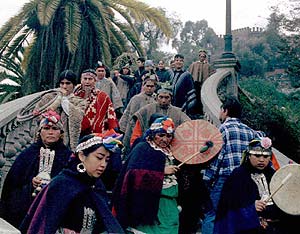
* Chile: Have Chilean authorities unfairly harassed foreign documentary filmmakers researching the indigenous Mapuche community?
* Latin America: “It is high time for the United States to redefine its approach to regional aid, not merely in the name of friendship but also in its own interest,” said Costa Rican president Oscar Arias in a must-read op/ed piece from the Washington Post.
* Paraguay: After meeting with newly-inaugurated leader Fernando Lugo, Venezuelan president Hugo Chavez promised to provide Paraguay “with all the oil it needs, right to the last drop”.
* Panama: A U.S.-led military exercise involving several countries of the region focused on defending the Panama Canal “from an attack by a fictional terrorist group bent on damaging the world economy.”
Image- elmundo.es
Sources- Upside Down World, Washington Post, Reuters, The Latin Americanist, Reuters UK
Wednesday, July 11, 2007
Mel Gibson meets Oscar Arias over possible donation
 Mel Gibson took time away from yelling at Central American studies professors to meet with Costa Rican president Oscar Arias on Monday (image). Gibson- whose previous experience with Central America also includes the 2006 film Apocalypto- discussed a possible financial pledge to Costa Rican natives and told reporters that he brought a house on the country's Pacific coast.
Last word on the story goes to celeb blog Defamer:
“We imagine Gibson's new Costa Rican neighbors will be eager to pitch projects to the high-profile resident and benefactor. Still, aspiring local screenwriters may be disappointed to learn…that the last thing Gibson is interested in exploring is "a native Costa Rican take on What Women Want," having his heart set instead on a 9-page treatment outlining a 90-minute, real-time flaying to death of a single Indian by Spanish Conquistadors.”
Sources- Defamer, The Latin Americanist, IMDB, MSNBC
Subscribe to:
Comments (Atom)