Saturday, May 5, 2007

Cinco de Mayo: The Battle of Puebla and more

This Saturday is the Mexican holiday of Cinco de Mayo, but unlike popular belief it does not celebrate Mexico’s independence. (That would be on September 16th). Beer adverts aside, Cinco de Mayo commemorates the Battle of Puebla in 1862 when Mexican forces beat the French military in the city of Puebla. (Mexico had been under French control from 1862 to 1867).

There have been a number of key military battles over the past two centuries that took place in the Americas that are still remembered. Here are some of them (with the help of Wikipedia):

* Battle of Crête-à-Pierrot (1802) - One of the first major battles in the Haitian Revolution. Though the French would win the battle, Haitian rebels ultimately prevailed after the French suffered massive losses.

* Battle of Chacabuco (1817) - Despite being outnumbered by nearly a 3:1 margin, Jose de San Martin and Bernardo O’Higgins led Chilean forces against the Spanish in this battle fought just outside Santiago.

* Battle of Boyacá (1819) - El Libertador Simón Bolivar commanded about 3000 soldiers including “a small British Legion” in this battle which would assure independence for Nueva Granada.

* Battle of Ayacucho (1824) - This was the decisive battle for Peru’s independence; as a result of the Independence army’s victory, Spanish forces agreed to leave Peru.

* Battle of Cerro Corá (1870) - The final battle in the brutal War of the Triple Alliance which would lead to Brazilian occupation of Paraguay for several years.

* Battle of Celaya (1915) - “The single bloodiest battle of the Mexican Revolution” which led to the beginning of the end for Pancho Villa’s forces.

* Battle of Carrizal (1916) - Battle between U.S. Expeditionary Forces and Pancho Villa’s troops nearly led to a war between Mexico and their northern neighbors.

* Battle of Yaguajay (1958) - A turning point in the Cuban revolution; the battle was won by rebel forces led by Fidel Castro and would soon lead to the end of Fulgencio Batista’s rule in Cuba.

Links- Wikipedia, National Geographic, Mexidata.info, PBS

Image- Answers.com

Friday, May 4, 2007

Follow-ups on Hugo Chavez, beauty queens, and more

The following are a list of follow-up articles on recently reported stories here on The Latin Americanist:

Links- The Latin Americanist, International Herald Tribune, Living in Peru, Xinhua, Ireland On-line, news.com.au, WHBF, CNN, BBC News

Images- BBC News, Al Jazeera

Shady math and Colombia’s “record” drug bust

(I don’t like to indulge in conspiracy theories, but the following tale from Colombia caught my attention).

On Sunday, Colombian authorities claimed that they were involved in the largest drug bust in the country’s history (image). Defense Minister Juan Manuel Santos even boasted that it was “the greatest number of tons (of cocaine) ever seized.”

Fast forward to Wednesday when Colombian police revised their figures on how much cocaine was actually seized. Citing “confusion…made in the initial sight count of the drug,” the actual amount of confiscated cocaine was nearly half of the amount initially estimated. (13 tons versus 25 tons).

*Puts on tin foil hat*

Note that the revised figure was released after Colombian president Alvaro Uribe arrived in Washington, DC on Tuesday, talked with President Bush at the White House, and gave several speeches praising his administration. (It is possible that the revised figures were even publicized after Uribe met with Democratic legislators on Wednesday). Perhaps the Colombian police withheld the changed number until after Uribe traveled to DC and met with key politicos. Possibly the revised figure wasn’t really “revised” after all and the Colombian authorities hid the real number in order for Uribe to leave on an extraordinary note for Washington.

*Takes off tin foil hat*

Or maybe I really ought to just lay off the occasional conspiracy theory and toss my tin foil hat in the trash.

Image- Melbourne Herald Sun

Links- news.com.au, The Telgraph, BBC News, The Latin Americanist, ABC News

Republican debate touches on immigration

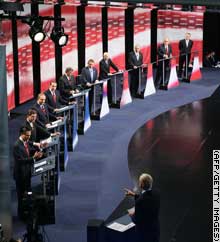
Ten Republican presidential hopefuls met last night in a debate remembered for the constant mentioning of Ronald Reagan and some differing over President Bush’s policies. Regarding the latter, several of the candidates commented over the issue of immigration (via Forbes):

John McCain-

“The status quo is not acceptable. We have to secure our borders. But we also need a temporary worker program, and we have to dispose of the issue of 12 million people who are in this country illegally. This issue is an important and compelling one, and it begins with national security. But we also need to address it comprehensively."

Tom Tancredo-

“No more platitudes, no more obfuscating with using words like, 'Well, I am not for amnesty, but I am for letting them stay.' That kind of stuff has got to be taken away from the political debate, as far as I'm concerned, so people can understand exactly who is where on this incredibly important issue.”

Duncan Hunter-

“Right now, the border is 2,000 miles of a very porous area where hundreds of thousands of people come across on an annual basis…Some from communist China, some from Iran, some from Korea. We have to secure the border. That's the biggest failure of the federal government."

Ron Paul-

“The purpose of government is to protect the secrecy and the privacy of all individuals, not the secrecy of government. We don't need a national ID card.”

Meanwhile, the immigration debate in Congress may heat up as Democrats are considering introducing their own proposal.

Links- Guardian UK, Bloomberg, Forbes

Image- CNN

Daily Headlines: May 04, 2007

* Former Peruvian president Alberto Fujimori denied plans to seek political asylum in order to avoid trial for corruption charges.

* Cuba’s government placed additional restrictions on foreign travelers coming into the country according to the Miami Herald.

* Overcrowding and the lack of promised aid from the U.S. are hurting Haiti’s prisons, according to an audit by the US Agency for International Development.

* While Argentina has lost millions of tons of soybeans due to bad weather, the country’s corn industry is getting a big boost from drought-ridden South Africa.

* Rest in peace to Brazilian media magnate Octavio Frias de Oliveira who died on Sunday.

Links- CNN, Miami Herald, Caribbean Net News, Bloomberg, The Latin Americanist, Los Angeles Times

Image- CNN

Thursday, May 3, 2007

Great Scot! Is Panama to blame for Scotland’s union to the Brits?

The annals of history serve as a rich tapestry of events that may seem far-fetched but are actually true. Take the case with the push for Scottish independence that was hindered by a disastrous attempt to colonize in Panama.

By the late 1600s, the Scottish economy was doing poorly from constant warfare, lack of a sustainable market outside its borders, and widespread famine. As a solution, the Bank of Scotland established a colonization company which then decided to create an outpost in Panama. It was a huge gamble in that half of Scotland's liquidity was invested in the project despite the raising of private funds.

What did the colonists find in Panama? Certainly not the welcome wagon:

“The conditions were horrible. It was unsuited for agriculture and the Indians they met were uninterested in the trinkets they brought them. This is probably because they only brought useless things like wigs, combs, and mirrors. During the spring of 1699, torrential rain brought disease to the colony and many died from malaria and yellow fever. About 10 colonists were dying each day and the rest had to live on a pound of nasty, moldy flour per week”.

With the economy in absolute ruin the Scottish government would soon sign the 1707 Acts of Union which politically incorporated Scotland into the United Kingdom.

Three centuries later all is not lost in the campaign of Scotland’s independence. Pro-independence factions are expected to win in today’s Scottish parliamentary elections.


Links- Wikipedia, The First Post, Scotland’s Past, The Panama Report, Bloomberg

Image- WorldAtlas.com

IADB: Remittances to L. America have slowed down

According to figures from the Inter-American Development Bank (IADB), the amount of money sent from immigrants in the U.S. to Latin America has been at a slower rate in January and February than during the same period last year. This could spell trouble for countries such as El Salvador, Honduras and Jamaica whose economies rely on funds received from abroad:

“We don't know if it's a trend or a minor correction," (IADB official Donald) Terry said. "If it becomes a trend as opposed to a moment in time, this would not be good in terms of U.S. interests in Central America.”

Mexico, Brazil, and Colombia received the most money in remittances in 2006; however, remittances to Central America countries totaled almost 65% of all remittances to Latin America in 2004.

An interesting addendum to the story- a global economics blog linked to a recent Wall Street Journal article connecting the U.S. housing slump to the slowdown in remittances.


Links- The Indianapolis Star, Inter-American Development Bank, Migration Policy Institute, RGE Monitor

Image- The Earth Institute at Columbia University

Shootout at Havana airport

In a story which is just beginning to unfold, a shootout occurred this morning at Havana’s international airport. The story has yet to be acknowledged by the official Cuban press, but it seemed like two or three recently deserted members of the Cuban army tried to hijack a civilian plane when they engaged in a gunfight with airport security. Sources vary on any fatalities that may have occurred.

Here are the only three links we could find on the incident:

  1. Deutsche Presse-Agentur (via Monsters & Critics)
  2. Miami Herald
  3. Luces y sombras (blog)
Update #1: More on the shootout via Global Voices Online.

Update #2: The Associated Press and BBC News report on the shootout, too.

Image- HavanaJournal.com (Jose Marti International Airport in Havana, Cuba)

News briefs on Immigration

* Political commentator Lou Dobbs latest diatribe against immigrants (and a lame one at that)- choosing May Day as the date for pro-immigrant marches.

* Presidential candidate Bill Richardson and Texas officials join a growing list of politicos that have raised doubts over added fences along the U.S.-Mexico border.

* U.S. immigration officials gave an extension to the Temporary Protection Status for another 18 months; the measure affects citizens of Honduras, El Salvador, and Nicaragua.

* Oops! A case of mistaken identity led to the deportation of a legal immigrant from El Paso, Texas to Guatemala.

* Here’s an interesting statistic- according to U.S immigration authorities there’s been a 20% increase in the amount of deportations in 2007 compared to last year.


Links- International Herald Tribune, The Latin Americanist, Guardian UK, El Paso Times, USA TODAY

Image- University of San Diego

Report: Brazilian anti-crime measures are failing

Human rights group Amnesty International released a report today criticizing Brazil’s government for their woeful lack of security around the country. The report mentions the "patchwork of violent fiefdoms” found in the slums of Sao Paulo and Rio de Janeiro, and denounced the increased militarization of police forces to combat crime.

The report (which can be read in its entirety here) goes on to make several recommendations on how to lower violence in Brazil including:

  • “the introduction of human-rights based policing”
  • prison reform
  • programs to lower extrajudicial killings

Links- Amnesty International, Newsday, Reuters AlertNet

Image- Guardian UK

Mining strike continues in Peru

Peru’s government and labor leaders enter another day of negotiations with the hope of stopping a mining strike that has gone on since Monday. The government claims that the strike has drawn “tepid support” though the prices of copper have gone up this week as the strike progresses.

Mining is one of Peru’s primary industries; the striking miners (image) have demanded better pay and improved labor rights.

Links- Reuters, Forbes, CIA Factbook, BBC News

Image- BBC News

Daily Headlines: May 03, 2007

* Yet another problem related to Santiago, Chile’s transit network: increased air pollution while cleaner running buses are gradually being implemented.

* Belarus president Alexander Lukashenko- deemed as Europe’s “last dictator” by the U.S.- will pay an official visit to Venezuela soon.

* China’s government is peeved at the Caribbean island of St. Lucia for breaking off diplomatic relations with them and re-establishing ties with Taiwan.

* $261 million in cuts were proposed in the latest budget from Puerto Rico’s governor.

* Yesterday, Argentines commemorated the silver anniversary of the sinking of the warship General Belgrano during the Falklands War.


Links- The Latin Americanist, MercoPress, BBC News, El Universal, CBS News, Caribbean Net News, Channel 4 News

Image- BBC Mundo (Transantiago bus stop)

Wednesday, May 2, 2007

Titulares de las Americas

The following is a quick overview of several headlines making the rounds in the Latin American press:

Links- La Nacion, Hoy Bolivia, RCN, The Latin Americanist, Jornada, La Nacion, La Prensa Libre, elPeriodico de Guatemala, El Pais

Image- La Prensa (Fire razing several hectares of Nicaragua’s Volcán Masaya National Park)

Giuliani blasts Chavez, defends Venezuelan lobbying links

In a speech to The Latino Coalition yesterday, Republican presidential hopeful Rudy Giuliani deemed Hugo Chavez as a “dangerous” leader who would have “little power” if it weren’t for oil revenues. However, the former New York City mayor echoed previous statements defending his law firm’s ties to Citgo, which is controlled by Venezuela’s state-run oil company.

In the same speech, Giuliani rejected claims that he has taken a more right-wing stance on immigration compared to his time as mayor. According to NBC's Carrie Dann, Giuliani was:

“careful to portray the immigration debate through the prism of national security -- his strongest issue by far”.

Links- Guardian UK, Newsday, The Latin Americanist, New York Sun, New York Daily News, MSNBC- First Read

Image- FOX News

Bush praises Colombian prez during DC visit

Colombian president Alvaro Uribe is ''a true democrat, a strong leader and a friend'' according to U.S. President George W. Bush who met with Uribe this morning at the White House (image). Bush went on to add that a free trade between both countries is more than an economic pact and it represents “strategic interests” in the region.

Uribe’s reception in the U.S. capital has been mixed; according to El Tiempo he was received by a standing ovation at the Council of the Americas though he was greeted by dozens of protestors before speaking at the Center for American Progress.

Uribe will be in Washington until Friday in order to promote free trade and to defend his administrations’ increasingly controversial ties to right-wing paramilitary groups. An integral part of Uribe’s strategy will be to convince Democrats in Congress who have been increasingly doubtful of him. To wit, Uribe’s staff has hired a lobbying firm with close ties to Democratic politicians.

isacson at Plan Colombia and Beyond provides a pretty good list of pros and cons of Uribe. (I won’t get nit-picky over the summary though my personal views on Uribe tend to gravitate towards the “cons”.)

Uribe’s time in DC will not be exclusively lobbying and speeches; tomorrow night he will receive the Light unto the Nations Award from the American Jewish Committee.


Links- Miami Herald, El Tiempo, RCN, Council of the Americas, Center for American Progress, The Latin Americanist, ABC News, CNN, earthtimes.org, Plan Colombia and Beyond

Image- BBC News

Violence ends immigrants' rights march in Los Angeles

Though most of yesterday’s pro-immigrant marches in the U.S. transpired peacefully with hundreds of thousands of marchers, violence erupted in Los Angeles’ MacArthur Park. According to one blogger’s eyewitness account, several “anarchist youth” provoked Los Angeles Police Department (LAPD) officers who responded by shooting tear gas and rubber bullets into a crowd that included “mothers with children, the elderly and handicapped, and many others who were peacefully congregated.”

(Hat tip for last link: Global Voices Online).

Even reporters covering the Los Angeles march were not immune from the officers’ reaction as police “knocked over (Telemundo) cameraman Juan Guerra and reporter Gabriel Huerta was hit by a plastic bullet.”

In an interview this morning Telemundo national news anchorman Pedro Sevcec called yesterday’s incidents “lamentable” and emphasized the “disproportionate” amount of force from the LAPD. Video to the interview as well as footage of Sevcec being caught in the middle of a chaotic scene may be accessed here.

LAPD Commissioner William Bratton promised an internal investigation of the incidents in MacArthur Park.

YouTube has a video of CNN reporting incident in question; despite it being provoked by “eight young people” (according to Sevcec), the video certainly indicates that the reaction by police was more than necessary:

Links- Daily Herald, Raw Story, Gothamist, LAX-LIM, Telemundo52.com, Univision, YouTube