Showing posts with label guerillas. Show all posts
Showing posts with label guerillas. Show all posts
Friday, December 28, 2012
Daily Headlines: December 28, 2012
* Brazil: Doctors In Brazil who previously had to notify officials of patients who developed AIDS will now need to inform authorities of all HIV cases.
* Latin America: Could Latin America’s “culture of family, support, and living a life to spend time with your family” explain why some countries in the region are at the top of a global happiness index?
* Colombia: The son of a former Colombian senator and ambassador filed a civil lawsuit in Florida against the South American country’s two main guerilla groups.
* Argentina: In a setback for the government the Argentine Supreme Court backed an injunction protecting media giant Grupo Clarin from being partially broken up.
Video Source – YouTube via user 1818video (Excerpt from a Frontline documentary, possibly “Sick Around the World” from 2008).
Online Sources- USA TODAY, CNN, ABC News, Christian Science Monitor

Wednesday, October 26, 2011
Daily Headlines: October 26, 2011
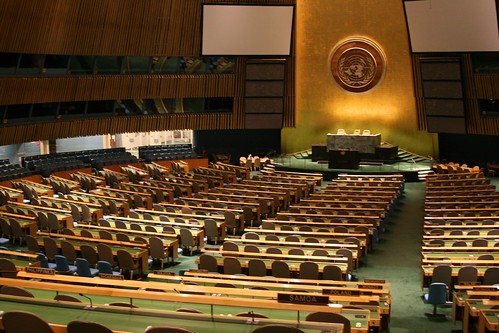
* Cuba: For the twentieth consecutive year the U.N. General Assembly called for an end to the decades-long U.S. economic embargo on Cuba.
* Paraguay: Will Paraguay seek military aid from neighboring Brazil in order to combat the growing threat of guerilla activity?
* Venezuela: The outgoing Commissioner for the Inter-American Commission on Human Rights slammed criticism of the body from the Venezuelan government.
* Mexico: According to a joint report between the U.N. and the Organization of American States, Mexico is the world’s fifth-most dangerous country for journalists.
Image Source – Flickr user Jay Reed (CC BY-SA 2.0)
Online Sources - CTV News, El Universal, UPI, CNN
Thursday, July 29, 2010
Daily Headlines: July 29, 2010
 * Ecuador: UNESCO removed the Galapagos Islands from its list of endangered sites after citing “strong action” by the Ecuadorian government to fix environmental problems.
* Puerto Rico: Several hundred supporters of “independence militant” Carlos Alberto Torres celebrated his release on parole after spending thirty years in prison.
* Paraguay: Police gunned down one of country’s most wanted fugitives - Paraguayan People's Army leader Severiano Martinez.
* Colombia: The State Department reversed its previous decision and will grant Colombian journalist Hollman Morris a visa to come to the U.S.
Image – The Telegraph (“Marine iguanas are unique to the Galapagos.”)
Online Sources- Boston Globe, LAHT, MSNBC, Miami Herald
Tuesday, July 28, 2009
Sweden Demands an Explanation from Venezuela
 Over the weekend Colombia announced that it had found Swedish arms among those captured from the FARC, the New York Times reported. Then Sweden confirmed that it had sold those arms to Venezuela. And now Sweden wants answers.
"It is correct that they have found these weapons to be Swedish-made," said Jens Eriksson, a top political adviser at the Foreign Ministry to Trade Minister Ewa Bjorling."We are working together with Colombian authorities to investigate the matter further and we have contacted Venezuelan authorities to clear up how these arms ended up in Colombia."
Venezuelan Interior Minister Tareck El Aissami denied that the weapons had come from his country.
Online sources: NYT, Reuters
Image credit: Mercopress
Saturday, September 13, 2008
Daily Headlines: September 13, 2008
 * Venezuela: The White House has added more fire to the growing diplomatic crisis with Venezuela and Bolivia; yesterday, the Treasury Department has accused the Chavez administration of trafficking drugs and funding Colombian guerillas.
* U.S.: Fear of raids and deportations have led illegal immigrants to stay behind in areas under danger from an incoming hurricane. Sound familiar?
* Spain: Actor Javier Bardem is trying to backtrack from supposedly disparaging comments he made over his countrymen which he claims were mistranslated.
* Mexico: Carlos Santana and Rob Thomas’ 1999 duet “Smooth” is the second-most popular song ever according to Billboard? Really?!
Image- Al Jazeera English
Sources- The Latin Americanist, Bloomberg, Christian Science Monitor, Guardian UK, prefixmag.com
Monday, August 4, 2008
Subcomandante Marcos returns to public spotlight
 The head of the Zapatista rebel group- commonly known as Subcomandante Marcos- emerged publicly over the weekend for the first time this year. According to Mexican daily La Jornada, Marcos received “a caravan” of foreign sympathizers in the southern Mexican state of Chiapas. During his appearance, Marcos was reportedly flanked by pair of commanders and criticized the state of the political left in Mexico:
“In Mexico, no. There is still talk of that expectation; that it’s possible if the left comes into power then they will not abandon being left.” Yet all the countries of the world notice that it’s the opposite, said Marcos. “Those on the left who are not necessarily radical leave their ideology once they get into power. The speed and the depth which they do so vary, but they ultimately transform themselves. That is the ‘stomach effect’ of power” either it digests you or turns you into shit. – [ed. personal translation]
Marcos also added his admiration of the Zapatistas who “chose to fight” instead of merely “winning or losing.”
Marcos is best known for leading the Zapatista National Liberation Army (EZLN) in a revolt on New Year’s Day 1994. Marcos and his cohorts received sympathy worldwide yet he has kept a lower profile in recent years, especially after the contentious 2006 presidential election.
Image- La Jornada (Subcomandante Marcos along with one of his commanders during a reported public appearance on Friday).
Sources (English)- The Latin Americanist, BBC News, Guardian UK
Sources (Spanish)- La Jornada, Union Radio, RCN
Thursday, March 6, 2008
Today’s video: United Self-Defense Forces of Colombia
The recent focus on Colombia has centered on the diplomatic hullabaloo resulting from the death of FARC guerilla commander Raul Reyes. Today, however, thousands of protestors marched in Colombia and around the world in solidarity with victims of Colombia’s civil conflict. Much like protests on February 4th, today’s marches were to repudiate violence and to promote peace. Yet while last month’s event placed a special emphasis on opposing the FARC, today’s actions paid special notice to those murdered and “disappeared” by paramilitary forces.
One of Colombia’s main paramilitary armies was the United Self-Defense Forces of Colombia (AUC, in Spanish). The AUC served as an umbrella for other paramilitary groups and its military modus operandi was intimidation and massacres. Despite the group’s demobilization between 2005 and 2006, the AUC has been connected to Colombia’s “para-politics” scandal. Moreover, former AUC members have been key in the formation of new paramilitary factions such as the Black Eagles.
The video below shows testimony of a peasant woman in southern Colombia whose life was turned upside down by paramilitary and guerilla violence.
(Video link):
Sources (English) –Reuters AlertNet, The Latin Americanist, tkb.org, globalsecurity.org, Wikipedia, YouTube
Sources (Spanish) – RCN, El Tiempo
Wednesday, March 5, 2008
Today’s Video: the Manuel Rodriguez Patriotic Front
We continue this week’s video theme of Latin American guerilla and paramilitary groups with a look at Chile’s Manuel Rodriguez Patriotic Front (Spanish initials FPMR). The group formed in 1983 with the aim of attacking the government led by one of the most divisive leaders in Latin American history- Augusto Pinochet. The FPMR nearly succeeded in snuffing out Pinochet in an assassination attempt in 1986 which killed five of his bodyguards.
The following video shows part of a 2001 Chilean TV report on that event including interviews with former FPMR members.
(Video link):
The FPMR split in the post-Pinochet transition to democracy with one faction participating in politics and another continuing armed struggle. According to Wikipedia, the FPMR ended the “armed struggle in December 1997.”
Previous videos this week focused on the Shining Path and the Argentine Anticommunist Alliance (a.k.a. Triple A).
Sources- janes.com, Wikipedia, BBC News, tkb.org, globalsecurity.org, The Latin Americanist
Wednesday, February 20, 2008
Colombia: A tale of two protests
 On February 4th, millions of protestors in Colombia and around the world marched against violence caused by the FARC guerilla group. The genesis of the protest was a Facebook entry created in January by three young adults. Participation grew through word of mouth and a strong media focus as marchers shouted “No mas FARC” (“No more FARC”).
Some were critical of the marches with Colombian legislator Piedad Cordoba calling them “an expression of hatred, racism and exclusion.” And even though the protest’s organizers emphasized that the marches should avoid overtly political overtones, a few people used the occasion to denounce Hugo Chavez:
Many marchers supported Mr. Uribe and chanted slogans against Venezuelan President Hugo Chavez. Last month, Mr. Chavez played a key role during the release of two high-profile hostages held by the FARC. But after the hostages were released, the Venezuelan president suggested that the FARC be taken off the list of terrorist groups and be deemed a legitimate army.
Juan Alejandro Garzón, a self-employed environmentalist, carried a large banner that read: "Chavez: Get it right, Colombians don't want the FARC.
Meanwhile, a “collective of human rights groups” is calling for protests on March 6th against violence caused by paramilitarism in Colombia. Much like the misguided views opposed to the actions of February 4th, some have denounced the March 6th protests. One unfortunate example is from the Colombian government itself:
“I personally will not participate, as I did enthusiastically in the march against the FARC,” was the response of José Obdulio Gaviria, a presidential advisor considered to be President Uribe’s chief ideologist. “It will be difficult for Colombian society to participate in this type of event, when we just finished marching against the people who are convening it.”
In the end, whether the March protests get the same amount of attention and participation as this month’s marches remain to be seen. One hopes that it does as a sign of repudiation of the needless violence in Colombia.
Sources (English)- Scotsman.com, International Herald Tribune, Foreign Policy Passport, Prensa Latina, Christian Science Monitor, Plan Colombia and Beyond
Sources (Spanish)- El Tiempo, RCN
Image- Al Jazeera
Subscribe to:
Posts (Atom)