Showing posts with label Felipe Calderon. Show all posts
Showing posts with label Felipe Calderon. Show all posts
Friday, May 1, 2015
Daily Headlines: May 1, 2015
* Cuba: “We will only advance toward the normalization of bilateral relations (with the U.S.) on a basis of respect for the sovereignty…which includes the lifting of the blockade,” declared the lone speaker at Cuba’s annual May Day parade today.
* Venezuela: Ex-Brazilian President Henrique Cardoso, former Mexican leader Felipe Calderon and 24 other heads of state signed an open letter to the Venezuelan government urging the release of imprisoned opposition activists.
* Nicaragua: Lawmakers in Nicaragua approved a proposal that would allow Russia to build satellite bases on the Central American country.
* Brazil: Police in Curitiba have clashed twice with teachers protesting a planned reform to the pension and retirement system of public employees.
YouTube Source – teleSUR (Venezuelan President Nicolás Maduro joined Cuban leader Raul Castro and thousands of other attendees at the annual May Day parade in Havana on Friday.)
Online Sources – Bernama, Yahoo! News, BBC News, Fox News Latino

Wednesday, October 23, 2013
Daily Headlines: October 23, 2013
* Cuba: The Cuban government will phase out its “unpopular” dual-currency system that has been in place since 1994 in favor of a new single currency.
* Mexico: Mexican President Enrique Peña Nieto might launch an official investigation into the alleged hacking of then-President Felipe Calderon’s public e-mail by the U.S. National Security Agency.
* Honduras: Recant polls indicated that Xiomara Castro, the wife of ousted President Manuel Zelaya, and Congressional chief Juan Hernandez are in a statistical dead heat ahead of next month's presidential election.
* Haiti: U.S. immigration officials released from custody four Haitian migrants who were found last week holding on to the hull of a capsized boat near the coast of Miami.
Video Source – YouTube via euronews
Online Sources- Reuters; CSMonitor.com; The Latin Americanist; Huffington Post; ABC News
Wednesday, February 20, 2013
Report Highlights “Disappearances” in Mexico
Around 250 people are believed to have disappeared in Mexico during the administration of former President Felipe Calderón according to a new report from Human Rights Watch (HRW).
The HRW report, which was released on Wednesday, found that 149 people between December 2006 and December 2012 were victims of “enforced disappearances” committed by “all branches of the security forces”. Furthermore, the report noted how in more than sixty cases evidence was uncovered linking “state agents” with criminal groups such as drug gangs to organize disappearances and extort money from the families of victims.
HRW explained that they uncovered evidence in an apparent disappearance case showing how police in a Nuevo León town “arbitrarily detained” nineteen construction workers in 2011 and gave them to an organized crime group.
The human rights group believes that there is “little doubt” that there are unofficially “thousands” more cases of disappearances in Mexico. An Interior Ministry official confirmed this hours after the HRW report was published when she admitted that there are over 27,000 disappearance cases in Mexico.
None of the 249 cases investigated by HRW have led to a conviction in a court of law. “All too often, (prosecutors and law enforcement officials) blame the victims and tell families it is their responsibility to investigate,” according to the report.
Days after coming to office last December 1st, current President Enrique Peña Nieto announced the creation of a new national police force which he said would be better trained and equipped to fight crime. Nevertheless, one senior HRW official also observed how current President Enrique Peña Nieto must take more decisive action:
Wednesday, January 23, 2013
Daily Headlines: January 23, 2013 (We’re Back!)
* Guatemala: Pre-trial hearings began in a case against former dictator Efrain Rios Montt who has been accused of genocide related to his brief rule in the midst of Guatemala’s bloody civil war.
* Venezuela: Venezuelan officials and Bolivian President Evo Morales have provided optimistic assessments of President Hugo Chavez who has not been seen publicly since undergoing cancer surgery about six weeks ago.
Update: Is the photo in this article a recent picture of a recuperating Hugo Chavez walking with his brother in Cuba or is it an image originally taken in 2011?
* Mexico: The dean of Harvard University’s Kennedy School of Government defended the appointment of former Mexican President Felipe Calderon to a teaching fellowship despite opposition from several anti-violence activists.
* Colombia: Pop music star Shakira gave birth to her first child, Milan Piqué Mebarak, at a hospital in the Spanish city of Barcelona.
Video Source – YouTube via user povborders (Excerpt from “Granito”, a 2011 documentary that focused on the efforts to gather evidence against former Guatemalan dictator Efrain Rios Montt.)
Online Sources including Update- Semana.com, Huffington Post, NPR, Fox News Latino, USA TODAY
Friday, November 30, 2012
Report: Fourteen Women Murdered per Day in Mexico
In a televised farewell speech broadcast this week, Mexican president Felipe Calderon expressed his satisfaction with the path his country took during his six years in the presidency. Yet while he patted himself on the back for having “worked to leave a stronger country with a better justice system and a healthier and stronger economy,” there are numerous goals that went unfulfilled during the Calderon regime. One of them is the plight of violence against women.
Fourteen Mexican women day each day as a result of violence according to a report published by the Fundación Origen women’s’ rights group. Between November 2011 and 2012 the organization claimed that 4112 women were victims of femicides while nearly 4000 females “disappeared” during that period of time.
“One of the worst things is that most of them stayed quiet and only two of the femicides registered over the past year were denounced,” alleged Fundación Origen president Mariana Baños to Mexican daily Milenio.
A survey conducted by Mexico’s National Human Rights Commission (CNDH, in Spanish) found that 30% of women do not denounce violence against them since they believe that “if there is domestic violence it’s a family issue and nothing more.” Yet the CNDH also concluded that problem with women speaking out against being the targets of violence also occurs due to a lack of help from the government.
“There are laws for the protection of female victims of violence in most of the 31 states and Mexico City but they are not respected,” claimed attorney José Luiz Zamora to Xinhua. “There is also a lack of political will behind funding and creating the necessary mechanisms for these laws to be applied,” added Zamora.
Monday, September 3, 2012
Daily Headlines: September 3, 2012
* Mexico: While members of Mexico’s Caravan for Peace anti-violence campaign continued their trek across the U.S., Mexican President Felipe Calderon claimed that crime has been “confronted decisively” under his administration.
* Venezuela: Nicia Maldonado, Venezuela’s Minister of Indigenous Peoples, claimed that government investigators found no evidence of an alleged massacre committed against the Yanomami community.
* Guatemala: Swiss police arrested Erwin Sperisen, former chief of Guatemala’s national police, who is accused of being involved in the extra-judicial killing of six prisoners in 2006.
* Peru: The government lifted a state of emergency in three provinces that was imposed in July when five people died in violent protests.
Video Source – YouTube via Univision News (Author turned activist Javier Sicilia leads the Caravan for Peace tour that started nearly a month ago)
Online Sources- Chicago Tribune, The Telegraph, Bernama, CNN, ABC News
Monday, July 2, 2012
Vázquez Mota Wins Mexican Expat Vote
Josefina Vázquez Mota may’ve ended in third in yesterday’s Mexican presidential election but she scored a win among her countrymen living abroad.
According to Mexican electoral officials, the former minister representing the PAN gained 42.16% of the expat vote while Andrés Manuel López Obrador was second with 38.99%.
Presumed general election winner Enrique Peña Nieto of the PRI finished a distant third among Mexicans abroad with a paltry 15.61%.
The results were a repeat of the previous presidential election six years ago when most expats opted for the PAN’s Felipe Calderon while the PRI candidate only gained 4% of the vote. For Carlos Arango, the head of Chicago-based community organization Casa Aztlán, the results this year are not a surprise:
Once again most voters abroad “punished” the PRI since “they have no sympathy in the U.S.,” said Arango. “Those that are living abroad have not forgotten that they had to leave Mexico due to the problems caused by PRI-led regimes.”
The activist also noted that Enrique Peña Nieto and his party “did not invest in the expat community until the very end of his campaign.”
Mexico: Enrique Peña Nieto Widens Lead in Presidential Election (Updated)
Mexico’s old guard is apparently poised to reclaim the country’s presidency.
According to Mexico’s electoral board, the IFE, Enrique Peña Nieto of the PRI leads the race for the presidency. With 84.27% of the votes counted, the center-right Peña Nieto is first with 37.55% of the vote, 5.31% ahead of the leftist Andrés Manuel López Obrador.
Update (12:15): Peña Nieto has widened his lead to over 6% with nearly 93% of the vote counted, which explains why he's received congratulatory messages from several countries including Britain and Spain.
The former State of Mexico governor claimed that he won the election after a "quick count" conducted by the IFE gave him a 6-8% lead over López Obrador.
“Mexicans have given our party another chance. We are going to honor it with results,” said Peña Nieto to his followers while a senior IFE official claimed that Peña Nieto’s electoral advantage is “irreversible.”
If the numbers do hold then it would represent a return to the presidency for the PRI, the party which ruled Mexico for seventy-one years until 2000 when PAN candidate Vicente Fox ended the hegemony.
“The last word hasn't been spoken yet…We simply do not have all the facts,” said López Obrador, who claimed that he would not quit until all the votes are counted.
It is unknown if López Obrador’s backers plan to repeat the actions of six years ago when he launched massive street protests after controversially losing the presidential race by less than 1% to current president Felipe Calderon.
Tuesday, May 15, 2012
Daily Headlines: May 15, 2012
* Latin America: Members of the UNASUR bloc vowed to “share information on their military spending” but will it be enough to stem the growing arms trade throughout Latin America?
* U.S.: Despite objections from immigrant rights groups and Latino rights activists the federal government continues to implement the “Secure Communities” program across the country.
* Mexico: The recent discovery of forty-nine headless bodies in northern Mexico has brought additional scrutiny on President Felipe Calderon’s offensive against on drug gangs.
* Ecuador: A U.S. judge dismissed some of the claims made by attorneys for Chevron against Ecuadorian plaintiffs in an environmental damages lawsuit.
Video Source – YouTube via Al Jazeera English (From April 2009 – “Latin America's largest defense trade show in the Brazilian city of Rio de Janeiro has attracted governments from all over the region.”)
Online Sources- UPI, MSNBC, Fox News Latino, BusinessWeek
Tuesday, April 3, 2012
Daily Headlines: April 3, 2012
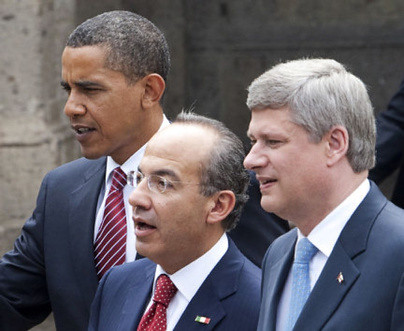
* Mexico: At the “Three Amigos” summit yesterday Mexican President Felipe Calderon called on the U.S. to revive an assault weapons ban while Canadian Prime Minister Stephen Harper vowed to boost trade with his North American partners.
* Ecuador: President Rafael Correa said that he would skip this month’s Summit of the Americas in Colombia since Cuba was not invited.
* U.S.: Over 3100 undocumented immigrants, most of whom are convicted criminals, were apprehended as part of a federal immigration sweep last week.
* Nicaragua: The head of the Nicaragua Sunflowers sex workers’ organization claimed that seven prostitutes have been murdered over the past twelve months.
Image Source – Flickr via Oldmaison (The heads of government of the U.S., Mexico and Canada met at the 2009 edition of the “Three Amigos” summit in Guadalajara). (CC BY-SA 2.0)
Online Sources- Voice of America, Huffington Post, LAHT, Bloomberg
Monday, December 5, 2011
Daily Headlines: December 5, 2011

* Mexico: President Felipe Calderon defended his anti-crime policies despite an estimated 43,000 deaths related to drug violence since he took office.
* Peru: President Ollanta Humala declared a state of emergency in areas of northern Peru where police have clashed with protesters opposed to a controversial mining project.
* Haiti: Rest in peace Sonia Pierre; the human rights activist who defended the rights of Dominican-born Haitians died yesterday at the age of 48.
* Brazil: Brazil’s chief ambassador at global climate talks in South Africa defended a government-backed proposal that would overhaul the country’s forest laws.
* Nicaragua: Thousands of people marched in Managua on Saturday to call attention to alleged “massive electoral fraud” in the reelection of President Daniel Ortega.
* Argentina: For the third time since 2006, Argentina lost in the finals of the Davis Cup tennis competition.
Image Source – Flickr via Knight Foundation (“Hundreds of Mexican journalists silently marched in downtown Mexico City (last year) in protest of the kidnappings, murder and violence against their peers throughout the country.”) (CC BY-SA 2.0)
Online Sources - Bloomberg, Miami Herald, Reuters, insidecostarica.com, ABC News, BBC Sport
Friday, November 25, 2011
Daily Headlines: November 25, 2011
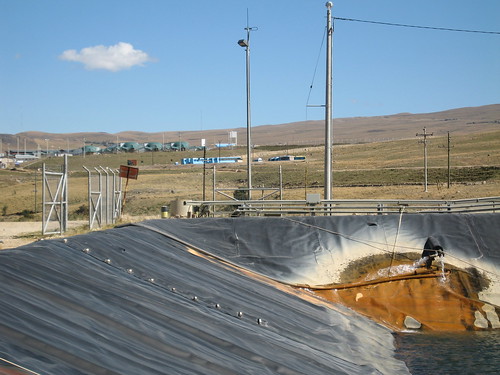
* Peru: Activity in the Cajamarca region is slowly returning to normal after thousands of demonstrators marched in protest against the proposed Conga gold mine.
* Mexico: A group of Mexican human rights lawyers have filed a complaint with the International Criminal Court against several senior officials including President Felipe Calderon.
* Uruguay: World Health Organization chief Margaret Chan blasted tobacco firms that "harass" countries that have strong anti-smoking laws like Uruguay.
* Venezuela: China and Venezuela signed a series of pacts this week in areas such as energy, telecommunications and agriculture.
Image Source – Flickr user Participatory Learning (The Yanacocha gold mine seen here is owned by the same firm that is behind the proposed Conga mine in Peru’s Cajamarca region). (CC BY 2.0).
Online Sources- Fox News, BBC News, MSNBC, BusinessWeek
Tuesday, October 18, 2011
Daily Headlines: October 18, 2011
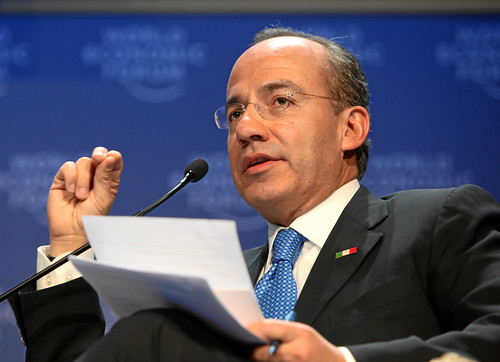
* Mexico: Members of the opposition PRI are incensed at President Felipe Calderon’s suggestion that they might seek deals with drug gangs if their candidate wins the presidency next year.
* Bolivia: Over 1500 indigenous marchers protesting against a controversial highway project are close to arriving at the capital city of La Paz.
* Brazil: An International Monetary Fund director warned that debt problems in European countries like Greece could lead to “capital flight” from Brazil.
* Central America: At least 84 people have died as a result of landslides and flooding caused by days of heavy rainfall.
Image – Via Flickr user World Economic Forum. (“Felipe Calderón, President of Mexico captured during the session 'Reviving Economic Growth' at the Annual Meeting 2009 of the World Economic Forum in Davos, Switzerland, January 30, 2009.”) (CC BY-SA 2.0)
Online Sources- Reuters, BusinessWeek, Al Jazeera English, Boston.com
Saturday, August 27, 2011
Weekend Headlines: August 27-28, 2011
* Mexico: President Felipe Calderon deemed as "true terrorists" those responsible for a deadly arson attack in Monterrey on Thursday but would it be better to heed ex-leader Vicente Fox's suggestion of negotiating with drug gangs?
* Chile: Chilean police have come under fire after authorities confirmed yesterday that a teen was killed during major anti-government protests.
* South America: A six-year-long diplomatic quarrel between Argentina and Uruguay over a Finnish-owned pulp mill seems to have come to an end.
* Guatemala: The country's Constitutional Court gave the green light for the extradition of ex-President Alfonso Portillo to the U.S. where he awaits trial.
* Argentina: An agreement was reached that would allow for a 25% increase of the minimum wage.
* Venezuela: Central bank data indicated that the Venezuelan economy is supposed to grow by 2.5% in the second quarter this year, which is 2.3% less than the first quarter.
Online Sources - Xinhua, Sacramento Bee, Voice of America, Reuters, El Universal, Bloomberg
Video Source - YouTube via Al Jazeera English
Saturday, May 14, 2011
Weekend Headlines: May 14-15, 2011
 * Panama: According to documents uncovered by Wikileaks, president Ricardo Martinelli “ridiculed a member of his cabinet” and China refused an offer for diplomatic recognition from Panama.
* Cuba: The official Granma newspaper claimed that dissident Juan Wilfredo Soto Garcia died of natural causes rather than at the hands of the police.
* Mexico: President Felipe Calderon supported the “powerful (economic) argument” used by his U.S. counterpart Barack Obama in a push for federal immigration reform.
* El Salvador: A former Salvadoran army officer pled guilty in a U.S. federal court for trying to sell arms to Colombia’s FARC guerillas.
Image – Mercopress
Online Sources- Newsroom Panama, AFP, Miami Herald, LAHT, MSNBC
Friday, May 6, 2011
Mexicans march on Cinco de Mayo
For some, Cinco de Mayo is an excuse for revelry but several hundred Mexicans took advantage of the holiday to march against the country’s drug-related violence:
As the above video showed one of the key figures in the march was Javier Sicilia, a poet turned anti-violence activist after his son was murdered roughly six weeks ago. “We cannot understand why (Mexican president Felipe Calderon) does not understand why the criminals are out there. If they are out there, it is because the institutions and the state are co-opted," Sicilia said at the start of the silent march yesterday.
The protest started in the central Mexican city of Cuernavaca and is scheduled to end on Sunday with a rally in Mexico City. On that day several solidarity protests are planned to take place in other Mexican cities as well as north of the border in New York, California, and Texas.
Protest organizers hope that others will join them in the fifty-six mile trek to the Mexican capital city. Among those joining the march are families of victims caught in the crossfire in the government offensive against drug gangs. Also taking part in the march are parents who are seeking justice for their children killed in a June 2009 nursery school fire.
Despite mounting criticism of his push to combat crime, President Calderon remained defiant in a televised speech that aired on Wednesday night. According to BBC News:
Video Source – teleSUR via YouTube
Online Sources- The Latin Americanist, AlterNet, BBC News, CNN, El Universal, Milenio, Fox News Latino
As the above video showed one of the key figures in the march was Javier Sicilia, a poet turned anti-violence activist after his son was murdered roughly six weeks ago. “We cannot understand why (Mexican president Felipe Calderon) does not understand why the criminals are out there. If they are out there, it is because the institutions and the state are co-opted," Sicilia said at the start of the silent march yesterday.
The protest started in the central Mexican city of Cuernavaca and is scheduled to end on Sunday with a rally in Mexico City. On that day several solidarity protests are planned to take place in other Mexican cities as well as north of the border in New York, California, and Texas.
Protest organizers hope that others will join them in the fifty-six mile trek to the Mexican capital city. Among those joining the march are families of victims caught in the crossfire in the government offensive against drug gangs. Also taking part in the march are parents who are seeking justice for their children killed in a June 2009 nursery school fire.
Despite mounting criticism of his push to combat crime, President Calderon remained defiant in a televised speech that aired on Wednesday night. According to BBC News:
Mr. Calderon rejected the idea that the operation he launched in December 2006, which has seen thousands of troops and extra police deployed against drug gangs, should end.Calderon’s remarks were supported by senior government official Francisco Blake Mora who earlier today pushed the Mexican legislature to pass a National Security Law.
"On the contrary, we must redouble our efforts because if we stop fighting they will kidnap, rob and kill all over the country."
Video Source – teleSUR via YouTube
Online Sources- The Latin Americanist, AlterNet, BBC News, CNN, El Universal, Milenio, Fox News Latino
Thursday, March 31, 2011
Mexican Attorney General resigns
Mexico’s Attorney General resigned for the second time since President Felipe Calderon assumed power in late 2006.
Arturo Chavez Chavez cited personal reasons for his resignation on Thursday as Mexico’s chief law enforcement official. He served for eighteen months during a period when drug-related violence continued to escalate. His work came under increased scrutiny this month after Wikileaks revealed a September 2009 cable where U.S. diplomats blasted Chavez as "a less capable political operator...stymied by his considerable human rights baggage."
Chavez also came under fire this year with the uncovering of the "Fast and Furious" operation where U.S. law enforcement agencies illicitly permitted gun smuggling into Mexico with the purpose of tracking the activities of drug gangs.
Chavez’ resignation opens the doors for Mexico’s first female Attorney General. Calderon named investigative prosecutor Marisela Morales to the post with the aim of deepening “the strategic role of the attorney general's office, in particular in the fight against organized crime". Morales, who was a co-recipient of the State Department’s International Women of Courage award, is best known for creating Mexico's first federal witness-protection program and combating police corruption.
Morales’ appointment needs to be confirmed by Mexico’s Senate that is considering a reform that would allow the legislature and not the executive to select the Attorney General. It’s unknown how long the confirmation process will take or whether it will be as contentious as the one for Chavez. (The former top prosecutor for Chihuahua was criticized during confirmation hearings for botching up investigations into the murders of women in Ciudad Juarez).
The following video from Mexican daily El Universal delves into Calderon’s announcing of Morales as the nominee for the next Attorney General:
Video Source – El Universal via YouTube
Online Sources- Voice of America, Canadian Press, CNN, The Latin Americanist, El Universal, BBC News, CSMonitor.com
Arturo Chavez Chavez cited personal reasons for his resignation on Thursday as Mexico’s chief law enforcement official. He served for eighteen months during a period when drug-related violence continued to escalate. His work came under increased scrutiny this month after Wikileaks revealed a September 2009 cable where U.S. diplomats blasted Chavez as "a less capable political operator...stymied by his considerable human rights baggage."
Chavez also came under fire this year with the uncovering of the "Fast and Furious" operation where U.S. law enforcement agencies illicitly permitted gun smuggling into Mexico with the purpose of tracking the activities of drug gangs.
Chavez’ resignation opens the doors for Mexico’s first female Attorney General. Calderon named investigative prosecutor Marisela Morales to the post with the aim of deepening “the strategic role of the attorney general's office, in particular in the fight against organized crime". Morales, who was a co-recipient of the State Department’s International Women of Courage award, is best known for creating Mexico's first federal witness-protection program and combating police corruption.
Morales’ appointment needs to be confirmed by Mexico’s Senate that is considering a reform that would allow the legislature and not the executive to select the Attorney General. It’s unknown how long the confirmation process will take or whether it will be as contentious as the one for Chavez. (The former top prosecutor for Chihuahua was criticized during confirmation hearings for botching up investigations into the murders of women in Ciudad Juarez).
The following video from Mexican daily El Universal delves into Calderon’s announcing of Morales as the nominee for the next Attorney General:
Video Source – El Universal via YouTube
Online Sources- Voice of America, Canadian Press, CNN, The Latin Americanist, El Universal, BBC News, CSMonitor.com
Wednesday, March 16, 2011
Mr. Calderon goes to Washington – I spy with my little eye...
 One of the most important deals reached during the recent visit by Mexican president Felipe Calderon to the White House had to do with bilateral trade. But according to a New York Times article published today both Calderon and Barack Obama agreed to continue with the use of U.S. military drones along the border with Mexico.
The aim of the previously undisclosed agreement according to the Times is to collect intelligence on Mexican drug gangs. The data gathered by the drones reportedly helped with the capture of several suspects connected with the shooting death of U.S. immigration agent Jaime Zapata.
Mexico’s constitution strictly limits the operation of foreign military and law enforcement authorities. Nonetheless, CNN cited a statement from the Mexican National Security Council affirming that the drone activities are “undertaken with full respect to the law.”
The drone program started in February and includes the use of the Air Force’s Global Hawk that is unarmed, uses sensors and can reach altitudes of 60,000 feet.
The border drones have been previously used in order to catch illegal migrants though that program was not without its mistakes:
It used to be that the Department of Homeland Security flew drones over the U.S.-Mexican border to watch for illegal immigrants. That proliferation of military technology to a civilian mission isn’t without its share of malfunctions: Not only did the communications systems occasionally fritz out, but on at least one occasion, a small drone — the property of the Mexican government — crashed into an El Paso backyard.
Image- France 24
Online Sources- BBC News, The Latin Americanist, New York Times, CNN, wired.com
Friday, March 4, 2011
Mr. Calderon goes to Washington - Keep on truckin'
 In anticipation of Thursday’s meeting between the presidents of Mexico and the U.S., I claimed that it will “take more than a meeting to tackle the many topics between the neighboring states.” Perhaps I spoke to soon after both leaders announced an agreement over a long-standing trade dispute.
Felipe Calderon and Barack Obama agreed yesterday to allow Mexican trucks to cross the border and operate on U.S. highways. Cross-border trucking has been held up since the North American Free Trade Agreement was ratified in 1995. Yet at a White House news conference with Calderon, Obama declared “we have found a clear path to resolve the dispute over trucking between our two countries.”
Under the new arrangement, which requires congressional approval, Mexican truckers planning to cross the border would have to be fluent in English and subject to drug testing. Additionally, their vehicles will be obligated to carry electronic on-board recorders in order to ensure “compliance with hours-of-service and related laws.”
The agreement could have an immediate impact on the U.S. economy in that the Mexican government pledged to drop a number of tariffs placed after a 2009 pilot program was cancelled. According to the White House, Mexico would remove taxes on $2.4 billion worth of imports on goods such as pork, cheese, corn and fruits.
The deal has been met with opposition from some labor unions and independent truckers who worry over the potential loss of jobs and revenue in the U.S. Conversely, the pact was backed by business interests as well as U.S. Rep. Henry Cuellar from Texas who praised the “important step to more open, transparent and efficient trade between the two countries.”
Meanwhile, one Mexican truck company owner viewed the deal with cautious optimism:
“I am going to need to analyze it and know how it’s going to function to see if we would participate,” (Transportes Rafa owner Rafael) Godinez Beltran said. “It would open the market for work, but I’m going to wait and see if it can get beyond the politics.”The meeting between Calderon and Obama comes amid allegations of tense relations between their respective states after Wikileaks revealed U.S. diplomatic cables criticizing Mexican anti-drug efforts.
Image- Gregory Bull/AP via The Seattle Times (“A Mexican truck driver radios his company after taking his rig into the U.S. from Juarez, Mexico.”)
Online Sources- Sydney Morning Herald, BusinessWeek, SignOnSanDiego.com, Houston Chronicle, The Latin Americanist
Friday, February 11, 2011
Daily Headlines: February 11, 2010
 * Argentina: According to documents released by WikiLeaks U.S. diplomats believed that corruption in Argentina was widespread and implicated senior officials including the late President Nestor Kirchner.
* Mexico: President Felipe Calderon admitted earlier this week that the government needs to “improve much more in the treatment of migrants” that travel through Mexico.
* Central America: U.S. Assistant Secretary of State William Brownfield said that the Obama administration is contemplating a $200 million anti-drugs plan for Central America.
* Uruguay: The government announced plans to expand the use of wind farms, which can supply an estimated 25% of Uruguay’s electricity by 2015.
Image – Thomas Coex/AFP/Getty Images via The Guardian (“WikiLeaks has released several thousand of about 250,000 classified US embassy cables.”)
Online Sources- The Globe and Mail, People’s Daily Online, LAHT, MercoPress
Subscribe to:
Posts (Atom)