Wednesday, March 31, 2010

De Musica Ligera: Choc Quib Town

Yesterday we featured one of the documentaries that were showcased at this year’s South by Southwest Festival. The main attraction for audiophiles, however, is the chance to enjoy incredible musical groups such as Choc Quib Town:
The songs of Choc Quib Town mix Afro Colombian traditional genres like Bunde, Currulao, BambazĂș and Aguabajo with the music of Afro descendants of the U.S., Jamaica, Cuba and others like Hip Hop, Reggae, Electronic, Rumba, Flow, Salsa, Songo and Guajira.
See (and listen) for yourself:

Online Sources- YouTube, The Latin Americanist, South by Southwest Festival

Ignoring the Golden Rule

Developments involving an influential Mexican cleric and a priest originally from Cuba may put increased pressure against Pope Benedict XVI and the Vatican.

Last week officials at the Legion of Christ (LOC) admitted that their late leader fathered three children with two women and sexually abused minors. “We express our sorrow and grief to each and every person damaged by our founder's actions," said a letter written by sixteen LOC leaders regarding the actions of Rev. Marcial Maciel.

The accusations against Maciel were nothing new as we reported last August yet the group was forced to admit that they covered up Maciel’s abuse since 2006. This was preceded by a two-year Vatican investigation against Maciel who was allowed to retire and he would eventually pass away in 2008.

Maciel’s sordid life has damaged the LOC’s once-powerful international reputation but has had little negative effect on the group in Mexico. “The Legion has long-standing ties with the ruling class and an expansive network of elite schools,” which has helped them in Mexico according to the Los Angeles Times.

In the meantime, a lawyer in a Florida clergy sex abuse case claimed that the Vatican protected Rev. Ernesto Garcia-Rubio and his “troubled past” before being transferred to South Florida in 1968:
After arriving in Miami in 1968, Garcia-Rubio served as a church advocate for recent immigrants from Latin America, (attorney Jessica) Arbour said, giving him access to child refugees from Cuba, El Salvador and Nicaragua.

The priest would take the children in, and then require them to have sexual contact with him, she said. If the child refused, Arbour said, Garcia-Rubio would threaten to deport them. Arbour says her client was 15 when he came to the U.S. by himself from Nicaragua.
With millions of Catholics like myself celebrating Holy Week these scandals are difficult to stomach. It’s nothing short of tragic that the likes of Rev. Maciel made a mockery of their spiritual beliefs by exploiting vulnerable victims.

Image- New York Times (Image of Rev. Marcial Maciel)
Online Sources- AP, Wall Street Journal, The Latin Americanist, CNN, Los Angeles Times, MSNBC

Supreme Court rules in deportation case

The U.S. Supreme Court ruled today that lawyers are obligated to tell clients of the risk of deportation should they enter a guilty plea.

In a 7-2 decision, the high court gave a verdict in favor of undocumented immigrant Jose Padilla. Padilla was arrested in 2001 for felony drug trafficking and originally entered a plea of not guilty. He subsequently changed his plea to guilty in exchange for reduced jail time and after his attorney told him that doing so would not affect his immigration status. Padilla’s lawyer was wrong and, thus Padilla was placed by immigration authorities under order for deportation to his native Honduras.

The high court’s ruling in Padilla v. Kentucky overturns a previous verdict against the plaintiff by Kentucky’s Supreme Court. As part of the top tribunal’s majority opinion, Justice John Paul Stevens said that Padilla’s constitutional rights were broken since he received inadequate legal counsel:
We granted certiorari to decide whether, as a matter of federal law, Padilla's counsel had an obligation to advise him that the offense to which he was pleading guilty would result in his removal from this country. We agree with Padilla that constitutionally competent counsel would have advised him that his conviction for drug distribution made him subject to automatic deportation. Whether he is entitled to relief depends on whether he has been prejudiced, a matter that we do not address.
In his dissent, Justice Antonin Scalia claimed that the “Constitution…is not an all-purpose tool for judicial construction of a perfect world.”

Meanwhile the high court heard arguments in the similar case of Carachuri-Rosendo v. Holder. The court must decide if Jose Angel Carachuri-Rosendo can be legally deported to Mexico after pleading guilty a second time to possession of drugs.

Image- ABC News
Online Sources- Reuters, JURIST, Kansas City Star, Los Angeles Times

Chevron wins arbitration over Ecuador

The ongoing battle between oil giant Chevron and the Ecuadorian government just got a whole lot messier.

On Tuesday an arbitration board ruled that Ecuador violated international law against Chevron. The tribunal located in The Hague concluded that the South American country “illegally delayed” commercial rulings between officials and Chevron-owned subsidiary Texaco. Though the oil company had sought a payment of $1.6 billion, the board ruled that Ecuador would instead have to pay $700 million.

Ecuadorian authorities said that they would appeal the ruling; the country’s Attorney General accused Chevron of employing “a well orchestrated strategy” designed to distract from the multibillion-dollar environmental damage suit. As Shelia McNulty wrote on the Financial Times website, however, the decision was a “major win” for Chevron:
The commercial arbitration is separate from - and secondary to - the arbitration Chevron has sought to resolve a $27bn claim by indigenous people who charge that Texaco (which Chevron bought in 2001) left an environmental disaster in its wake when it withdrew from the country. But it appears to support Chevron’s underlying claim, which is that the company is being unfairly treated by the court system generally…

Indeed, the $700m is unlikely to ever be paid. But for Chevron, the win is being able to feed off the symbolism.
Chevron and Ecuador have pulled all the stops in the ugly environmental case between them; last September the oil firm accused the then-presiding judge of bribery while Chevron was accused of using dirty tricks as part of their public relations offensive.

Image- Huffington Post
Online Sources- Reuters, FT.com, BusinessWeek, UPI, The Latin Americanist,

Colombia: Rebels free soldier held captive for over 12 years

Today is the first full day that Pablo Moncayo enjoys his newfound freedom after spending over 4000 days in captivity.

The Colombian soldier whom the local press dubbed as the world’s longest held kidnapped victim” was finally freed on Tuesday by his rebel captors. Much like the liberation on Sunday of Pvt. Josue Calvo, Moncayo was handed over by the FARC in a nearby jungle location to a “humanitarian commission” led by Sen. Piedad Cordoba and the International Red Cross. "You have no idea how staggering it is to return to civilization," said Moncayo after being reunited with his family members and then unlocking the heavy steel chains his father wore around his body in solidarity with his son’s plight.

Unfortunately the joyous occasion was somewhat marred by controversy after the Colombian government complained that Venezuelan-owned TV network Telesur broke official protocol by divulging images of Moncayo’s handover. The channel’s president replied by denouncing the Colombian government’s “history of…stigmatizing Telesur” and reminded them of their misuse of the Red Cross symbol during a 2008 rescue operation.

Moncayo’s liberation was said to be the last by the FARC unless a prisoner exchange is agreed to along with the government. Despite the suffering of dozens of families the odds of an agreement are pretty slim:
"Our hopes remain and we have to keep fighting," said Fanny Martinez, a cousin of the 33-year-old soldier.

The rebels sent a statement with the humanitarian team that picked up Moncayo in which FARC commander Alfonso Cano said: "With this unilateral gesture, the FARC considers the path cleared for the immediate exchange of prisoners of war."

But President Alvaro Uribe has opposed a swap of imprisoned rebels for hostages unless any guerrillas who are freed agree to abandon the FARC. Uribe has always insisted any rebels freed from Colombia's prisons as part of a prisoner swap be taken in by another country, such as France.
Image- Times Online
Online Sources- LAHT, The Latin Americanist, BBC News, Telesur, AP, NPR

Daily Headlines: March 31, 2010


* U.S.: Rest in peace Jaime Escalante; the Bolivian-born former Los Angeles teacher who strove to educate inner-city students died of bladder cancer yesterday. (The above video comes via UPI).

* Guatemala: A man was convicted for the 2009 murder of a lawyer who previously taped a video accusing President Alvaro Colom of killing him.

* Latin America: The World Meteorological Organization claimed that the El Nino weather phenomena that affects the Americas and the world is expected to die out after the middle of this year.

* Mexico: According to KPMG Mexico beat out nine other nations including Japan, the U.S. and Britain as the most efficient country to do business.

Online Sources- UPI, Los Angeles Times, YouTube, Vancouver Sun, Reuters, AP, The Latin Americanist

Tuesday, March 30, 2010

Today's Video: Breaking the chains

We'll have more tomorrow on the freeing of Colombian soldier Pablo Emilio Moncayo, who was let go by his rebel captors after being kidnapped over twelve years ago. For now, here is the moment when he was reunited Wednesday afternoon with his family including a niece and sister who were born while he was held hostage:

Online Source - CNN

Survey: Haitians seek work, schools, and shelter

Ahead of a conference of donors on Wednesday Oxfam released a report examining the views by Haitians two months after a major earthquake shook the country.

According to a survey conducted of over 1700 Haitians for the relief agency the primary concerns are jobs, schools, and homes. “Haitians are not expecting charity; they want to get jobs, to educate their kids, and to make sure they have a roof over their heads at night,” said the Chief of Mission of Oxfam International in Haiti in a press release. Furthermore, most respondents have little confidence in their own government and would rather see an alliance “between foreign governments, Haitian civil society and the central government in Port-au-Prince.”

Today’s Huffington Post featured a “joint commentary” on the situation in Haiti by the heads of eight relief aid organizations. The article listed several “key areas” where donor governments could help the most and reflect the views of Haitians in the Oxfam poll:
Economic Recovery: Haitians have lost both housing and jobs, and their economy lies in ruins. Between 70 and 80% of Haitians are out of work. Reconstruction projects must ensure local labor opportunities. Jobs and cash-for-work programs are urgently needed in Port au Prince and outside the capital, too, where families hosting displaced relatives and friends are already facing major scarcity and stress. Women and young people -- sometimes an afterthought in economic development programs -- also need urgent help to support themselves and should be included in plans to get the Haitian people back to work.
The International Donors' Conference Towards a New Future for Haiti is expected to create financial commitments needed for post-earthquake reconstruction.

Image- CBC (“A woman walks along a street lined with rubble from buildings that collapsed in the earthquake in downtown Port-au-Prince, Wednesday, March 24, 2010.”)
Online Sources- Oxfam America, CNN, Huffington Post, Reuters

Falklands oil: Much ado about nothing?

Tensions between Britain and Argentina over the sovereignty of the Falklands Islands/Islas Malvinas climaxed recently over an oil exploration deal. Faced with a possible “oil rush” near the disputed islands, the Argentine government tried to drum up regional support to impede drilling in the area. Eventually British company Desire Petroleum was able to tow a drill rig from Scotland southbound to the Falklands area.

Despite the rising tensions caused by the oil exploration plans it may ultimately turn out to be a bust for Desire. Preliminary drilling has yielded “disappointing” results that caused the firm’s stock to plummet by 50%. Early analysis from drilling off the coast off the Falkands showed "that oil may be present in thin intervals but that reservoir quality is poor". The company advised that further tests would be done this week in order to see if they could salvage something.

Desire’s actions have also caused double-digit stock losses in two other British oil firms working around the Falklands- Rockhopper and Falkland Oil and Gas. Desire faces a disheartening loss similar to what occurred over a decade ago:
If subsequent drilling yields the same disappointing results as Desire's first well, then this will be the second time in 13 years that a Falklands oil boom has ended in tears. In May 1998, Desire's shares crashed by 30% after a drilling operation in the North Falklands basin found that hydrocarbons were present, but not in commercial quantities.
Image- BBC News (“Desire's oil platform was moved from Scotland to the Falklands in February.”)
Online Sources- RTT News, CNN, The Latin Americanist, Guardian UK, BBC News

Nuestro Cine: Injustice in Mexico

This year’s edition of the South by Southwest Festival (SXSW) was held earlier this month and featured numerous talks, films, and musicians. We’ll look at one of the musical acts later this week. Today we’ll feature one of the documentaries that were presented at SXSW.

“Presunto Culpable” (Presumed Guilty) provides a unique look at the Mexican judicial system from the perspectives of two lawyers representing their accused murderer Tono Zuniga. The film is also “a searing indictment of a system where the Police do not have to investigate because the system presumes guilt” according to SXSW’s website.

“Presunto Culpable” received honors at the Guadalajara Film Festival and a deal may soon be worked out to feature it in foreign countries. For the time being please check out the trailer to this very interesting film:

Online Sources- Televisa, SXSW, YouTube

Advocates Hope for Large Latino Turnout


After a big push to get Latinos involved with the census, what's the consensus?

It might be too soon to tell, but everywhere from Michigan to Texas, local activists are hoping that by getting Latinos involved early and often, they've been counted more than in the past.

TIME reported Monday that the census misses the point with Latino citizens, asking them their race but not realizing for many, their race is Puerto Rican or Mexican or Nicaraguan, an unavailable option.

Many, if not most, Hispanics in the U.S. think of their ethnicity (also known as Latino) not just in cultural terms but in a racial context as well. It's why more than 40% of Hispanics, when asked on the Census form in 2000 to register white or black as their race, wrote in "Other" — and they represented 95% of all the 15.3 million people in the U.S. who did so.


The way the census is written, it implies that "Hispanic origins are not races," according to TIME. A similar problem exists with Arabs, who are considered white by the census. Many are now organizing a write-in campaign.

Th Afro-Latino Forum has encouraged people to "check both," meaning including both their black and Latino heritage while filling out the census.

The government provides a "Toolkit for Reaching Latinos," available here.

Raul A. Reyes from My Latino Voice writes that Question 8, asking whether a person is Hispanic, Latino or Spanish, is confusing when coupled with Question 9, asking someone's race. For most Latinos, these questions should be together, in one question. Mr. Reyes proposes using the scientific classifications he learned about in his third-grade science class: Caucasian, Negroid, and Mongoloid, along with Multiracial.

Sources: Redding News Review, census.gov, TIME, publicbroadcasting.net, lubbockonline.net

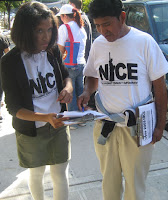
Photo: New York Community Trust, group New Immigrant Community Empowerment, or NICE, one group that's helped undocumented immigrants fill out the census, work in the community.

Suspect Detained in American killings


Mexican police have detained a gang member in the killings of three Americans.

The 45-year-old suspect was part of the Barrio Azteca gang working for the Juarez drug cartel, the AP reported.

Earlier this month, an employee of the U.S. Consulate, her husband and a Mexican citizen were killed leaving a children's birthday party in Juarez.

In other Mexico news, ten youths were killed in Durango. CNN reports that the victims, ages 18 to 21, were riding in a pickup truck and did not stop at a drug cartel's fake checkpoint.

They were coming from having picked up money to support their school as part of a federal program, CNN reported.

The Dallas Morning News examines how drug spillover has affected the border town of Fort Hancock, Texas, and Fox in Arizona reports that a rancher was found shot to death.

Also, the New York Times has a story about visiting an empty Mexico with suggestions for business travelers.

Sources: AP, BBC, NYT, CNN, Dallas Morning News, Fox12

Photo: CNN

Daily Headlines: March 30, 2010

* U.S.: With Cesar Chavez Day being celebrated in a handful of states this week, it’s worth noting that there are preliminary plans for a Hollywood film on the late civil rights and labor activist.

* Honduras: March has been a bleak month for Honduran journalists with at least five members of the media having been murdered.

* Chile: “There were no immediate reports of damage or injuries” after a 6.1 magnitude aftershock shook Chile over the weekend.

* U.S.: In testimony at the Marcelo Lucero murder trial yesterday one of the seven teens accused of participating in his death described how he and his cohorts spent that fateful November 2008 night going “beaner hopping.”

Image – Los Angeles Daily News (“Hundreds turn out during the 17th Annual Cesar E. Chavez March for Justice and Cultural Arts Festival that started with a rally at Brand Park in Mission Hills and ended at Ritchie Valens Park in Pacoima CA. March 28,2010.”)
Online Sources- Reuters, BusinessWeek, Herald Sun, The Latin Americanist, New York Times

Monday, March 29, 2010

Ricky Martin publicly comes out of the closet

Yep, he said it:
Puerto Rican pop singer Ricky Martin has opened up on his blog about his sexuality. "I am proud to say that I am a fortunate homosexual man," wrote Martin on (his website) Monday. "I am very blessed to be who I am."…

"If someone asked me today, 'Ricky, what are you afraid of?' I would answer "the blood that runs through the streets of countries at war...child slavery, terrorism...the cynicism of some people in positions of power, the misinterpretation of faith," wrote Martin. "But fear of my truth? Not at all!”
Rumors of Martin’s homosexuality have lingered over the years such as Barbara Walters’ “inappropriate” questions at Martin in a 2000 TV interview.

According to the New York Daily News, Martin’s “career in the United States has fizzled out for now, (yet) he is still a superstar in Latin America.”

Image- New York Daily News
Online Sources- New York Daily News, Chicago Tribune, Miami Herald

Could genetics and pee curb dengue fever?

Last week we briefly looked at how health officials throughout Latin America are preparing for a possible dengue fever outbreak. (Bolivia’s government has reportedly distributed over 4000 candles coated with mosquito repellant, for example).

Scientists have been working for decades to figure out how to curb the speared of dengue via infected mosquitoes. Researchers in California, for instance, have created a new breed of mosquito that cannot fly. Meanwhile scientists at Cornell University identified a unique way to possible prevent the spread of dengue:
The scientists identified a protein that appears to be involved in promoting urination as the insects feed on blood. When mosquitoes consume and process blood meals, they must urinate to prevent fluid and salt overloads that can kill them, as well as shed weight to be able to fly away, the scientists said.

"Thus, blocking the function of this protein in natural populations of mosquitoes may limit their ability to survive the physiological stresses of a blood meal and to further transmit viruses," researcher Peter Piermarini said.
There is currently no vaccine or similar treatment to avoid dengue apart from preventative measures. Nonetheless, it’s possible that the work by researchers could lead to a vaccine against an illness that the Centers for Disease Control cites as infecting 100 million people yearly.

Image- ABC Online
Online Sources- Centers for Disease Control, Wikipedia, The Latin Americanist, Voice of America, UPI

Colombian soldier freed by guerillas

Reunited and it felt so good:

Colombian Army Private Josue Daniel Calvo was freed yesterday after spending roughly eleven months held against his will be the FARC guerillas. Calvo hugged several family members shortly after stepping off a Brazilian army helicopter and appeared to be in satisfactory health after previous reports claimed that he was seriously injured in the April 2009 battle that led to his capture. Nevertheless Calvo is currently at a Bogota military clinic where he allegedly told doctors that the rebels carried him in hammock during his first seven months in the jungle.

Calvo was handed over in a publicly unknown part of southeastern Colombia by the FARC to a commission that included the International Red Cross and Senator Piedad Cordoba. Cordoba- who has served as a liaison in previous liberations- called on the guerillas and the government to make a more serious effort at seeking a peaceful solution:
The senator referred to a new call by the citizen movement Colombianos y Colombianas por la Paz (Colombians for Peace) for a humanitarian exchange between the government and the guerrillas, to secure the release of 21 hostages still held by the FARC.


"We are in the process of writing letters to President Uribe, all of the presidential candidates and the FARC," CĂłrdoba said…

The rebel group also announced that it would deliver the remains of JuliĂĄn Ernesto Guevara, a police officer who died in captivity in 2006, nearly eight years after he was captured by the FARC. 


The insurgents "told us they have his remains, but that they have not been able to bring them out of the jungle because of the continuous attacks by the army. They asked us to be on the alert," CĂłrdoba added.
Tomorrow the FARC are expected to free Pablo Emilio Moncayo, who has spent 12 years in the jungle. Moncayo’s father, Gustavo, has campaigned relentlessly for his son’s liberation including going on nationwide treks with chains surrounding his body. Unfortunately, Moncayo will likely be the last hostage freed at least until current Colombian president Alvaro Uribe leaves office later this year.

Nearly two dozen police and soldiers have been identified by the FARC as part of a possible prisoner swap that has been downplayed by Uribe.

Online Sources- Xinhua, BBC News, Reuters, IPS, The Latin Americanist, YouTube, CNN

Daily Headlines: March 29, 2010

* Mexico: President Felipe Calderon claimed that “powerful lobbies in the (U.S.) Congress” are impeding efforts to decrease the stream of illegal arms into Mexico.

* Paraguay: Just over two months since being shot in the head Paraguayan soccer player Salvador Cabanas “has been out taking free kicks and shooting baskets” while rehabilitating in Argentina.

* Peru: At least seven people died in the southeastern part of the country due to torrential rains and flooding.

* Latin America: In a major energy deal for Bolivia the Andean country is expected to quadruple natural gas exports to Argentina by 2021 via an agreement signed last week.

Image – The Telegraph (“Mexican police, such as these officers investigating a violent incident in Juarez, have been threatened by local cartel bosses.”)
Online Sources- Reuters, LAHT, CBC, The Latin Americanist

Saturday, March 27, 2010

Weekend World Watch: Lights out

* World: Locales around the world including Big Ben (image), the Sydney Opera House, and New York’s Times Square briefly shut off their lights Saturday night as part of Earth Hour 2010.

* India: According to the Indian press the military successfully fired two short-range ballistic missiles.

* Middle East: "We cannot resume indirect negotiations as long as Israel maintains its settlement policy and the status quo," Palestinian Authority President Mahmoud Abbas said at a summit of the Arab League.

* Thailand: The military is withdrawing from certain areas in order to avoid conflict with tens of thousands of protesters rallying in favor of former prime minister Thaksin Shinawatra.

Image – The Telegraph
Online Sources- Reuters, Xinhua, CNN, BBC News

Weekend Headlines: March 27-28, 2010

* Spain: Judge Baltazar Garzon- best known for indicting ex-Chilean strongman Augusto Pinochet- could be charged with “abuse of power” in investigating Spanish civil war crimes.

* El Salvador: On the thirtieth anniversary of the murder of Oscar Romero El Salvador’s government formally apologized for his death as a "victim of illegal violence".

* Peru: Workers at mines owned by Buenaventura may strike over the weekend due to a supposedly insufficient sharing of profits.

* Colombia: In a shocking incident a twelve-year-old boy died after unknowingly carrying a package bomb into a local police station.

Image – Guardian UK
Online Sources- AP, The Latin Americanist, BBC News, Reuters, Sydney Morning Herald

Friday, March 26, 2010

Today's Video: Penguins!

We'll be back for a few posts over the weekend. For now here's a CNN story on penguins that swim thousands of miles north and land on the beaches of Rio de Janeiro: