Sunday, June 3, 2007

Week in Review: May 28 to June 03

In order to make up for the lack of posts last week, here are several headlines that were in the news over the past few days:

Monday May 28

* Radio Caracas Television ceased its transmission after not getting its broadcast license renewed, but the network has continued its transmissions via alternate means. (See Thursday May 31).

* Miss Japan won the 2007 Miss Universe pageant despite several pre-contest favorites from the Americas.

* Recently escaped Colombian police officer Jhon Frank Pinchao tells the Colombian press that an exchange between jailed guerillas and kidnap victims “will always be the best option.”

* Remember the riots several weeks ago in Argentina over the country’s rail service? On Monday, irate passengers lashed out again due to massive delays.

Tuesday May 29

* Bolivian president Evo Morales tries to unite other South American leaders against FIFA’s decision to ban all international matches at very high altitudes.

* Remember the brouhaha over Newt Gingrich’s remarks on Spanish being a “ghetto” language? Gingrich’s Spanish tutor tried to clarify his student’s statement in an article published in Politico.com.

* Negotiations have been “optimistic” between Argentine and Uruguayan representatives over the construction of a Finnish-owned paper mill.

Wednesday May 30

* Mexico City mayor Marcelo Ebard said that first trimester abortions will be carried out despite the federal government’s legal challenge, while a study showed that over a million Brazilian women are at risk from illegal abortions.

* Nicaraguan heath officials seized thousands of tubes of tainted Chinese toothpaste that was sold there and a few other Latin American countries.

* Peru’s stocks suffered its largest drop in over seventeen years due to investors’ worries over China’s economy.

Thursday May 31

* From the boob tube to YouTube – CNN reported that Radio Caracas Television continues its daily broadcasts via popular Internet video site YouTube.

* Come back to “Macondo” – Colombian author Gabriel Garcia Marquez returned to the town that inspired him to write "100 Years of Solitude."

* In an article published in the International Herald Tribune, a law study concluded that verdicts in asylum cases in the U.S. vary on the backgrounds and genders of immigration judges.

Friday June 1

* “Jesus loves you. I am your pastor and I will help you.” – The Guardian UK describes how religion is being used to combat violence in the slums of Rio de Janeiro.

* Condoleezza Rice expressed her displeasure at Spain’s government for establishing closer relations with Cuba.

* A Brazilian judge indicted two U.S. pilots and four Brazilian air traffic controllers involved in Brazil’s worst airplane accident.

Saturday June 2

* Thousands of “Chavistas” marched through Caracas in a show of support towards Venezuelan president Hugo Chavez.

* In an interview with CNN, Cuban national assembly president Ricardo Alarcon said that Fidel Castro has “fully recovered” from the numerous surgeries he has had.

* A Caribbean connection is behind a supposed terrorist plot that was broken up by U.S. authorities.

Sunday June 3

* In an interview with the Deutsche Presse-Agentur, Mexican President Felipe Calderon blamed “U.S. demand for narcotics” as the cause of widespread violence by Mexican drug gangs.

* Cuban television showed the first video images of Fidel Castro since February.

* The father-in-law of a U.S. kidnap victim in Colombia offered himself as a part of a possible prisoner exchange with guerillas.

Sources (English)- CNN, BBC News, The Latin Americanist, Guardian UK, YouTube, International Herald Tribune, Yahoo! News, Monsters & Critics, Politico.com, ABC News, Reuters AlertNet, Scientific American, Bloomberg

Sources (Spanish)- El Tiempo, El Pais, La Nacion, Sol de Mexico, RCN

Image- United States Institute of Peace

Friday, June 1, 2007

Headlines for May 31

Apologies for the sporadic posting today and yesterday, folks:

Latin America could be the next potential outsourcing source.
Countries continue in the region's trend to ban smoking.
Roman Catholic bishops gather and vow to invigorate the church.
Navy ship prepares South and Central American goodwill mission.

Links: rediff News, Inter Press Service News Agency, Miami Herald, Baltimore Sun

Wednesday, May 30, 2007

FIFA cuts out some Latin American cities


Latin American leaders are joining together against a FIFA banthat would bar games in several of the region's cities.

Bolivia's President Evo Morales is galvanizing other leaders in an effort to fight the international soccer organization's May 27 ban on matches in cities, including La Paz, more than 2,500 meters above sea level, according to a May 29 article on iAfrica.com. The ban also would exclude Bogota, Colombia and Quito, Ecuador.

FIFA issued the ruling to protect players' health.

Link: iAfrica.com

Photo: smh.com.au Uruguay's Alvaro Recoba against Ecuador's Ivan Hurtado during the 2006 World Cup in Quito, Ecuador

Tuesday, May 29, 2007

Weekly Debate: Venezuela and the media

At midnight on Monday, Radio Caracas Television (RCTV) ceased operations (for all intents and purposes) after the Venezuelan government declined to renew the network’s broadcasting license. Hours after the RCTV shutdown, the government denounced CNN and Globovision for spreading “lies” and misinformation against Hugo Chavez. Venezuelans have spent days protesting for and against the measure, and anti-Chavez protesters denounced government troops that shot tear gas and rubber bullets at them.

So what do you think about Chavez' decision? Is his opposition to RCTV censorship or correct? Will he go after other media outlets or just this one time against RCTV? Will opposing media be more or less anti-Chavez due to the RCTV situation? Are the problems between Chavez and the Venezuelan media worse than conflicts with the press in other Latin American countries?

Please feel free to give your opinion by voting in the poll located on the sidebar and/or by leaving a comment to this post.

What’s your opinion?

Sources- CNN, Guardian UK, The Latin Americanist, BBC News

Image- BBC News (Pro-RCTV protester in Caracas, Venezuela)


Daily Headlines: May 29, 2007

* Brazil’s government will create a new program to subsidize birth control pills, while Mexico’s government is mounting a legal challenge to Mexico City’s abortion law.

* An interchange between imprisoned guerillas and kidnap victims “will always be the best option” said recently rescued Colombian police officer Jhon Frank Pinchao.

* Congrats to Argentine film “XXY” and Mexican actress Elisa Miller for receiving top awards during the Cannes Film Festival.

* In an article published over the weekend in Granma, Fidel Castro blasted U.S. President George W. Bush as "an apocalyptic person."

* Coca-Cola was levied with a $1 million fine for monopolistic practices in Mexico.

* Follow-up #1: Opposition in Venezuela and Haiti is mounting against the Chavez administration’s financing of two Danny Glover films.

* Follow-up #2: Miss Japan won last night’s Miss Universe pageant despite several Latin American contestants as favorites and some classless jeering from the crowd.

Sources (English)- CNN, International Herald Tribune, The Latin Americanist, The Hollywood Reporter, CNN, Granma, BBC News, MSNBC, Monterey Herald, ABC News

Sources (Spanish)- Milenio, El Tiempo

Image- CNN

Monday, May 28, 2007

Will Chavez go after CNN and Globovision?

Note: Last post for today.

Less than a day after Radio Caracas Television (RCTV) closed due to the non-renewal of their broadcast license, Venezuela’s government seems to be going after news giant CNN and local news network Globovision. According to Bloomberg:

“Communications and Information Minister Willian Lara said CNN last week falsely portrayed a Mexican protest as being in Caracas and displayed images of Chavez alongside an al-Qaeda leader. Globovision, a 24-hour news channel, ran scenes from the 1981 attempt to kill Pope John Paul II, which Lara said was incitement against Chavez.

‘This is an effort to associate Hugo Chavez with two things, violence and death,’ Lara said in a televised news conference today in Caracas. ‘CNN lies about Venezuela.””

In the meantime, anti-Chavez demonstrators in Caracas alleged that their peaceful protests were interrupted by troops who fired tear gas and rubber bullets at them. The European Union, Reporters Without Borders, and Honduran media groups facing their own problems with the president have condemned the decision against RCTV. (Mind you, not everyone in the Americas is displeased at the closing of RCTV).

Even though RCTV could be transmitted on cable TV, the network’s president did not discard the possibility of “government pressure” to eliminate that possibility.

Image- SBS – World News Australia (Protests around RCTV’s headquarters yesterday in Caracas became violent after police fired a water cannon at a group of unruly protesters)

Sources- CNN International, Globovision, Bloomberg, CNN, Reuters, Reporters Without Borders, El Universal, The Latin Americanist

Contestants from the Americas favorites for Miss Universe crown

Online betting outfits have several Latin American and Caribbean contestants as favorites to win the Miss Universe beauty pageant tonight in Mexico City. One website has Miss Venezuela Ly Jonaitis and Miss Brazil Natalia Guimaraes as the top two to vie for the crown, while another site has participants from the Western Hemisphere in eight of the top ten spots.

Several contestants have broken the mold of the traditional Miss Universe candidate such as Miss Jamaica Zahra Redwood. The most radical deviation has been by Miss Sweden Isabel Lestapier Winqvist who dropped out of the competition and said that the pageant “is degrading to women and weighed down by scandals”.

Seventy-seven contestants (image) will aim to succeed Puerto Rican Zuleyka Rivera as the next Miss Universe.

Sources- Monsters & Critics, theonlinewire.com, wagerpartners.com, The Latin Americanist, The Hindu, Wikipedia

Image- sawf.org

Chile and Bolivia still at odds over border

Over a century ago Bolivia signed a treaty ceding its coastal land to Chile. Since then, citizens of the landlocked country have held slight resentment towards Chile, while Bolivia’s government has tried to work out a deal in order to regain access to the ocean.

Despite gradually closer relations between the two countries, Chile continues to refuse Bolivian demands over a coastline. Last week Chile’s government rejected a Bolivian proposal that would have exported much-needed natural gas from Bolivia in exchange for granting Bolivia a coastline. The latest round of discussions has been unsuccessful for Bolivia’s territorial demands and it appear that Chile will not bend backwards.

Sources (English)- People’s Daily Online, Bloomberg, The Latin Americanist

Sources (Spanish)- Wikipedia Español, Consciencia.net, Radio Univerisdad de Chile

Image- BBC Mundo (19th-century map of Peru (in pink) and Bolivia (in green))

L. American countries hurt by FIFA high altitude ban

The world’s governing body for soccer- FIFA- announced that international matches may not be played in locations whose altitudes are located 8200 feet above sea level. The measure has hit several Latin American countries the hardest; international games may not be played in Quito, Ecuador, Bogota, Colombia, and La Paz, Bolivia.

Soccer officials in Bolivia deemed the measure as “against the right to ‘play where one lives’”, while Peruvian commentators claimed that FIFA caved in to demands by Brazil and Argentina. Bolivian President Evo Morales has even called for an emergency Cabinet meeting to figure out what to do. Nonetheless, FIFA president Sepp Blatter said that playing at such a high altitude “is not healthy or fair.”

Interestingly enough, Mexico City’s Estadio Azteca (located about 7350 feet above sea level) was saved from FIFA’s decision.

Image- fussballtempel.net (Estadio Hernando Siles in La Paz, Bolivia)

Sources (English)- ESPN Soccernet, Radio Australia Sports, BBC News, Stuff.co.nz, Wikipedia, Soccer by Ives

Source (Spanish)- El Tiempo

Daily Headlines: May 28, 2007

Note: Posting will be a little light over the next 24 hours due to the Memorial Day holiday here in the U.S.; a day of remembrance and reflection.

* Will the Dominican Republic’s “little New York” plan be successful or result in a resounding “Bronx cheer”?

* Archeologists in Mexico found wooden pieces that may have been used in “peace offerings” by the Aztecs over five hundred years ago.

* The few survivors of a Peruvian government flight that killed thirteen people claimed that inclement weather was to blame for the accident.

* Via Angus Reid: El Salvadoran president Tony Saca has a paltry 23.4% approval rate, while Rigoberta Menchu is a distant third in the race for Guatemala’s presidency.

* A chapter in Uruguay’s dark past is being reopened with the exhumation of bodies supposedly killed during political repression in the 1970s.

* A crash in the 66th lap ended Venezuelan rookie driver Milka Duno’s hopes of finishing her first Indianapolis 500.

* Colombian songwriter Fabio Alonso Salgado (a.k.a. Estefano) was shot and critically wounded at his Miami residence.

* Follow-up: The beleaguered Universidad de Chile soccer team was saved from bankruptcy and a possible dissolution after a group of investors purchased the club.

Sources (English)- Guardian UK, Wikipedia, Angus Reid Consultants, International Herald Tribune, The Latin Americanist, FOX Sports, CBS News, ESPN, ABC News

Sources (Spanish)- La Razón,

Image- ABC News (Construction of a subway tunnel in Santo Domingo, Dominican Republic)

RIP: RCTV

At midnight on Monday, Radio Caracas Television (RCTV) ceased operations. On Saturday, Venezuela’s Supreme Court permitted the government to go through with not renewing RCTV’s broadcast license. Throughout the weekend protests for and against the government’s decision have gone on and they are expected to continue. RCTV executives claimed that troops took over RCTV relay stations Sunday evening hours before the network signed off.

As Global Voices Online noted, Venezuelan bloggers are split on the Chavez administration’s decision against RCTV, which had been one of the country’s most vocal anti-Chavez media outlets. For the time being, RCTV has been replaced with a public television station- TVes.

As of the time of publication of this post, RCTV’s website was down.

Image- cadenaglobal.com

Sources- BBC News, Bloomberg, Global Voices Online, El Universal, RCTV.net, Reuters

Friday, May 25, 2007

De Musica Ligera: Big Apple summer concerts

Whether one is a native or a tourist, one of the advantages of being in New York City over the summer are the excess of concerts that are held throughout the city. With the Memorial Day weekend representing the symbolic beginning of the summer in the U.S., we bring to you six concerts that will go on in the “Big Apple” over the next few months.

As an added incentive, please note that all of the following concerts have free admission! Hence, we’ll have to reluctantly put aside future performances by Manu Chao and Os Mutantes.

June 6th: Puerto Rican Power

Boricua salsa giants will perform in Battery Park as part of the River to River Festival. The group formed in the early 1970s and had famed salsero Tito Rojas as their main singer trough most of the 1980s. Rojas has enjoyed a successful solo career for nearly two decades, but Puerto Rican Power continues going strong as they near three decades together.

July 1st: Rodrigo y Gabriela, Vietnam, JDH and DAVE P

The Mexican duo (by way of Ireland) will headline a nighttime concert as part of the Central Park SummerStage series. Though visa problems nearly derailed their North American tour earlier this year, the pair has been slowly gaining notoriety with heir infectious mix of acoustic rock. It’s almost impossible to not be stirred by their tunes, one of which we include below.

July 13th: Zoe, The Prinker Tones, Chestes

The Latin Alternative Music Conference (LAMC) has been held for yearly in New York for the past few years and 2007 will be no exception. Several famous acts have played free concerts as a result of LAMC including Aterciopelados two years ago and ex-Soda Stereo front man Gustavo Cerati last year. This year, Mexican rockeros Zoe (who we touched on here) will perform in Brooklyn’s Prospect Park along with Spain’s The Pinker Tones and Monterrey pop group Chetes.

July 14th: Café Tacuba, Pacha Massive, La Sista

The following night, LAMC will host a concert in Central Park with well-known band Café Tacuba. The Mexican quartet will top what should be a killer concert with local act Pacha Massive and Boricua singer La Sista.

July 15th: Nortec Collective, Grupo Soñador

Much like Bondo do Role and Insitituto Mexicano de Sonido (who we discussed here), Tijuana’s Nortec Collective fits in the musical genre known as “Latintronica.” As we described in this post, it is a genre which fuses traditional, folkloric Latin American music (northern Mexican sounds, in the case of Nortec Collective) with elements from electronic music. Superficially it may seem like an oil-and-water combination, but Nortec’s sound is anything but.

August 9th: Yerba Buena, Los Amigos Invisibles, Jose Conde y Ola Fresca

Eclectic, fascinating music will be the order of the day during this concert at Hudson River Park. Yerba Buena combines funk, hip-hop, and afro-Cuban beats into a wonderful milieu of music, while disco and funk are in the repertoire of Los Amigos Invisibles (who I was lucky enough to see free at El Museo del Barrio last August). Good times, good times!

Are there any other concerts going on this summer that you want to tell others about? Then please feel free to either comment to this post or drop us a line at ourlatinamerica@yahoo.com!

Sources- YouSendIt, YouTube, Huevos Pericos, The Latin Americanist, Latin Alternative Music Conference, RiverRocks, Central park SummerStage, Celebrate Brooklyn!, River to River Festival, Lincoln Center

Image- afropop.org (Los Amigos Invisibles performing in Prospect Park last summer)

News briefs on Colombia

Because there are too many to list separately, here are several links on different news stories regarding Colombia:

* President Alvaro Uribe said he would “release” several imprisoned guerrillas by June 7th as a gesture “in the national interest”.

* FARC commander Raul Reyes has urged the government of France to push for the release of former presidential candidate Ingrid Betancourt and three American hostages.

* Despite his differences with Democrats, Uribe will be on hand at a star-studded award gala honoring Bill Clinton next month.

* In a survey carried out by Colombian media outlet RCN, most people were opposed to Uribe’s suggestion of not jailing politicians with ties to paramilitaries.

* Ex-U.S. ambassador to Colombia Anne Patterson was nominated by the White House as the next ambassador to Pakistan.

* The University of Chicago may be the next school to ban all Coca-Cola products from campus due to allegations of labor abuses in Colombia.

* Singer Juanes has been rumored to have separated from his wife, actress Karen Martinez.

Sources (English)- BBC News, Guardian UK, The Latin Americanist, International Herald Tribune, Chicago Maroon, Contactmusic.com

Sources (Spanish)- RCN, El Tiempo

Image- 33ff.com

Semifinalists decided in Copa Libertadores

Two top Brazilian teams, one of the world’s best squads, and a surprise team out of Colombia make up the four semifinalists to South America’s top soccer club competition- the Copa Libertadores (Liberator’s Cup).

Sao Paulo-based team Santos continues its recant resurgence by coming behind to beat Mexico’s Club America on Wednesday. With Pele in the stands enjoying the match, Jonas and Rodrigo Souto scored in the second half to win the game and the series 2-1.

Santos will go on to meet southern Brazil's Gremio who took advantage of playing their quarterfinal second leg at home to overcome Paraguay’s Defensor Sporting via penalty shootout. Gremio’s kickers were perfect from the penalty spot and the boys from Porto Alegre won 4-2 in the shootout, and get to rub it in the noses of their closest rivals- reigning Copa Libertadores champions Internacional.

Colombia’s Cucuta Deportivo won their quarterfinal series 4-2 over Uruguay’s Nacional after tying them 2-2 in the second leg. Despite having played in the Colombia’s second division in 2005, Cucuta made it past the group stage as the 13th seed and upset Mexico’s Toluca in the second round.

Cucuta’s Cinderella run faces its most difficult challenge after having to face legendary Argentine club Boca Juniors. Juan Roman Riquelme and Rodrigo Palacio gave “Los Xeneizes” a 2-0 win against home side Libertad of Paraguay. The Asuncion-based side was hoping for an upset after tying Boca in the first leg 1-1, but it's the five-time Libertadores champs from Buenos Aires move on.

Sources- Wikipedia, Fox Sports, International Herald Tribune, Reuters

Image- El Tiempo (Boca Juniors player Martin Palermo fights for a loose ball against Libertad’s goalie during Thursday night’s Copa Libertadores quarterfinal match)


Mexico: Calderon rolls the dice on anti-crime policy

A newspaper shuts down due to constant threats.

The assassination of a top police official in Monterrey.

Twenty-two dead during a gunfight in Sonora.

Infiltration of the police by drug gangs.

With crime in Mexico apparently out of control president Felipe Calderon has steadfastly stood by his policy against crime and the people seem to praise him for his efforts:

“Mr. Calderón's popularity has also doubled, with two-thirds of Mexicans now approving of his presidency. It is not necessarily because they believe he is solving the problem of insecurity, however. For most Mexicans, analysts say, taking bold action – even if initially unsuccessful – is better than none at all”.

Caldron’s policy changes have not been without controversy, however. His proposal to use army soldiers in law enforcement operations has met with strong criticism from opposition politicians. The use of U.S. aid to expand Mexico’s electronic surveillance program may easily backfire due to issues over U.S. involvement and privacy.

Yet the ultimate arbiter of Calderon’s anti-crime police will be if it’s successful in diminishing crime. That remains to be seen.

Sources (English)- CNN, International Herald Tribune, Monsters & Critics, People’s Daily Online, Christian Science Monitor, South Florida Sun-Sentinel

Sources (Spanish)- Jornada, El Universal

Image- BBC News (“Federal police units were sent to hunt down the gang members”)

Honduras: Gov’t orders propaganda on TV and radio

Ecuador and Venezuela aren’t the only Latin American countries to have disputes over freedom of press.

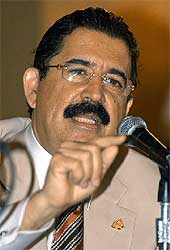
In Honduras, President Manuel Zelaya ordered that all TV and radio stations must air government propaganda for two hours daily starting on Monday for ten straight days. Zelaya’s edict comes after having “poor relations” with the media since coming into power in 2005, and may be legal since the law allows for government to order broadcasters to transmit messages that are “of importance to the country”.

Honduran newspaper Tiempo Digital reports that the country’s main journalists association has demanded that Zelaya reconsider his controversial decision:

“For the Journalists College it has been a surprise to find out that the president wishes to impose his will on radio and television stations. In the past, the people have been disturbed by many de facto stations working for the government.”

(La Tribuna has the entire communiqué from the president of the Honduras Journalists College).

Sources (English)- CNN, BBC News, The Latin Americanist, Associated Press - Far and Wide

Sources (Spanish)- Tiempo Digital, La Tribuna

Image- 20minutos.es