Showing posts with label water. Show all posts
Showing posts with label water. Show all posts
Monday, November 7, 2016
Daily Headlines: November 7, 2016
* Nicaragua: President Daniel Ortega easily won a third straight term during an election marred by the lack of international observers and accusations of fraud by the opposition.
* Puerto Rico: Ricardo Rossello, the odds-on favorite to become Puerto Rico’s next governor, has pushed for statehood in order to pull the commonwealth out of its economic crisis and “finally finish the 500-year debacle that has been colonialism.”
* Bolivia: The presidents of Bolivia and Peru agreed on a comprehensive plan that would provide landlocked Bolivia access to the ocean.
* Ecuador: Diplomatic authorities gave Swedish investigators permission to question Wikilieaks founder Julian Assange at the Ecuadorian embassy in London next week.
YouTube Source – France 24 English (“Former Marxist guerrilla leader Daniel Ortega is expected to easily clinch a third consecutive term as president of Nicaragua on Sunday, buoyed by steady economic growth that has trumped fears he is trying to install autocratic family rule.”)
Online Sources – Los Angeles Times, Fox News Latino, UPI, Mashable

Monday, April 18, 2016
Daily Headlines: April 18, 2016
* Latin America: Ecuadoran officials claimed the death toll from a 7.8-magniude earthquake on Saturday night that was the country’s worst tremor since 1979 rose to 350 fatalities.
* Brazil: Financial markets in Brazil opened today with gains after the House of Deputies easily approved sending the impeachment process against President Dilma Rousseff to the Senate.
* Chile: Some 4 million people Santiago is without drinking water and parts of in central Chile are flooded following periods of “unusually” heavy rainfall.
* Venezuela: Venezuela President Nicolás Maduro announced that clocks would be turned ahead by 30 minutes to help ease the country's energy crisis.
YouTube Source – euronews
Online Sources – CNBC, Reuters, NBC News, Bloomberg
Tuesday, March 29, 2016
Daily Headlines: March 29, 2016
* Chile: President Michelle Bachelet of Chile said her government could countersue Bolivia at the International Court of Justice regarding a dispute over water rights from the Silala River located in a border region.
* Latin America: Argentina and Uruguay’s joint bid to host the 2030 World Cup received a boost from the president of FIFA, while the ex-chief of the Honduran soccer federation pled guilty to his role in the “FIFA-gate” corruption scandal.
* Brazil: A group of Brazilian legislators called for relaxing the country’s harsh gun laws even though 60,000 homicides took place in the country in 2014.
* Puerto Rico: A U.S. federal judge sided with Wal-Mart and quashed a law that raised taxes wealthy companies paid “on goods they buy from ‘related parties’” in debt-ridden Puerto Rico.
YouTube Source – CCTV News (“Bolivia argues it owns the Silala River and is not being compensated for Chile's use of the water. Chile argues that the water flows across their shared border and therefore it constitutes as an international river.”)
Online Sources – NPR, Fortune, Sky Sports, euronews, ABC News
Friday, February 19, 2016
Daily Headlines: February 19, 2016
* Latin America: According to the World Bank, Latin America could lose approximately $3.5 billion due to the Zika virus outbreak with some tourism-dependent countries losing over 1% of gross domestic product.
* Peru: The Peruvian government declared a water quality emergency after a pair of oil spills contaminated water supplies in the Amazonas and Loreto regions.
* U.S.: An estimated 14,000 gathered at the Wisconsin state Capitol building as part of the “Day Without Latinos” protest against strong anti-immigrant measures.
* Puerto Rico: The untimely death of Supreme Court judge Antonin Scalia might improve the odds of the high court ruling in favor of a debt restructuring program for Puerto Rico.
YouTube Source – CCTV America
Online Sources – Peru This Week, NASDAQ, Fusion, Reuters
Thursday, August 27, 2015
Daily Headlines: August 27, 2015
* Latin America: Economic experts and environmental analysts warned that Latin American and Caribbean states must lower water consumption for agricultural needs in order to ensure water security throughout the region.
* U.S.: A Texas court issued a reprieve against the execution of a convicted Nicaraguan national, while the mother of an Argentine on death row in Texas for 19 years is hoping that Pope Francis will intervene during his U.S. visit next month.
* Ecuador: For the second straight year an InterNations survey named Ecuador as the best country for expats including the highest scores in areas like “feeling welcome,” “personal finance” and “cost of living”.
* Colombia: A coalition of Colombian women’s rights groups called for the government to take a more active role in investigating sexual violence by “state security forces, paramilitaries and other private actors.”
YouTube Source – CCTV Americas Now
Online Sources – Economic Times, Fox News Latino, The Guardian, U.S. News & World Report, NBC News
Monday, February 2, 2015
Daily Headlines: February 2, 2015
* Brazil: Brazil's worst drought in decades has led to special alerts in four Brazilian states including Rio de Janeiro and São Paulo, decreased agriculture production in Espirito Santo and water rationing in more than ninety cities.
* South America: The Argentine government wants to create a new intelligence agency in the wake of the death of prosecutor Alberto Nisman while scandal-plagued former Colombian intel chief Maria del Pilar Hurtado turned herself in to police.
* Venezuela: Is U.S. Vice President Joe Biden planning a coup against Venezuela’s government or is Nicolás Maduro searching for scapegoats amid a domestic economic crisis?
* Chile: President Michelle Bachelet proposed reforming Chile’s complete ban on abortion by legalizing the procedure in cases of rape or when the mother’s life is at risk.
Video Source – YouTube user Reuters (“Agricultural producers in Rio de Janeiro state battle with the worst drought Brazil has seen in 80 years which is killing large numbers of livestock and crops.”)
Online Sources – Latin American Herald Tribune; Buenos Aires Herald; BBC News; Bernama; UPI
Monday, November 3, 2014
Daily Headlines: November 3, 2014
* Latin America: Residents in countries like Mexico and Guatemala over the weekend commemorated their respective holidays to honor and respect the deeds.
* Argentina: The Argentine government suspended the operations of Procter & Gamble after accusing the household products giant of committing $138 million in tax fraud.
* Puerto Rico: Gov. Alejandro Garcia Padilla urged Puerto Ricans to unite and work harder to overcome the commonwealth’s “worst fiscal and economic crisis ... since the 1940s.”
* Brazil: Several hundred people took to the streets of Sao Paulo to protest water shortages and perceived inaction by local officials.
Video Source – YouTube user Charles and Ray Eames (1957 short film by famed industrial design duo Charles and Ray Eames on Mexico’s Day of the Dead holiday).
Online Sources – euronews; Latin Post; Reuters; Hispanically Speaking News; Fox News Latino
Tuesday, September 9, 2014
Daily Headlines: September 9, 2014
* Mexico: Drought conditions on both sides of the border over the past few years could explain why Mexico allegedly owes some 380,000 acre-feet of water to the U.S.
* Latin America: A recent UNICEF report found that Latin America and the Caribbean has the worst homicide rate among children and youth, and at roughly three times the global average.
* Venezuela: Has Venezuela unofficially fallen into a recession due to a decrease of goods coming into the country?
* Honduras: According to Honduras’ human rights commissioner the number of deaths caused by firearms had more than doubled between 2005 and 2013.
Video Source – Reuters via YouTube (Areas of northern Mexico were devastated in 2011 due to the worst drought conditions in about seventy years).
Online Sources – The Washington Post; MercoPress; LAHT; Reuters
Saturday, March 22, 2014
The Weekender – Water
“The Weekender” is our new feature where every weekend we hope to highlight a short film, movie or documentary pertaining to Latin American and the Caribbean.
March 22nd is the U.N.-sponsored World Water Day, which helps to examine the importance of water in our daily lives and the challenges communities face globally in order to gain access to such a vital substance. This year’s theme focuses on the “closely linked an interdependent” relation between water and energy including how they affect economic development and wealth worldwide.
The 2009 documentary Water Which Makes Us Alive looks at how residents of the Peruvian community of Andamarca manage the limited supplies of water that are in their area. Their system of self-regulation aims to ensure that they can all have a fair access to water for all and helps in the survival of the Andamarca area.
According to a synopsis of the documentary from Culture Unplugged Studios, “This spiritual, social and political system of water management is an example for managing water resources for irrigation in a participatory, democratic way that respects the ecosystem…Without the sense of unity that underlies this collective management, the inhabitants would break their roots and the community would be transformed into a dead place.
Unfortunately Water Which Makes Us Alive cannot be embedded though we have included a link to the very insightful and interesting film. This link is available under the page break as well as a short embedded video on an innovative billboard in Peru that converts air into potable water.
March 22nd is the U.N.-sponsored World Water Day, which helps to examine the importance of water in our daily lives and the challenges communities face globally in order to gain access to such a vital substance. This year’s theme focuses on the “closely linked an interdependent” relation between water and energy including how they affect economic development and wealth worldwide.
The 2009 documentary Water Which Makes Us Alive looks at how residents of the Peruvian community of Andamarca manage the limited supplies of water that are in their area. Their system of self-regulation aims to ensure that they can all have a fair access to water for all and helps in the survival of the Andamarca area.
According to a synopsis of the documentary from Culture Unplugged Studios, “This spiritual, social and political system of water management is an example for managing water resources for irrigation in a participatory, democratic way that respects the ecosystem…Without the sense of unity that underlies this collective management, the inhabitants would break their roots and the community would be transformed into a dead place.
Unfortunately Water Which Makes Us Alive cannot be embedded though we have included a link to the very insightful and interesting film. This link is available under the page break as well as a short embedded video on an innovative billboard in Peru that converts air into potable water.
Wednesday, March 19, 2014
”Extreme Emergency” in Drought-Hit Haitian Region
When referring to the affects of weather on Haiti one probably thinks of hurricanes and other tropical storms ravaging the Caribbean nation. Yet northeastern Haiti has been hit by a doughty so severe that one government official called the situation an “extreme emergency.”
According to Pierre Gary Mathieu, representative of Haiti’s National Coordination of Food Security (CNSA), the drought has lasted eight months and has led to the loss of two harvest seasons. As a result, farmers have been forced to travel farther in order to obtain water while some schools where meals are provided to impoverished students do not have water or food.
“People need jobs immediately but they also need food,” Mathieu said to the Associated Press (AP) in an article published on Wednesday.
Even though some rain has fallen recently in the affected area, Mathieu believes that it will take at least six months for a recovery to occur. Nevertheless, government officials are expected to meet tomorrow with international aid workers in order to plan out a proper response to the drought affected area. (A World Food Program spokesman told the AP that the organization would send food kits containing rice, beans and cooking oil to some 120,000 people in northwestern Haiti).
The latest CNSA outlook for the first six months of this year concluded that the drought may not affect national food production and availability yet could cause a “deterioration” in food security in dry areas. For example, Haiti has imported thousands of tons of rice from Vietnam to satisfy local demand yet rice farmers in areas like Maribaroux and Fort Liberté have experienced difficulties due to “the lack of water in irrigation systems.”
Thursday, February 20, 2014
Daily Headlines: February 20, 2014
* Panama: Work on a major expansion of the Panama Canal is expected to resume today after a two-week hiatus due to disputes over cost overruns and financing the project.
* Latin America: According to a new Gallup poll 58% of people in the U.S. have a favorable view of Mexico compared to 47% of respondents last year.
* Haiti: “I am going to share with the pope the reality of Haiti: speak to him of our riches, of our weaknesses and our limits,” said Chibly Langlois, who on Saturday will become Haiti’s first Roman Catholic Cardinal.
* Bolivia: How did unrest in Bolivia eleven years ago affect a recent Indian court ruling regarding water services?
Video Source – euronews via YouTube
Online Sources- Reuters; Gallup; GlobalPost; Business Standard
Thursday, April 25, 2013
Today’s Video: Melting Away
The latest edition of Earth Day was held on April 22nd with the theme of “The Face of Climate Change.” While some strides have been made towards addressing global warming, the phenomena have been blamed for environmental problems in parts of the world.
Scientists have identified climate change as the main reason for the rapid melting of glaciers in several Latin America countries. Such is the case in Peru where the nation’s eighteen mountain glaciers are vital to the region's water sources for drinking, irrigation and electricity. The possibility that Peru’s glaciers could disappear over the next few decades has officials in Peru and the U.S. worried over the political ramifications of “millions and millions of hungry and thirsty” individuals.
Peruvian communities have created innovative ways to prevent the shortage of water caused by the shrinking glaciers. It remains to be seen if catching moisture from fogs and other measures will be sufficient to help Peruvians:
Scientists have identified climate change as the main reason for the rapid melting of glaciers in several Latin America countries. Such is the case in Peru where the nation’s eighteen mountain glaciers are vital to the region's water sources for drinking, irrigation and electricity. The possibility that Peru’s glaciers could disappear over the next few decades has officials in Peru and the U.S. worried over the political ramifications of “millions and millions of hungry and thirsty” individuals.
Peruvian communities have created innovative ways to prevent the shortage of water caused by the shrinking glaciers. It remains to be seen if catching moisture from fogs and other measures will be sufficient to help Peruvians:
Saturday, November 10, 2012
Weekend Headlines: November 10-11, 2012
* Cuba: Blogger Yoani Sánchez and ex-hunger striker Guillermo Fariñas were among the approximately twenty dissidents briefly detained after protesting in Havana.
* Guatemala: A family of ten were among the over fifty fatalities caused by Wednesday's 7.4-magnitude earthquake that was the most powerful to hit the nation since 1976.
* Mexico: U.S. and Mexican officials are reportedly close to signing a pact regarding water use in the border region.
* Argentina: The Argentine government may be forced by a U.S. court to pay billions of dollars in defaulted debt to private creditors.
Tuesday, March 20, 2012
Ecuador Anti-Mining March Heading Into Homestretch
In Ecuador several hundred demonstrators are nearing the end of their two-week march to protest against government-backed large-scale mining projects. Demonstrators, such as members of Ecuador's main indigenous organization (CONAI), alleged that the new mining would displace entire communities and cause deep environmental damage.
The march began on March 8th, days after President Rafael Correa signed a deal for the $400 million investment in a copper mining project near El Pangui. He has claimed that the project will help bring much-needed development for the region and that the marchers have the “aim of destabilizing” the government.
The protest is expected to finish on World Water Day, which is not a coincidence since critics against the planned project worry that water supplies could become contaminated. According to a report from the informatEcuador website (and translated via Global Voices):
The mining zone for this project is located exactly on one of the main water sources for the city of Cuenca and many other towns. Many inhabitants of these towns are protesting against this activity with very good reason.The vice president of CONAI said that at least 20,000 demonstrators are expected to converge on Thursday in Quito.
It remains to be seen if the "March for water, life and the dignity of the people" will lead to policy changes. Yet the debate over water usage and control that has affected parts of Latin America in the past will likely continue to be a controversial issue.
Video Source – YouTube via TeleamazonasEC
Online Sources- The Nation, CRE, Global Voices Online, Reuters, BBC News
Wednesday, September 28, 2011
Daily Headlines: September 28, 2011
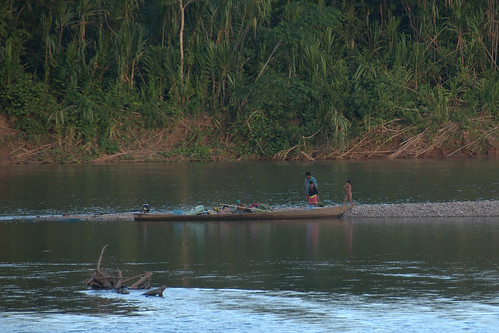
* Latin America: A study of major river basins worldwide including some in Latin America concluded that “inefficient use and unfair distribution” of water are affecting global food production.
* Bolivia: The country’s interior minister and his deputy resigned yesterday as a result of alleged police brutality during protests over the weekend against a controversial highway project.
* Costa Rica: A report found that Costa Rica is the top Central American country for money laundering with over $4 billion laundered between 2000 and 2009.
* U.S.: Baltimore Orioles slugger Vladimir Guerrero became the all-time hits leader for a player born in the Dominican Republic.
Image – Via Flickr user Bird Brian (“Indigenous nomad family on the Tambopata River.”) (CC BY 2.0)
Online Sources- MLB.com, InSight, Huffington Post, The Latin Americanist, Bloomberg
Wednesday, June 8, 2011
Today’s Video: Zoom
On Thursday a rocket is scheduled to take off carrying the "Aquarius/SAC-D" satellite into space as part of a collaborative effort between the U.S. and Argentine space agencies. The aim of the satellite is to measure the levels of salt in the world's oceans. The importance of the Aquarius project, as one of the team's researchers told MercoPress, cannot be understated:
The project has generated plenty of excitement among members of CONAE, Argentina's space agency. "We may come from different places, but we all talk the same language. And it isn't English - it's science," said CONAE investigator Sandra Torrusio to the Space Daily.
For more on the Aquarius project and the progress made by Argentine scientists check out the following video from GlobalPost:
By the way, the title to this post was inspired by this song from seminal Argentine rockeros Soda Stereo.
Online Sources - MercoPress, Space Daily, Boston Globe
Video Source - GlobalPost, YouTube
“Salinity is the glue that bonds two major components of Earth's complex climate system: ocean circulation and the global water cycle,” said Aquarius Principal Investigator Gary Lagerloef of Earth & Space Research in Seattle. “Aquarius will map global variations in salinity in unprecedented detail, leading to new discoveries that will improve our ability to predict future climate.”Researchers hope that in a few months the equipment on the "Aquarius/SAC-D" satellite can update 125 years of data obtained by ships and buoys.
The project has generated plenty of excitement among members of CONAE, Argentina's space agency. "We may come from different places, but we all talk the same language. And it isn't English - it's science," said CONAE investigator Sandra Torrusio to the Space Daily.
For more on the Aquarius project and the progress made by Argentine scientists check out the following video from GlobalPost:

By the way, the title to this post was inspired by this song from seminal Argentine rockeros Soda Stereo.
Online Sources - MercoPress, Space Daily, Boston Globe
Video Source - GlobalPost, YouTube
Tuesday, March 22, 2011
Today’s Video: High and dry
There are several items in the news that we plan on discussing today including some related to U.S. President Barack Obama's visit to Latin America. Before doing so, however, we would like to point out that today is World Water Day.
According to British risk consultants Maplecroft, most countries in the Middle East and North Africa have very insecure water supplies and this could lead to increased political strife. Regarding Latin America, a majority of countries in Central and South America face a "medium" water security risk. Some of these states have faced mixed results after the privatization of publicly-owned water companies though the main challenge according to IPS news is "expanding coverage of high-quality water services".
In the Americas, Mexico is one of the few "high" risk countries regarding water supply according to the Maplecroft study. Water shortages have hurt the metropolis of Mexico City though other parts of Mexico are also affected by a lack of safe water resources. This (along with "clever advertising campaigns by multinational corporations" and government inaction) has led Mexico to become the world's top consumer of bottled water.
The following video via YouTube user nanasurbanas looks at the many difficulties faced by the indigenous Huichol community due to the scarcity of potable water. It is a very fitting video to feature on World Water Day:
Online Sources - Maplecroft, AHN, IPS, Al Jazeera English, McClatchy
Video Source - nanasurbanas via YouTube
According to British risk consultants Maplecroft, most countries in the Middle East and North Africa have very insecure water supplies and this could lead to increased political strife. Regarding Latin America, a majority of countries in Central and South America face a "medium" water security risk. Some of these states have faced mixed results after the privatization of publicly-owned water companies though the main challenge according to IPS news is "expanding coverage of high-quality water services".
In the Americas, Mexico is one of the few "high" risk countries regarding water supply according to the Maplecroft study. Water shortages have hurt the metropolis of Mexico City though other parts of Mexico are also affected by a lack of safe water resources. This (along with "clever advertising campaigns by multinational corporations" and government inaction) has led Mexico to become the world's top consumer of bottled water.
The following video via YouTube user nanasurbanas looks at the many difficulties faced by the indigenous Huichol community due to the scarcity of potable water. It is a very fitting video to feature on World Water Day:
Online Sources - Maplecroft, AHN, IPS, Al Jazeera English, McClatchy
Video Source - nanasurbanas via YouTube
Monday, April 12, 2010
Daily Headlines: April 12, 2010
 * Chile: Conservative legislators banded together and defeated a measure that would’ve renamed Chile’s main international airport in honor of the late poet Pablo Neruda.
* Nicaragua: A study done on Lake Apanas- a UNESCO-listed nature reserve- found that the lake is polluted and endangering local wildlife.
* Puerto Rico: Puerto Rican pugilist Miguel Cotto will fight WBA super welterweight champion Yuri Foreman in a June bout at Yankee Stadium.
* Argentina: Spanish authorities approved the extradition of an Argentine pilot accused of participating in “death flights” during the infamous Dirty War period.
Image – Guardian UK (“Lover boy ... Pablo Neruda with his wife Delia.”)
Online Sources- Expatica Spain, Bloomberg, Xinhua, AP
Wednesday, September 23, 2009
Daily Headlines: September 23, 2009
 * Chile: The border dispute between Bolivia and Chile has heated up over “a highland stream” that flows through the Atacama desert.
* Mexico: Representatives of the Diego Rivera and Frida Kahlo Trust filed a lawsuit yesterday regarding over 1200 pieces of allegedly forged Kahlo art that appeared in a pair of books.
* Haiti: Mourners in Miami paid remembrance to an 8-month-old girl who died with eight other Haitian migrants at sea last May.
* Latin America: According to some counternarcotics officials in the Americas, “at least nine top-tier Latin American drug cartels have established bases in 11 West African nations.”
Image- New York Times (“Licancabur volcano towers above the high desert Andean plain on the Chilean-Bolivian border.”)
Online Sources- AP, LAHT, CNN, Reuters
Tuesday, August 25, 2009
Today’s Video: Parched in Mexico
Mexico is undergoing its driest spell in nearly seven decades. But how bad is the drought in that country? Enough for one official to wish for hurricanes:
(Video link):
Online Sources- Reuters, LAHT
From the beginning of the hurricane season to date, seven storms have formed in the Pacific and three in the Atlantic. But none has come near enough to Mexico’s coasts to dump a significant amount of rainfall and thus alleviate the drought.I’m not a meteorologist or a water expert, but I don’t think the solution to having too little water is to hope for too much of it at once. Then again it may not be such an odd notion when cities are rationing water usage, reservoirs are running dry, and small farmers are suffering due to hundreds of dead cattle.
“Despite the destructive force of these phenomena, Mexico can’t live without them. The country would be nothing but desert,” the Conagua official said.
(Video link):
Online Sources- Reuters, LAHT
Subscribe to:
Posts (Atom)