Monday, February 07, 2011

Ex-braceros demand owed funds from Mexico

The bracero program ran in the U.S. from 1942 to 1964 and permitted over four million Mexicans to legally labor as guest workers. The jobs were often backbreaking, physically demanding positions on farms, mines and rail yards where workers earned only a few dollars per day. The bracero program would eventually end after numerous employer abuses were revealed such as employees signing strict work contracts in English.

In 2008 a U.S. court settlement obligated the Mexican government to pay compensation to braceros that worked in the first five years of the program. Yet legal red tape in Mexico has delayed the distribution of the withered funds. Hence, several former braceros and their families protested in front of the Mexican consulate in Los Angeles last wee and they demanded the money promised to them by the Mexican government:
The Mexican government put 10 percent of the braceros’ wages into savings accounts for later use. Some braceros received their savings, but (ex-bracero Juan Javier) Jimenez and about 35,000 others are still waiting. Some have died.

The soft-spoken Jimenez said he’s gotten the runaround for years. He called on the Mexican government to publish regulations that provide for payments of about $4,000 each.
The amount sought by the former braceros is modest but well deserved in recognition of all their dedication and hard work.

Image- PBS
Online Sources- PBS, scpr.org, The Latin Americanist

Bolivia renews demands for access to sea

It has been over a century since Bolivia ceded its coastline to neighboring Chile. Recent efforts by landlocked Bolivia to regain access to the sea have been repeatedly rejected by Chile and odds are that it will not change this week.

For the first time since 1950, Chile’s Foreign Minster met with his Bolivian counterpart in La Paz. Bolivia’s David Choquehuanca is expected to bring up the contentious issue of Bolivian access to the Pacific Ocean during his meeting with the visiting Chilean diplomatic chief, Alfredo Moreno. The Chilean delegation will seek a “useful, feasible, and practical” answer to the Bolivian demands, said Moreno though he refrained from publicly endorsing a specific solution.

The bilateral discussions were somewhat marred by allegations from a former senior Bolivian diplomat that ex-president Michelle Bachelet proposed access to the sea via a seventeen-mile stretch of land that would still remain under Chilean sovereignty. Current president Sebastián Piñera would subsequently reject such an option according to former Bolivian Deputy Foreign Minister Hugo Fernandez. (Choquehuanca publicly denounced Fernandez’ claims).

Last October Peru granted Bolivia access to build a port on a “desolate patch of…shoreline”, which was a diplomatic breakthrough. The role of Peru, which also ceded land to Chile in 1904, in any negotiations between Bolivia and Chile cannot be understated. For instance, the Peruvian government refused to agree to a provision plan in 1975 due to 19th-century territorial claims.

Image- BBC Mundo (19th-century map of Peru (in pink) and Bolivia (in green)).
Online Sources- Terra Peru, The Latin Americanist, La Tercera, AFP, The Guardian, EFE, BBC Mundo

News Briefs: Immigration

  • According to the Los Angeles Times there has been an influx of Indian migrants crossing the U.S. border with Mexico. Immigration authorities claimed that the hundreds of migrants make up “the ‘most significant’ human-smuggling trend being tracked by the U.S.” Meanwhile Homeland Security asserts that none of the 1600 Indians caught trying to cross the border last year were classified as terrorists.
  • Some immigration rights activists are none too pleased with an iPhone app game depicting smugglers. The app "pokes fun and trivializes the harsh reality of our current immigration policy," said a representative of the New York Immigration Coalition to a local daily. One of the game’s developers claimed, however, that the app is satirical and based on the difficulties his friends had trying to immigrate into the U.S.
  • A study by the International Institute for Environment and Development said that climate change will not lead to mass migrations around the world. The report cited studies in countries like Bolivia to conclude that most people displaced by climate change prefer to stay inside their own country.
  • In Texas a group of Hispanic Republican legislators are trying to steer the GOP away from backing harsh anti-immigrant measures. In neighboring New Mexico, meanwhile, Republican Governor Susana Martinez has come under fire for her executive order allowing police to seek the immigration status of suspects.
  • A U.S. appeals court upheld a $78,000 claims ruling against a rancher who purportedly threatened and assaulted a group of four migrant women. The judge who at one point oversaw the trial, John Roll, received death threats and was killed last month in a shooting that critically injured Congresswoman Gabrielle Giffords.
  • Canada’s Museum of Immigration opened today at Halifax’s Pier 21 which served as a “front door for more than a million immigrants, refugees, troops, wartime evacuees, war brides and their children.”
  • Lastly, a Pew Hispanic Center report released last week may have poured some cold water on the “anchor babies” myth.
Image- Los Angeles Times (“In Harlingen, Texas, Indian citizens released from an immigration center often are taken to the Greyhound bus station. Many struggle with poor English as they try to call family or friends, or buy travel tickets. (Don Bartletti, Los Angeles Times / February 6, 2011).”)
Online Sources- Economic Times, New York Daily News, Bloomberg, UPI, El Paso Times, Houston Chronicle, SFGate.com, CTV, USA TODAY

Daily Headlines: February 7, 2011

* Peru: The Third Summit of South American-Arab Countries that was supposed to take place in Lima next week was suspended due to the unrest in Egypt.

* Haiti: Immigrant activists and Haitian expat groups have urged an end to deportations from the U.S. after a recently expelled migrant died of "cholera-like symptoms."

* Chile: Police raided a luxury hotel on Easter Island and evicted a group of indigenous protesters who claimed that the resort was built illegally on their land.

* Cuba: The leader of Cuban opposition group the Ladies in White told the AP that she will try to convince one of her fellow female dissidents to halt her eleven-day-old hunger strike.

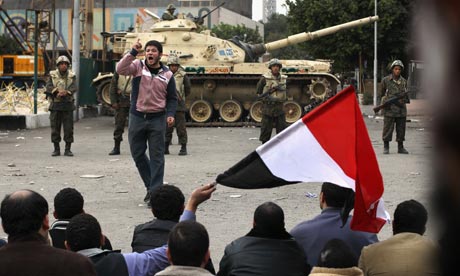
Image Source - Reuters/Mohamed Abdel Ghany via Reuters ("Pro-government demonstrators (front) face-off against anti-Mubarak supporters near Tahrir Square in Cairo February 2, 2011.")
Online Sources - MSNBC, Canadian Press, MiamiHerald.com, MercoPress

Sunday, February 06, 2011

Today’s Video: "Africa Rising"

Today is the International Day of Zero Tolerance to Female Genital Mutilation, an occasion in which to raise the awareness of the estimated 100 to 140 million women around the world who have had partial or complete circumcisions. Female genital mutilations are more common in Africa compared to other regions of the world though the practice has gradually decreased in countries like Ethiopia, Kenya and Egypt.

According to the International Organization for Migration the practice of female circumcisions has spread to Western countries but it's still relatively rare in Latin America. Nevertheless, Salvadoran-born filmmaker Paula Heredia focused on the fight against female genital mutilations in parts of Africa. She directed and produced the 2009 documentary "Africa Rising", a very revealing film that includes the following clip:

Online Sources - Voice of America, The Guardian, Deutsche Welle, imdb.com
Video Source - Women Make Movies via YouTube

Saturday, February 05, 2011

World Watch: Impasse

* Egypt: President Hosni Mubarak's piecemeal stabs at political reform and permitting the Muslim Brotherhood to participate in a dialogue with the government may not be enough to halt protests against the Mubarak regime.

* Asia: Cambodia and Thailand called a "tentative ceasefire" after a soldier died while the army fought in a disputed border area.

* Somalia: A "looming catastrophe" could occur in Somalia due to severe drought according to aid groups.

* Serbia: An estimated 55,000 demonstrated in Belgrade and called for the government to hold early elections.

Image Source - John Moore/Getty Images via The Guardian ("A protester leads fellow anti-government demonstrators in chants against Hosni Mubarak in Tahrir Square. They remained in the square following Friday's mass rally calling for the president to resign.")
Online Sources - BBC News, Voice of America, MSNBC, Al Jazeera English

Weekend Headlines: February 5-6, 2011

* Cuba: Gradually improving relations between the U.S. and Cuba could quickly sour after prosecutors on the island said that they would seek a twenty year prison sentence against a U.S. citizen accused of spying.

* Panama: According to Panama's National Association Against Cancer approximately half of the country's 4,500 registered cancer patients die as a result of a late diagnosis.

* Chile: The Marcelo Bielsa "soap opera" seemed to have ended on Friday when he announced his resignation as the coach of Chile's national soccer team.

* Mexico: A U.N. report concluded that since 2006 over 1000 children have been killed in connection with the Mexican government's offensive against drug gangs.

Image Source - PRESS TV (Alan Gross, seen in this photo with his wife, has been detained in Cuba since December 2009 and accused of spying for the U.S. government. The State Department rejected the allegation and assured that he was an aid worker contracted by Washington).
Online Sources - Goal.com, ABC News (Australia), LAHT, Xinhua, The Latin Americanist

Friday, February 04, 2011

Another Argentine woman dies via incineration

A quick follow-up on a story we mentioned earlier this week on violence against women.

As we mentioned on Tuesday, an Argentine women’s’ rights group claimed that there were 260 femicides last year with eleven of them resulting from incineration. According to La Casa del Encuentro the women’s current or former partner does most of these attacks and a spokesperson for the organization urged the government to categorize femicides in an independent crime category.

Sadly the trend of burning women continued into this year with another woman dying yesterday and becoming the fourth lady to die via incineration over the past two weeks:
The most recent case…was that of 32-yrar-old Verónica Medina who died on Thursday due to injuries sustained three weeks ago when she was doused with alcohol and set on fire. (The incident) occurred during a quarrel with her husband and in the presence of her two children.

Medina ran out into the street engulfed in flames to seek help from her neighbors. She was able to accuse her husband, something that most victims are unable to do because they die before accusing their aggressor.
Medina’s husband is currently under police custody and accused with homicide.

According to Argentine daily Clarin, 54 women have been admitted since 2005 to the Hospital de Quemados (Burn Hospital) after being immolated. Yet the medical center’s director, Juan Carlos Ortega, admitted that some of the cases could have been attacks against women that went undetected at the time.

Image- tipete.com
Online Sources- The Latin Americanist, EmpowHer, ABC.es, Clarin.com

Daily Headlines: February 4, 2011


* Haiti: The country’s electoral commission ruled against permitting government-backed candidate Jude Celestin to participate in next month’s second round of presidential elections.

* Colombia: A U.S. appeals court reopened a lawsuit alleging that the Drummond mining firm hired paramilitaries to kill three Colombian union activists.

* Chile: Energy could soon be rationed due to a variety of factors including a dry spell causing decreased hydroelectric output.

* Venezuela: The number of cholera cases in Venezuela has increased to 239 though there has yet to be a reported fatality.

Video Source – Reuters (Ex-first lady Mirlande Manigat will face musician Michel Martelly in the March 16th runoff election for the Haitian presidency).
Online Sources- CNN, Reuters, ABC News, Xinhua

Thursday, February 03, 2011

Brazilian journos allegedly harassed in Egypt

Visit msnbc.com for breaking news, world news, and news about the economy


Could Hosni Mubarak’s thirty years in the Egyptian presidency soon come to an end? According to the New York Times the White House is negotiating a deal where Mubarak would immediately resign and hand power to a provisional government led by recently appointed Vice President Omar Suleiman.

Even if a deal could be worked out tens (if not hundreds) of thousands of Egyptian demonstrators will likely not stand down. Indeed, mass protests are being organized for Friday, which some activists have called the "Day of Departure".

Thursday was marked by an increase on attacks on journalists, particularly those trying to do their job in the capital city of Cairo. Members of different media outlets from countries including the U.S., Japan, Britain, India and Sweden became targets of harassment, assault, and arrest reportedly by “angry supporters” of Mubarak. A pair of Brazilians was not immune from this assault on the press according to the Committee to Protect Journalists (CPJ):
Corban Costa of Brazilian Radio Nacional and cameraman Gilvan Rocha of TV Brasil were detained, blindfolded, and had their passports and equipment seized, according to Brazilian news accounts. The two were reportedly held overnight without water in a windowless room in a Cairo police station. An officer forced the reporters to sign a statement in Arabic saying they would immediately leave Egypt for Brazil, reports said. "We had to trust what he said, and sign the document, " Corban said. They said they will be sent back to Brazil on Friday.
The CPJ’s Mohamed Abdel Dayem told Voice of America that the assaults on the press were part of a government-backed “media blackout.” "The goal is to eliminate witnesses, journalists and otherwise, but really journalists are always the primary witnesses in any situation like this," added Dayem.

Suleiman denied that the government was pressuring the international media and instead accused the press of instigating unrest in Egypt. "I actually blame certain friendly nations who have television channels, they are not friendly at all, who have intensified the youth against the nation and the state," said the vice president to Nile TV.

Human rights activists were also supposedly the blank of attacks by pro-Mubarak factions; an official at Human Rights Watch claimed that researchers for the organization and Amnesty International were detained during a raid on a Cairo law center.

Video Source - MSNBC
Online Sources- MSNBC, GlobalPost, Committee to Protect Journalists, UOL Noticias, Voice of America, CNN, Human Rights Watch

World Watch: Liveblogs on Egypt


One of the most important news stories of the past week-and-a-half has been the uprising against the government in Egypt. The actions in Egypt are complex and more than the "binary 'good guys versus bad guys' lenses" espoused by some media sources and analysts according to this must-read article from the Jadaliyya e-zine.

With the ever-changing nature of the turmoil in Egypt, several news organizations have established liveblogs of the events. Here are a few of them (in alphabetical order):
Egyptian authorities forced the a blackout of Internet access, which lasted for approximately one week before being lifted on Wednesday. Nevertheless, as Global Voices' special coverage on Egypt showed, it was not enough to stifle communication outside of Egypt.

What are your thoughts on the events in Egypt? Please feel free to voice your respectful and civil opinion in the comments to this post.

Online Sources - Jadaliyya, Al Jazeera English, BBC News, Emerging America, NPR, Reuters, The Guardian, Global Voices, PC Magazine
Video Source - Al Jazeera via YouTube

Daily Headlines: February 3, 2011

* Cuba: The Castro administration may have promised to free four political prisoners yet a pair of dissident activists started a hunger strike against the government’s pressure to exile them.

* Brazil: Recently inaugurated President Dilma Rousseff may not be too keen on arms purchases as her predecessor, Luiz Inacio Lula da Silva.

* Argentina: Activity slowly resumed in the major port of Rosario after workers lifted an eight-day-long strike.

* Caribbean: Baseball’s Caribbean Series began last night with Mexico’s Yaquis de Obregon beating the Dominican Republic's Toros del Este in a sixteen-inning marathon.

Image – AFP via France24 (“Alejandrina Garcia (2nd R), the wife of political prisoner Diosdado Gonzalez, speaks on her mobile phone next to other relatives of Cuban political prisoners in Havana, in 2010. Two of the 11 high-profile Cuban political dissidents who rejected a deal for foreign exile have begun a hunger strike, an opposition group said.”).
Online Sources- UPI, Reuters, France24, Univision.com

Wednesday, February 02, 2011

Chevron files lawsuit vs. Ecuadorian plaintiffs

In the latest chapter in the legal battle between Chevron and Ecuadorian natives the former has raised the stakes in its offensive on the latter.

In the past several months, attorneys for the oil company have tried to raise doubts over claims made by the plaintiffs alleging environmental damage by Texaco (currently owned by Chevron) in the Ecuadorian rainforest. With a verdict expected soon in that multibillion-dollar lawsuit, Chevron filed a racketeering lawsuit yesterday against the legal team representing the plaintiffs. The federal lawsuit filed under the Racketeer Influenced and Corrupt Organizations Act (RICO) alleged that the Ecuadorian plaintiffs and their legal team aim to “extort (Chevron) into paying to stop the campaign against it". Furthermore, Chevron seeks a court order making any decision against the company in Ecuador unenforceable in the U.S.

Among those named as defendants in the RICO suit are lawyer Pablo Fajardo and community organizer Luis Yanza who both received the 2008 Goldman Environmental Prize for their work on the Ecuadorian case. Meanwhile, a spokesperson for the Ecuadorian plaintiffs accused Chevron of “corporate bullying at its worse.”

According to one analyst interviewed by the San Francisco Chronicle, the aim of the RICO suit may not be to seek a verdict but instead to put pressure on the Ecuadorians:
“The idea (behind the RICO statues) was to go after organized crime rings, but if you look at the law on its face, there are a number of situations it might cover that Congress might not have intended," said Sean Hecht, executive director of the Environmental Law Center at UCLA.

He questioned whether Chevron's suit might be a form of SLAPP, a strategic lawsuit against public participation. Such suits are designed primarily to apply pressure to the opposing side, rather than to win a judgment.
The lawsuit against Chevron has been filled with plenty of twists and turns; for instance, the firm won access to outtakes from a documentary about the lawsuit despite the objections of the filmmaker.

A Chevron ad campaign touting their corporate responsibility was satirically targeted by “activist-performers” The Yes Men last year.

Image- Dolores Ochoa R. / Associated Press via SFGate.com (“Indigenous women stand near an oil pit in 2005 in Ecuador, center of an 18-year legal battle with Chevron.”)
Online Sources- SFGate.com, Law.com, The Latin Americanist, FT.com, Reuters

Swiss "Duvalier Law" freezes ex-dictator's funds

While Jean-Claude Duvalier tries to put his spin on Haitian history, some of the foreign assets he allegedly stole during his presidency will not return to his hands.

A Swiss law nicknamed the "Duvalier Law" went into effect today, which blocks millions of dollars worth of assets belonging to the former Haitian strongman. Officially known as the Swiss Restitution of Illicit Assets Act, the law eases the "freezing, forfeiture and restitution" of assets stolen by corrupt politicians. If Duvalier wants his assets back he will have to demonstrate that he got them through legal means; otherwise, the funds could be claimed by the Haitian government.

The law was passed last year partly due to an embarrassing Swiss court decision that would've returned $4.6 million from Duvalier’s accounts that had originally been awarded to Haitian charities. Before that could be done, however, the Swiss parliament swiftly passed the law that came into effect today.

Duvalier, who recently returned to Haiti after being exiled, said in an interview with Univision insisted that the frozen Swiss funds did not belong to him. He claimed that they instead belonged to a foundation established by his family and that a “majority” of that money would be used to rebuild his mother’s city of birth.

Duvalier has been accused of embezzling over $100 million in public funds during his presidency between 1971 and 1986. Reports vary as to exactly how much money he has in Switzerland though one local news source claims that it’s approximately $6.2 million.

Duvalier hasn’t been the only strongman, past or present, recently targeted by the Swiss government:
The Swiss government has faced growing international pressure to change banking regulations after revelations that financial institutions had accepted money from former dictators such as Duvalier and Nigeria’s Sani Abacha. Until now, Swiss authorities insisted the rulers must be convicted at home before considering restituting any assets…

Switzerland on Jan. 19 said it had frozen any holdings of former Tunisian President Zine El Abidine Ben Ali and Ivory Coast leader Laurent Gbagbo to “prevent any possible misuse of the funds.”
Image - AFP via BBC News
Online Sources- BBC News, CNN, RTT News, swissinfo.ch, The Latin Americanist, Bloomberg

Daily Headlines: February 2, 2011

* Colombia: Juanes has reportedly cancelled an April 15th concert in Miami that was scheduled on the same date as the 50th anniversary of the Bay of Pigs invasion in Cuba.

* Caribbean: The mass deportations of thousands of undocumented Haitians from the Dominican Republic continues allegedly due to fears over the spread of cholera.

* Venezuela: Political relations between the U.S. and Venezuela are “at a standstill” according to a senior diplomat from the U.S. Embassy in Caracas.

* Brazil: The “pursuit of happiness” could soon become a Brazilian constitutional right.

Image – AFP via El Informador (Juanes performed in front of a crowd of over 90,000 spectators this past weekend in Merida, Mexico).
Online Sources- ABA Law Journal, The Latin Americanist, ABC News, El Universal, HULIQ

Tuesday, February 01, 2011

Mexican diplomat to Top Gear: Apologize

“The (Mexican) ambassador is going to be siting there with the remote control going like this [snores and imitates sleeping]. They won’t complain. It’s fine”.
---Jeremy Clarkson
Unfortunately for you, Mr. Clarkson, they did complain.

Mexican ambassador to Britain, Eduardo Medina Mora Icaza, demanded a public apology from the presenters of British motoring series “Top Gear” due to “xenophobic" and "offensive" comments made on their latest program. “In a country that boasts of its tolerance…it is totally incomprehensible and unacceptable that the premiere broadcaster should allow three of its presenters to display their bigotry and ignorance by mocking the people and culture of our country with such vehemence,” wrote Mora Icaza in a letter that was sent on Tuesday.

Clarkson and co-presenters James May and Richard Hammond have yet to publicly reply to Mora Icaza though it’s been reported “the BBC received the letter and plans to respond to the ambassador directly.”

The “Top Gear” presenters have not been immune to criticism over allegedly offensive comments on topics like environmentalism and truckers. They have previously raised the ire of Romanians and Germans, the latter occurring when Clarkson made mocking Nazi references while reviewing a BMW car.

Judge for yourself by watching the following video of the controversial remarks on Mexico and deciding if it was good-natured fun or in terrible taste:

It’ll be interesting to see if Hammond will defend his claims that Mexican cars reflects the country’s “characteristics” of being “lazy, feckless, flatulent, overweight, leaning against a fence asleep looking at a cactus with a blanket with a hole in the middle on as a coat." Perhaps the BBC will act much like in 2007 when the producers of an Australian reality show apologized for a “Mexican Night” challenge criticized as “offensive”.

Video Source - YouTube
Online Sources- Bloomberg, The Guardian, The Latin Americanist, MSNBC, The Scotsman, The Register, El Universal

Argentina: Rise in female incineration deaths

Perhaps the most well known case of violence against women in Latin America are the hundreds of femicides in the Mexico's Ciudad Juarez. In one South American country, meanwhile, an increase in femicides has caught the attention of police and women’s’ rights groups.

At least 260 women and young girls in Argentina were killed in 2010 including eleven via incineration according to local NGO La Casa del Encuentro. The number of female burn victims last year represented a slight increase compared to 2009 and includes the death of Wanda Taddei, the wife of former Los Callejeros member Eduardo Vázquez. (Quick aside: Los Callejeros were the rock band playing during 2004’s tragic Republica Cromagnon fire that claimed the lives of nearly 200 partygoers).

Sadly the increase in violence against women in Argentina continued into this year; last week alone three women were killed via incineration. Hence, La Casa representative Fabiana Tuñez proposed several reforms including preventing impunity against those accused of committing such crimes. Furthermore, as she told the local press:
"We ask that femicides are recognized as an independent criminal offense using antecedents that already exists in Guatemala, Costa Rica and most recently in Chile”…

The intent behind having femicides as a spate crime “is not because we believe that it is the only way to combat violence against women, but because it’s a judicial recognition to clearly show that this form of violence is unacceptable.”
The issue of violence against women has received renewed attention with the recant deaths of several Ciudad Juarez women’s rights activists. Additionally, an article published yesterday in Mexican daily El Universal accused the federal government of making “inoperable” a landmark 2007 law aimed at protecting women.

Image- El Universal
Online Sources- Terra Peru, The Latin Americanist, Clarin.com, ElComercial.com.ar

Daily Headlines: February 1, 2011

* Haiti: Former president Jean-Bertrand Aristide is one step closer to returning from exile after Haitian officials announced plans to issue him a diplomatic passport.

* Bolivia: At least 31 people are dead after floodwaters swept away a bus in a remote area of Bolivia.

* Chile: There is still a risk that an earthquake similar to the one that hit central Chile a year ago could again shake the region according to researchers.

* Mexico: Authorities offer a reward of over $1 million for information leading to the capture of anyone suspected in the gruesome August 2010 deaths of 72 Central American migrants.

Image – AP via BBC News (Former Haitian president Jean-Bertrand Aristide “fled the country in 2004, but says he is ready to return from exile in South Africa.”).
Online Sources- BBC News, Reuters, People’s Daily Online