Showing posts with label maras. Show all posts
Showing posts with label maras. Show all posts
Tuesday, July 24, 2012
Daily Headlines: July 24, 2012
* Argentina: Former dictator Jorge Videla, who was convicted weeks ago for the kidnapping and illegal adoptions of over thirty kids, said that the Catholic hierarchy “advised” him on how to deal with the disappearing of “Dirty War” dissidents.
* El Salvador: A truce between the Barrio 18 and Mara Salvatrucha street gangs has led to a plummeting murder rate as well as renewed optimism in the Salvadoran economy.
* Colombia: Four suspected FARC rebels were convicted by an indigenous tribunal and will be punished via public flogging.
* Ecuador: President Rafael Correa claimed that he would make a decision regarding Wikileaks founder Julian Assange’s asylum request “according to humanist principles.”
Video Source – YouTube via Al Jazeera English (In 2010 ex-dictator Jorge Videla was sentenced by an Argentine court to life in prison for human rights abuses during his rule between 1976 and 1983.)
Online Sources- Irish Times, The Latin Americanist, Businessweek, Fox News Latino, Bernama

Wednesday, September 24, 2008
Thou shalt not wear school uniforms
Making school uniforms "voluntary" may backfire in Guatemala
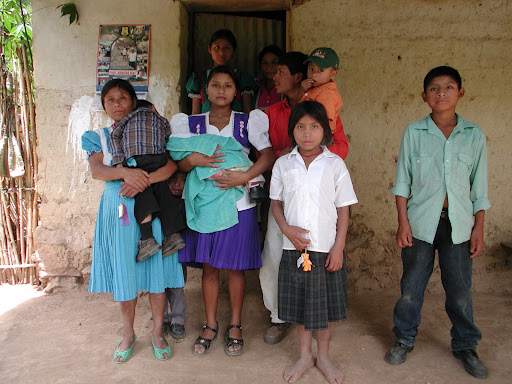 At first glance, Guatemalan President Alvaro Colom’s executive decree last week making school uniforms voluntary attire in public schools of all levels can be seen as a pragmatic and humanistic intervention. The education systems in the poorest countries of the region, one could surely argue, have long put an undue burden on the poor, and it's about time someone took a stand. And why not - they're just clothes, right?
“I can’t imagine the anguish of a parent that is unable to send his or her children to school,” Colom explained at his press conference. “In a way,” he added, “this is an act of income redistribution.” In a country where nearly 35% of the citizenry is functionally illiterate and the primary school completion rates are uncommonly low, Colom may be on to something. Guatemala is now the only place in the region (of which I am aware) to adapot national policy of voluntary uniforms.
For US citizens, the decree will make Colom sound like a true reformer, one in tune with civil liberties and the kinds of freedoms enjoyed in the US since the landmark Tinker V. Des Moines Supreme court case in 1969.
The decree, which also banned the ever-present “voluntary" school fees in most of the country’s public schools, follows a similar move last year from the Sandinista government in Nicaragua (where the act, incidentally, caused such an influx in enrollments that the government was unable to keep pace with teachers and infrastructure, and faced massive teacher strikes at the start of the school year).
While Colom’s intentions may be in the right place, the decree’s intended effects, however, are far from guaranteed. To be sure, for the vast majority of Guatemalans for whom school uniforms make school potentially a cost-prohibitive luxury, freedom of expression has not tended to be much of a concern. Three issues, however, call into question the wisdom of Colom’s seemingly rationale decision:
First, inherency: if uniforms are cost-prohibitive, why not just help families pay for them? Public and private financial assistance programs for books, uniforms, and other private costs to families have existed for years in countries such as El Salvador, Chile, Colombia, Mexico – and even in Guatemala. Nobody is complaining about the uniforms – just their marginal cost.
Second is the stigma that goes along with sending their child to a school where the social expectation is to send them in uniform. Changing culture is easier said than done, and in Guatemala, where formality and attire hold a particular cultural premium, no parent will want their child to be the exception to the norm, if not the rule. Those without uniforms will be segregating themselves, and potentially opening themselves up to a host of new challenges, biases, and mistreatment.
Third, the issue of allowing decorum to slide is apparently a monumental security concern for urban schools --where the majority of Guatemalan’s students are enrolled, and youth gangs and maras are real threats. “With this new rule, we won’t be able to tell who’s committing (acts of violence), noted one urban school teacher in Guatemala City.
Thus, at the start of the next school year, when the new policy takes effect, parents will face a new choice -- not on "if" and "where" to send their children to school, but how to dress him or her. How parents make this choice will be interesting to monitor, just as will the question of whether Colom’s move sets the trends for other populist-prone leaders in the region, or serves as a cautionary tale.
Sources: Prensa Libre, El Diario de Hoy, Wikipedia, Univision, El Nuevo Diario
At first glance, Guatemalan President Alvaro Colom’s executive decree last week making school uniforms voluntary attire in public schools of all levels can be seen as a pragmatic and humanistic intervention. The education systems in the poorest countries of the region, one could surely argue, have long put an undue burden on the poor, and it's about time someone took a stand. And why not - they're just clothes, right?“I can’t imagine the anguish of a parent that is unable to send his or her children to school,” Colom explained at his press conference. “In a way,” he added, “this is an act of income redistribution.” In a country where nearly 35% of the citizenry is functionally illiterate and the primary school completion rates are uncommonly low, Colom may be on to something. Guatemala is now the only place in the region (of which I am aware) to adapot national policy of voluntary uniforms.
For US citizens, the decree will make Colom sound like a true reformer, one in tune with civil liberties and the kinds of freedoms enjoyed in the US since the landmark Tinker V. Des Moines Supreme court case in 1969.
The decree, which also banned the ever-present “voluntary" school fees in most of the country’s public schools, follows a similar move last year from the Sandinista government in Nicaragua (where the act, incidentally, caused such an influx in enrollments that the government was unable to keep pace with teachers and infrastructure, and faced massive teacher strikes at the start of the school year).
While Colom’s intentions may be in the right place, the decree’s intended effects, however, are far from guaranteed. To be sure, for the vast majority of Guatemalans for whom school uniforms make school potentially a cost-prohibitive luxury, freedom of expression has not tended to be much of a concern. Three issues, however, call into question the wisdom of Colom’s seemingly rationale decision:
First, inherency: if uniforms are cost-prohibitive, why not just help families pay for them? Public and private financial assistance programs for books, uniforms, and other private costs to families have existed for years in countries such as El Salvador, Chile, Colombia, Mexico – and even in Guatemala. Nobody is complaining about the uniforms – just their marginal cost.
Second is the stigma that goes along with sending their child to a school where the social expectation is to send them in uniform. Changing culture is easier said than done, and in Guatemala, where formality and attire hold a particular cultural premium, no parent will want their child to be the exception to the norm, if not the rule. Those without uniforms will be segregating themselves, and potentially opening themselves up to a host of new challenges, biases, and mistreatment.
Third, the issue of allowing decorum to slide is apparently a monumental security concern for urban schools --where the majority of Guatemalan’s students are enrolled, and youth gangs and maras are real threats. “With this new rule, we won’t be able to tell who’s committing (acts of violence), noted one urban school teacher in Guatemala City.
Thus, at the start of the next school year, when the new policy takes effect, parents will face a new choice -- not on "if" and "where" to send their children to school, but how to dress him or her. How parents make this choice will be interesting to monitor, just as will the question of whether Colom’s move sets the trends for other populist-prone leaders in the region, or serves as a cautionary tale.
Sources: Prensa Libre, El Diario de Hoy, Wikipedia, Univision, El Nuevo Diario
Subscribe to:
Posts (Atom)