Showing posts with label Afro-Latinos. Show all posts
Showing posts with label Afro-Latinos. Show all posts
Wednesday, January 13, 2016
Daily Headlines: January 13, 2016 (Updated)
* U.S.: President Barack Obama’s call to eliminate the trade embargo against Cuba in his State of the Union speech might not sit well with Cuban-American legislators but perhaps they could agree to reform policy for migrants coming from the island.
* Puerto Rico: The Puerto Rican government will allegedly begin discussions today with creditors over the restructuring of approximately $70 million in public debt.
Update: On a related note, the U.S. Supreme Court heard arguments on Wednesday on a case that could have serious consequences for the island's future sovereignty.
* Nicaragua: Indigenous and Afro-Caribbean community leaders claimed that officials are obligating them to allow for the building of a controversial interoceanic canal through their lands.
* Guatemala: In one of the latest chapters in the “FIFA-gate” corruption scandal, former Guatemala soccer federation president Brayan Jimenez was detained and accused of bribery.
YouTube Source – AFP
Online Sources including Update – The Hill, The Guardian, Al Jazeera America, Bloomberg, Reuters, ABC News

Thursday, January 31, 2013
Attack on Afro-Uruguayan Activist Not Bias Assault Says Judge
A court decided that the controversial assault last month against an Afro-Uruguayan activist was not a bias attack and, thus, skipped charging Ramirez’ aggressors with racism.
Judge Juan Carlos Fernández Lecchini said yesterday that the accused and the victim had taken “competing” views as to whether or not racism was the motivation behind the assault on Tania Ramirez outside of a Montevideo nightclub on December 14, 2012. He claimed that the views taken by Ramirez and her attackers had not been “proven in one way or another” and “one cannot be persuaded when there isn’t anything to imbalance to opposite perspectives.”
Fernández Lecchini did leave the door open to the possibility of having racism being used as evidence against the accused. In the meantime, he went ahead with charging the three suspects with attempting to commit serious injury. If convicted, the accused (including a fourth suspect still on the loose) could face prison sentences of twenty months to six years.
Prosecutor Carlos Negro agreed with the attackers' claims that the assault was only a “street fight” and he backed the judge’s ruling.
“Every time one person insults another it would be defined as discriminatory since we shouldn’t forget that all insults contain some form of discrimination,” said Negro to the Subrayado website on Thursday.
Ramirez’ supporters, such as her boyfriend, vehemently disagreed with the judge’s decision:
“The assault began verbally with racial slurs. What does it take for this to be racist, a tattooed swastika or a Ku Klux Klan hood?
What if the attack had been the other way around with four black women beating up a white lady? I’m certain the police would’ve found the attackers the very next day,” he said in reference to the over one month police took to arrest Tania’s attackers.Fernández Lecchini remarks also left a sour taste in the mouths of several Afro-Uruguayan government officials and activists.
“If we live in a country where striking a person and calling her a “dirty black” (negra motuda) isn’t a racist act then we are lost,” noted Juan Raúl Ferreira, a member of the National Human Rights Institute.
Days after Ramirez was attacked several thousand people took to the streets of Montevideo and participated in an anti-racism march. Among those who participated in the protest were politicians representing numerous affiliations, social organizations like the Israeli Committee of Uruguay and members of Ramirez’ family.
Earlier this month a campaign led by Afro-Uruguayan activists announced their petition to Spain's Royal Academy of the Spanish Language seeking to remove the phrase "to work like a black person" (trabajar como un negro) from its famous dictionary.
"We ask you to revise the permanence of this expression in your dictionary, while we find ways to eliminate all discriminatory expressions from our plazas, our schools, our playgrounds and our homes," said an online petition that has been signed by at least 21,000 people.
According to the most recent national census, eight percent of the roughly 3.2 million Uruguayans categorize themselves as being of African descent. Yet Afro-Uruguayans reportedly receive salaries twenty to thirty percent less than their white counterparts while forty percent of Afro-Uruguayans live below the poverty line.
Video Source– YouTube via user SubrayadoHD (Security camera footage recorded the attack of four women, three minors and one of their mothers, on Tania Ramirez outside a Montevideo nightclub).
Online Sources – Diario El Pais, Subrayado, El Observador, Terra Colombia
Thursday, May 10, 2012
Today’s Video: Potty Mouth
A politician from the Colombian department of Antioquia has come under fire over his use of offensive colloquialisms.
As mentioned in Colombia Reports, provincial legislator Rodrigo Mesa used silly language to describe his opposition to a program aiding the neighboring province of Choco. “The money you will invest in Choco is like adding perfume to a turd,” said the politico as seen in the following video:
“When you go to a party at someone's home, the first thing is to clean the house so when guests arrive they find an organized home. But if they find some shitty, dirty diapers everywhere they are going to criticize," added Mesa in reference to the country’s poorest department and whose residents are mostly people of African descent.
Monday, May 7, 2012
Daily Headlines: May 7, 2012
* Mexico: The top four candidates for president “traded barbs” and accusations during Sunday night’s televised debate.
* Latin America: Has greater political participation of indigenous and Afro-descendant peoples led to policy changes improving these communities?
* Brazil: The future of the Brazilian economy “looks less bright than before,” warned European Trade Commissioner Karel De Gucht in a speech earlier today.
* Peru: At least fourteen people in a rehab center died after a fire swept through the clinic on Saturday.
Video Source – YouTube via Al Jazeera English
Online Sources- BBC News, Americas Quarterly, BusinessWeek, Voice of America
Tuesday, February 28, 2012
Today’s Video: Identity
Black History Month will soon be coming to a close. But it's never an inappropriate time to ask what does it mean to be an individual of African-American and Latino background? In the video below via mun2, several celebrities including actor Gina Torres, musician Christina Milian and journalist Soledad O'Brien provide insight into issues of cultural identity, discrimination, and race:
(Hat tip: Pocho).
Online Sources - Pocho
Video Source - YouTube via mun2
(Hat tip: Pocho).
Online Sources - Pocho
Video Source - YouTube via mun2
Wednesday, July 21, 2010
Afro-Brazilian university to be launched
 On Tuesday Brazilian President Luiz Inacio Lula da Silva signed into law the Racial Equality Statute, (RES), a measure that hopes to bring greater equality for the country’s Afro-Brazilian populace. An Afro-Brazilian university will be created as part as this plan according to Lula.
The Federal University for Portuguese-Afro-Brazilian Integration or Unilab will begin operations later this year in the northeastern state of Ceara. Aside from facilitating the education of roughly 2500 Brazilian students Unilab will also admit the same number of pupils from five African Portuguese-speaking countries including Angola and Mozambique. Hence, the federal university will “promote international cooperation between Brazil and African countries” via courses and other academic programs.
Aside from Unilab the RES includes making it easier for blacks to receive loans and mortgages and also initiates programs to preserve Afro-Brazilian culture. Yet some local bloggers were upset with the exclusion of a temporary form of affirmative action from the RES. Furthermore, the RES may do little to help to help residents of Afro- descendant communities near Sao Paulo who have been displaced by the construction and expansion of a space center:
Young women have few options. "University is a far-off dream for the majority, whose future will be housework, having children too early or migrating to urban centers to work as domestic employees or to swell the ranks of the unemployed or underemployed," (Regina Lúcia de Azevedo)Pacheco said. If they want to go for further studies, they have to leave, and that isn't easy for the family economy in the quilombo. "Sometimes girls repeat the final grade of primary school several times, because there is no way they can leave the communities," she said.Image- Jornal Digital
Online Sources- LAHT, IPS, Xinhua, Global Voices Online
Friday, December 4, 2009
Daily Headlines: December 4, 2009
 * Peru: The country’s Candoshi natives could soon disappear after being ravaged by a hepatitis B outbreak according to their tribal leader.
* Honduras: Could Brazil soon flip-flop and recognize the results of Honduras’ recent presidential elections?
* Latin America: Colombia has drastically cut its electricity exports to Ecuador and Venezuela reportedly due to the dry weather.
* Cuba: A group of “prominent African Americans” including professor Cornel West and actress Ruby Dee Davis have called on the Cuban government to do more to combat discrimination against Afro-Cubans.
Image – AFP (“Peruvian natives in the Peruvian Amazonian town of Yurimaguas.”)
Online Sources- Al Jazeera English, Xinhua, LAHT, Miami Herald
Monday, November 30, 2009
Daily Headlines: November 30, 2009
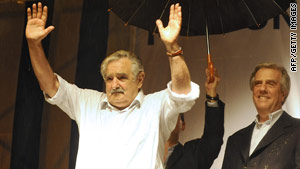 * Uruguay: Aside from Honduras there was another important election yesterday in Uruguay where former guerilla and ex-minister Jose Mujica became the new president-elect.
* Brazil: Scotland Yard has reached a settlement with the family of Jean Charles de Menezes- a Brazilian migrant gunned down by police who mistook him for a potential terrorist.
* Peru: The government issued a “historical pardon” to the country’s Afro-Peruvian population for countless abuses and discrimination from the colonial era up to the present.
* Latin America: Pope Benedict XVI met with the Argentine and Chilean presidents over the weekend.
Image – CNN
Online Sources- LAHT, Reuters, AFP, CNN, Guardian UK
Wednesday, September 3, 2008
Afro- Colombians
There have been accusations on the internet of Latino bloggers and writers using terms like "Latino" and "Hispanic" ::shudder:: to negate the specific experiences of Latinos whose identities are rooted in African and Native identities.
Kenyon Farrow writes:
Source : Kenyon Farrow
Kenyon Farrow writes:
...oftentimes I feel like in the US, it’s as if slavery didn’t happen in Latin America and there are no Black people there to speak of. Or that somehow or another, the Spanish speaking Caribbean and South America has “gotten beyond” racial categorization, when it was only a generation ago that people like Cuban singer La Lupe (among many others) proudly declared she was Black. And why don’t any of these Baseball players from the Dominican Republic get discussed as Black people? There’s also this thing that happens, where I have been told that I, as an African-American, don’t understand the nuances of what happens in terms of race/racialization in Latin America.
Source : Kenyon Farrow
Subscribe to:
Posts (Atom)