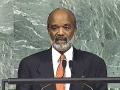
 With just under 10% of the votes counted in Haiti's election former President Rene Preval is leading the pack at 61.5%. (Washington Post)
haiti, politics, Current Affairs, caribbean, international politics,rene preval, aristide
With just under 10% of the votes counted in Haiti's election former President Rene Preval is leading the pack at 61.5%. (Washington Post) -Taylor Kirk
 Former Senator Tom Daschle contributed an op-ed piece to the Miami Herald that has some very sane policy recommendations for the United States in Latin America. Among them 1) accept the election of leaders whose beliefs do not match our own, provided those leaders accept the rules of the democratic road, and 2) make it cheaper and safer to remit money from the United States, even if that means regulating wire-sending operations, and 3) reform our immigration laws so that hard-working and law-abiding immigrants from Latin America can earn the opportunity to become U.S. citizens. Shame on South Dakotans for booting Daschle from office in 2004, only to elect this man, who somehow managed to misspell the word 'borders' on this page of his website (third line).
 -Taylor Kirk
 -Contributed by Erwin Cifuentes. Mexico’s government hired a Dallas-based PR firm to help project a more positive image of Mexico within the U.S. The aim, according to a representative from the PR firm is to focus on ''the good things that are happening in Mexico'' and ``correct some of the myths and misperceptions that are out there.'' (Miami)
 -Contributed by Erwin Cifuentes. Former Guatemalan gang members will be transformed into community leaders in a reality show set to air next month. The program will air in Central America and will be partially produced by the U.S. Agency for International Development. (The Star)
 -Contributed by Erwin Cifuentes. A new law passed last week by Guatemala’s legislature forces the government to provide sexual education classes and encourage the use of contraceptives. Still, Guatemala’s president and Catholic Church officials plan to appeal the congress’ decision on a supposed voting technicality. (BBC)
 -Contributed by Erwin Cifuentes. The early repayment of Brazil and Argentina’s massive multi-billion dollar debt to the IMF has led to problems within the global lending body. The IMF is facing a growing amount of critics who feel it should cut back its lending practices. (Chronicle)
 -Contributed by Erwin Cifuentes. Meetings in Mexico City between U.S. energy executives and Cuban officials had to be moved from a U.S.-owned hotel due to U.S. government pressure. Meanwhile, the U.S. Coast Guard will return seven of eight Cuban “balseros” rescued from a Bahamian island to Bahamas’ immigration authorities. An injured refugee airlifted to a Florida hospital will be allowed to stay in the U.S. due to the U.S.’s “wet-foot, dry-foot” policy. (Sun Sentinel)
 -Contributed by Erwin Cifuentes. Panama and Chile signed a free trade agreement on Saturday after more than a decade of negotiations. According to the deal, most Panamanian goods will not have to pay tariff when entering the Chilean market. (Xinhua)