 -Contributed by Erwin Cifuentes. Television programmers believe that English-language telenovelas may be the next hit genre to invade US TV. screens. Novelas planned for networks such as ABC and CBS are closely patterned after popular Spanish-language novelas; for instance, "Desire: Table for Three," is adapted from the Colombian series "Mesa Para Tres." (SFGate)
Tuesday, January 31, 2006
Telenovelas en ingles? They may come to an English-speaking network near you
-Contributed by Erwin Cifuentes. Television programmers believe that English-language telenovelas may be the next hit genre to invade US TV. screens. Novelas planned for networks such as ABC and CBS are closely patterned after popular Spanish-language novelas; for instance, "Desire: Table for Three," is adapted from the Colombian series "Mesa Para Tres." (SFGate)

Chavez meets with Cindy Sheehan while Iran okays business deal with Venezuela
 -Contributed by Erwin Cifuentes. During a meeting between US anti-war activist Cindy Sheehan, Chavez joked that he might put a tent up next to President Bush’s Texas ranch the next time Sheehan protests there. Also, Iran’s parliament approved several bills that would foster trade and commerce between Iran and Venezuela. (IRNA)
Uribe’s popularity plummets while authorities investigate possible Al-Qaeda link to criminal group
 -Contributed by Erwin Cifuentes. False accusations by the government on a rival candidate’s involvement with leftist rebels have hurt of Alvaro Uribe’s seemingly easy bid for presidential reelection as polls show his popularity decreasing dramatically. In addition, Colombian officials are investigating the possible infiltration of Al-Qaeda and Hammas in a recently-arrested criminal ring. (BBC)
Bolivia: Drug czar named; Morales cuts his salary in half
 -Contributed by Erwin Cifuentes. President Evo Morales named a coca leaf grower as Bolivia’s drug czar as part of his plan to radically change government policy on coca. Meanwhile, Morales vowed that he would cut his salary by more than half and would use the money saved to help pay social services. (BBC)
Rift between EU and Jamaica over death penalty
 -Contributed by Erwin Cifuentes. Multi-million dollar donations from the EU to a Jamaican anti-death penalty group have raised the ire of the Jamaican government. Though Jamaica last execution occurred eighteen years ago, the island’s government feels that the EU is interfering with Jamaica’s judicial system. (Jamaica Observer)
Wednesday, January 25, 2006
Fences make friends: outside the fence
 A cause to unite Latin America
Venezuelan liberator Simon Bolivar once wrote in his ‘Letter from Jamaica’ that the nations that now comprise Spanish-speaking Latin America should naturally be drawn to common causes, due to their “common origin, language, customs, and religion”. Over the years Pan Americanism floated in and out of intellectual fashion, though fading through the years as individual nations developed separate experiences and national identities.
Latin America has experienced a surge in continental identity in recent months, as their northern neighbor threatens to build a fence that will physically slice the hemisphere in half. If there was ever cause to make a collective protest against the United States, it is this. Nearly every country south of the proposed wall has a sizeable ex-patriate population in the US, and some, like El Salvador, receive significant proportions of their GDP from remittances.
By proposing the wall and attempting to make illegal immigration a felony, lawmakers are isolating an area of the world that we should have excellent ties with. There is no evidence that illegal immigrants are any more a source of crime or a drain on the economy than the proportion of our own population that is below the poverty line. Congress has made a new set of enemies at a time when we so desperately need friends.
latin america, border, Immigration, Illegal immigration, Politics
Monday, January 23, 2006
Photography of Bolivia
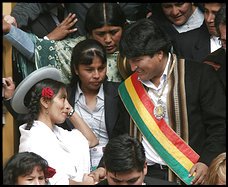 Browse these fantastic stills from The Washington Post (half-way down, right-hand side) (WAPO) WAPO also has commentary from Marcela Sanchez on Morales' first meetings with foreign officials as president-elect (English or Spanish).
latin america, south america, bolivia, evo morales
Friday, January 20, 2006
Bechtel drops suit against Bolivia
 Just days before Evo Morales is inaugurated as President of Bolivia, the US multinational giant, Bechtel, has backed down after a major international campaign and dropped a legal suit for $50 million against Bolivia. Instead the Bolivian Government will sign a contract today (19 January 2006) in which they will pay only 2 Bolivianos (14 pence) to end the case. Courtesy of Nick Buxton.
Bechtel first made the claim after they were forced out of the city of Cochabamba by huge popular protests in April 2000. Their decision to settle followed years of being bombarded with thousands of emails and letters, facing scores of protests outside their headquarters along with receiving largely negative coverage in the international media. Sources directly involved in the settlement suggest that Bechtel’s decision to eventually back down was a result of international citizen pressure.
The decision by one of the most powerful corporations in the world to end the legal claim will send a strong warning note to the nine multinational companies who are currently lining up to sue Bolivia. Suez, the French water multinational, and eight oil and gas companies including British Gas, Repsol, Total and Exxon have initiated legal proceedings which could result in legal claims being filed in the World Bank hosted International Centre for Settlement of Investment Disputes (ICSID) in mid 2006.
The companies are filing legal claims stating that actions taken by the Bolivian Government in 2005 are “tantamount to expropriation” and are therefore illegal under the various Bilateral Investment Treaties signed by Bolivia. Suez is protesting against a decision to end their contract to supply water to the impoverished city of El Alto which took place following major public protests against their failure to expand and supply affordable drinking water. The oil and gas companies, including British Gas, are protesting against a new hydrocarbons law passed in May 2005 which increased taxes and State control over the hydrocarbons resources in the country.
Under Bilateral Investment Treaties, companies can file demands for both investments made as well as loss of anticipated future profits which could result in a legal claim of billions by the energy multinationals.
However the Bechtel case shows that the multinationals may find themselves not just fighting a legal case but a growing and strengthening global movement of solidarity.
Jim Shultz, one of the principal organisers of the international campaign against Bechtel said: “Bechtel’s surrender settlement is historic. This is the first time that a major corporation has ever dropped a major international trade case such as this one as a direct result of global public pressure.”
He warned the oil and gas companies, such as British Gas, that the case “signaled that [the Bolivian social movements and international citizen groups] are able to battle these cases, not just in the closed-door forums favored by corporations, but also in the larger forum of world public opinion.”
Carmen and Newsweek
 Newsweek covers the Carmen Miranda exhibit in Rio, with a wealth of background info. (Newsweek)
latin america, south america, brazil, carmen miranda, rio de janeiro
Cuba cleared for the Baseball Classic
 Cuba's baseball team has been cleared by the US Treasury Department's Office of Foreign Assets Control to appear in the World Baseball Classic, which kicks off March 3rd in Tokyo, later moving to San Juan PR, Phoenix, and Orlando. Strike one for the embargo. (WAPO)
latin america, cuba, caribbean, embargo, baseball
Thursday, January 12, 2006
Mexico’s Elections: Out-Foxing the Left
 -Taylor Kirk
This summer’s elections in Mexico will be historic in more ways than one: ex-patriates in the United States will be allowed to vote by proxy in their home country’s elections for the first time, and Mexicans will have the chance to see if they have fully unlocked presidential politics from the political machine that the PRI once was. Outgoing president Vicente Fox has been influential on both counts, and he may be making important moves behind the scenes that will notably affect the outcome of this summer’s elections.
Fox first made it clear that he would remain a powerful force in politics until his last day in office when he attempted to prosecute the Mexico City mayor and left-wing presidential candidate Andres Manuel Lopez Obrador for a minor land dispute in which Obrador sought to construct a hospital on private land. The incident backfired, and the charges were retracted amid popular protest. The prosecution arguably added to Obrador’s popularity, as the majority of the capital’s voters sided with his argument in the dispute.
Obrador is now free from prosecution and is a promising candidate in the presidential race, and Fox appears to be changing his tactics to ensure that a presidential victory does not fall into the hands of the left. His government surprisingly authorized Zapatista leader Subcomandante Marcos to conduct a six-month tour of the nation, a sharp departure from the close eye the Mexican army has kept on the Zapatistas in the southern state of Chiapas. Marcos stated the purpose of the tour was to “forge alliances with leftist groups that are not taking part in the elections, campesinos, indigenous people, and other sectors, in order to hash out a new blueprint for the country ‘from the grassroots up’”, according to IPS News Service.
The Zapatista National Liberation Army (EZLN) has spent much of its tour trying to convince voters that Obrador will offer more of the same, and that his candidacy does not represent the values of the true left. Though Marcos has criticized all the presidential candidates (in addition to harrassing the first lady) his tour will most likely succeed in persuading some voters on the left to reconsider their support for Lopez Obrador. Given that the Fox administration didn’t permit the Zapatista tour for entertainment purposes, this may be exactly what they had in mind.
latin america, mexico, politics,andres manuel lopez obrador, vicente fox, elections, zapatistas, chiapas, subcomandante marcos
Wednesday, January 11, 2006
Profile of Michelle Bachelet
 Newsweek profiles Michelle Bachelet, soon to be the first female President of Chile. (Newsweek)
latin america, south america, chile, michelle bachelet, elections, politics, current affairs
Newsweek explores Morales' standing in Brazil
 Brazilians watched Evo Morales' ascent to power in Bolivia carefully, hanging on to every word he uttered regarding the re-nationalization of the country's oil fields and the economic 'decolonization' of Bolivia. As Bolivia supplies half of Brazil's natural gas, Brazilian wonks fret that Morales will now be tempted to turn the taps off. Newsweek explores the dynamics between Bolivia's president-elect and his neighbors, and how the situation may progress. (Newsweek)
latin america, bolivia, brazil, south america, oil, natural gas
Thursday, January 5, 2006
Global reactions to Morales win
 Depending on what periodical one picks up, the world views on Morales' win in Bolivia range from predictions of the apocalypse to the coming salvation of the Bolivian people. Below are some of the comments from around the world:
Al-Jazeera - "But hope can be found everywhere: in the chants of Bolivia's poor lauding Evo Morales and his people-centered agenda..."
Front Page Magazine - (USA) "A mineworker, labor agitator, and friend of the coca producers, Morales is little more than an opportunistic street thug."
Miami Herald - (USA) "Electing an indigenous man as president is a shock to the fragile social strata of South America and lifts the veil on Latin American racism long denied."
New Socialist Group- (USA) "At best, Evo will promote some marginal increases in property and royalty taxes, and perhaps increase some social spending on welfare services (but always limited by a tight fiscal budget)."
Periodico26 - (Cuba) "With this overwhelming support, the Bolivian people showed that they trusted the honest, incorruptible and austere political history of comrade Evo Morales..."
Pravda - (Russia) "Today, Evo Morales of Bolivia and Hugo Chavez of Venezuela join Fidel Castro as leaders...of socially progressive systems which focus on the need to create programs which serve the interests of the people, and not the corrupted super-rich clique of elitists living at Washington's beck and call."
The Progress Report - (USA) Bolivia's Evo Morales Could Shift the Hemispheric Balance of Power
SFBayView - (USA) "‘Mother Coca’ wins in Bolivia."
VHeadline - (Venezuela) "For the first time in decades Bolivia's government is at long last in the hands of the People."
Washington Post- (USA) "Lacking any coherent policies of his own, Morales will probably take instruction from Chavez..."
latin america, bolivia, evo morales, al-jazeera, pravda, media, south america, socialism
Film blames Cuba for JFK slaying
 A new documentary by German director Wilfried Huismann claims that the assassination of John F Kennedy was a ploy by the Cuban government, and that the Lyndon B Johnson administration covered up the details in order to resist pressure to invade the island. "Rendevouz With Death" debuted in a limited release Wednesday in Berlin. (Newsweek)
latin america, cuba, movies, film, huismann, wilfried huismann, jfk
Monday, December 19, 2005
Morales ahead in exit polls
 Bolivian presidential candidate Evo Morales claims victory after exit polls give him a significant lead in Sunday's election. (WAPO)
latin america, bolivia, evo morales, socialism
Subscribe to:
Posts (Atom)